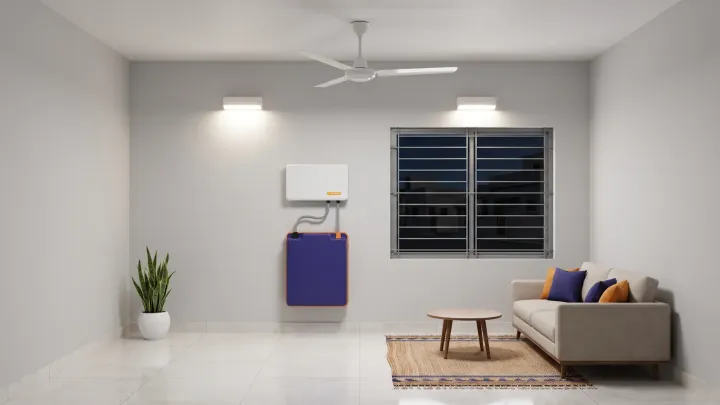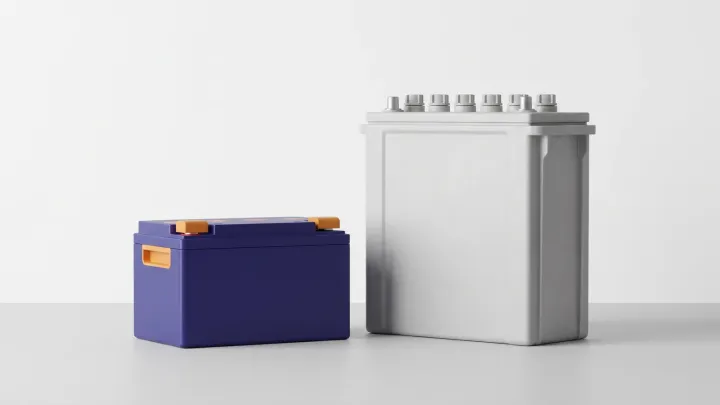

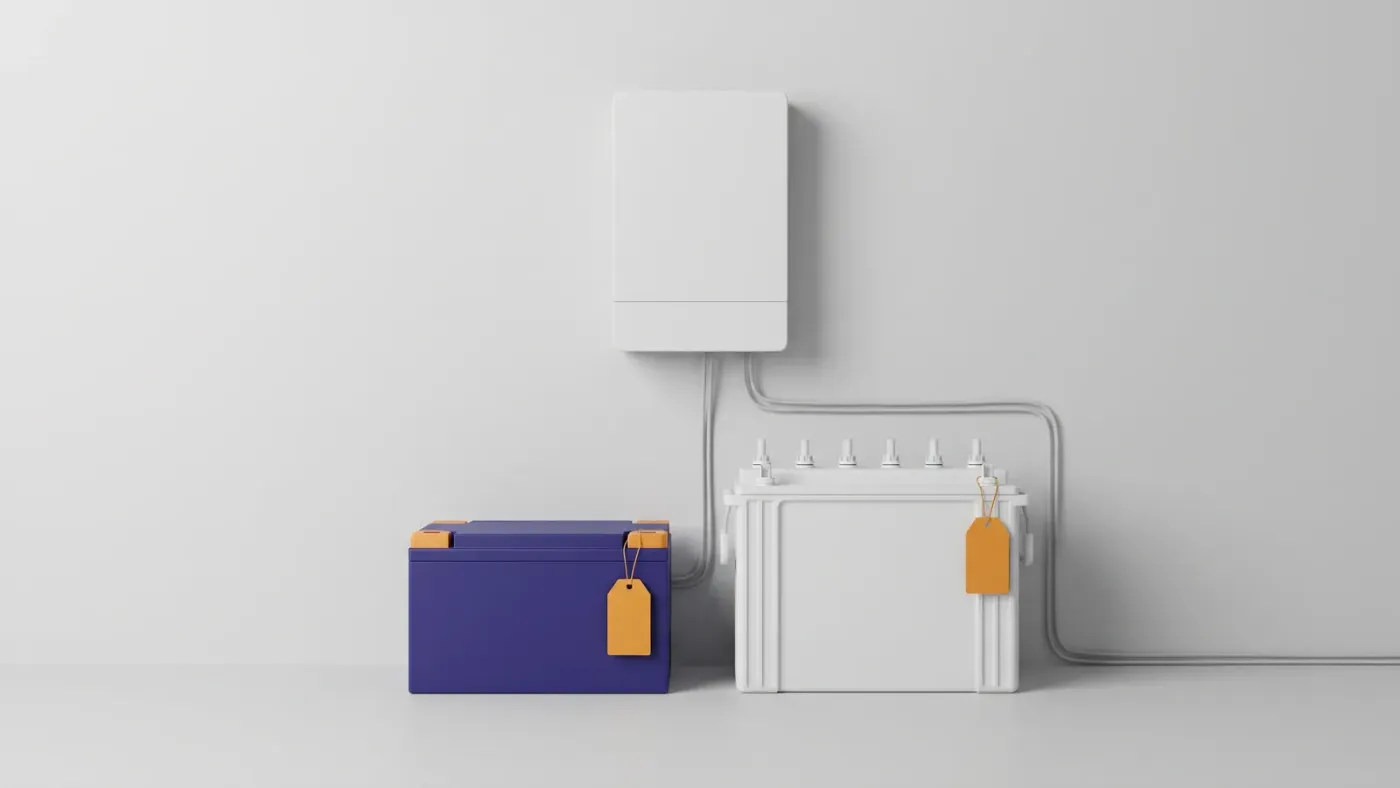
On 1 November 2026, makers' own websites listed a 12V 100Ah lithium inverter battery at ₹17,950 to ₹29,000 and a 24V 100Ah model at ₹35,500 to ₹47,499. Across every 12V and 24V lithium battery in our table, that works out to about ₹13,400 to ₹22,700 per kWh of stored energy.
Key Takeaways
- Price follows stored energy. Compare lithium inverter batteries by price per kWh, and check whether a figure is the selling price or the MRP.
- A tubular battery costs less on the day you buy it: a 200Ah tubular sold for a little over half the price of a 12V 200Ah lithium battery.
- Lithium and lead-acid inverter batteries have both paid 18% GST since 22 September 2025, as trade press and a battery maker report it, so the tax no longer separates them.
- Spread over rated cycles, our calculation puts the Shakti 12 Plus, the only lithium battery in our price table with a published cycle rating at 80% depth of discharge, well below two 200Ah tubulars per kWh delivered.
- Global battery pack prices fell 8% in 2025, but lithium prices in early 2026 were more than double their level a year earlier, so the direction for 2026 is unclear.
Lithium inverter battery prices by brand (1 November 2026)
These home inverter lithium battery prices were listed on each maker's own website on 1 November 2026. The selling price is what the site charged that day. MRP is the maximum retail price printed on the product, which includes all taxes, and a seller may charge less than it. Halovolt makes the Shakti batteries and the Urja, so we list them at our catalogue prices, which include GST, with the same columns as the others.
| Brand and model | Rating | Rated energy | Selling price | MRP | Warranty | ₹ per kWh (our calculation) |
|---|---|---|---|---|---|---|
| Halovolt Shakti 12 | 12.8V 100Ah | 1.28 kWh | ₹17,950 | ₹22,550 | 5 years | ₹14,023 |
| Luminous Helios | 12.8V 100Ah | 1.28 kWh | ₹29,000 | ₹40,000 | 60 months | ₹22,656 |
| UTL Solar LiFePO4 | 12.8V 100Ah | 1.28 kWh | ₹19,990 | ₹27,778 | "minimum of 5 years" (range-wide) | ₹15,617 |
| Halovolt Urja (1100VA inverter with inbuilt battery) | 12.8V 100Ah | 1.28 kWh | ₹28,800 | ₹34,800 | 5 years battery, 3 years inverter | ₹22,500 (includes the inverter) |
| Halovolt Shakti 24 | 25.6V 100Ah | 2.56 kWh | ₹35,500 | ₹44,500 | 5 years | ₹13,867 |
| Luminous Helios | 25.6V 100Ah | 2.56 kWh | ₹47,499 | ₹70,000 | 60 months | ₹18,554 |
| UTL Solar LiFePO4 | 25.6V 100Ah | 2.56 kWh | ₹41,790–45,340 (out of stock) | ₹55,655 | "minimum of 5 years" (range-wide) | ₹16,324–17,711 |
| Halovolt Shakti 12 Plus | 12.8V 200Ah | 2.56 kWh | ₹34,400 | ₹43,500 | 5 years | ₹13,438 |
| Halovolt Shakti 24 Plus | 25.6V 200Ah | 5.12 kWh | ₹69,900 | ₹88,800 | 5 years | ₹13,652 |
Sources: Halovolt catalogue, Luminous, UTL Solar.
The ₹ per kWh column is our own arithmetic: the price divided by rated energy, which is volts × amp-hours ÷ 1,000. The Urja figure covers a 1100VA inverter as well as its battery, so it is not a battery-only price.
Within one brand, price rises almost in step with energy. All four Shakti batteries fall between ₹13,438 and ₹14,023 per kWh. A 12V 200Ah battery and a 24V 100Ah battery both store 2.56 kWh, and they cost about the same.
UTL's page showed the 25.6V model at ₹45,340 in its listing and ₹41,790 in its specification table, so we give both. UTL states its warranty only in general terms for the range. Prices on these sites change often, so check the maker's page on the day you buy. Halovolt delivers free on every online order.
Brands that do not list a lithium price
Several brands sell lithium inverter batteries without a price on their own sites:
- Trontek says its Powercube lithium inverter batteries start at about ₹20,000 and sends buyers to dealers (Trontek).
- Microtek lists a 100Ah LiFePO4 battery with a 5-year warranty and no price (Microtek).
- Livguard lists its Lithium X and XDT lines with no prices (Livguard).
- We found no priced lithium inverter battery on Exide's site.
None of these sites showed a price for a 12V or 24V 200Ah lithium inverter battery on 1 November 2026. We did not check Su-Kam or Base. To compare backup times for each size, see our lithium inverter battery range.
Tubular inverter battery prices for comparison
Luminous sold its Red Charge RC 25000, a 200Ah tubular battery, for ₹18,199 on 1 November 2026, against ₹34,400 for the Shakti 12 Plus, a 12V 200Ah lithium battery. The tubular prices below were listed on the makers' sites that day.
| Model | Capacity | Selling price | MRP | Warranty | Weight |
|---|---|---|---|---|---|
| Exide InvaMaster IMST1000 | 100Ah @C20 | MRP only | ₹17,702 | 60 months | 41 kg |
| Exide InvaMaster IMTT1800 | 180Ah @C20 | MRP only | ₹28,108 | 60 months | 59.5 kg |
| Exide InvaTubular IT750 | 200Ah @C20 | MRP only | ₹37,021 | 66 months (48 free + 18 pro-rata) | 68 kg |
| Luminous Red Charge RC 25000 | 200Ah tall tubular | ₹18,199 | ₹21,100 | 36 months | 58 kg |
| Luminous Inverlast ILTT 25060 | 200Ah | ₹20,399 | ₹23,600 | 60 months | 63.5 kg |
| Luminous LPTT 12200H (sold as a solar battery) | 200Ah @C10 | ₹23,399 | ₹27,200 | 72 months | 70.5 kg |
Exide's pages show MRP, while Luminous shows a selling price as well, so compare MRP with MRP. Capacities are rated at different discharge rates (C10 or C20), so the same Ah figure is not exactly comparable. The Inverlast page title says 220Ah while its specification table says 200Ah.
The lithium battery is much lighter: 23 kg for the Shakti 12 Plus against 58–70.5 kg for these 200Ah tubulars. Luminous says the LPTT 12200H needs a water top-up every 8–10 months, and a sealed lithium battery needs none. For the full trade-off, read lithium vs tubular inverter battery.
GST on inverter batteries: 18% for lithium and tubular
Lithium-ion and lead-acid inverter batteries both pay 18% GST in India. Lithium-ion batteries came down from 28% to 18% at the 28th GST Council meeting on 21 July 2018 (Mercom, July 2018; Energetica India, July 2018). Other battery chemistries stayed at 28%.
GST 2.0 closed that gap. As reported by pv magazine India, the 56th GST Council meeting moved all batteries under heading 8507 to a uniform 18% (pv magazine India, September 2025). According to Tata Green Batteries, a battery maker, lead-acid inverter and solar batteries (HSN 85072000) moved from 28% to 18% from 22 September 2025, with lithium-ion packs unchanged at 18% (Tata Green Batteries). Since then, any price gap between a lithium and a tubular battery comes from the product itself. We could not check the official notification text for this change, so these two reports are our sources for it.
To find the GST inside a tax-inclusive price, multiply the price by 18 and divide by 118. For the ₹17,950 Shakti 12, that is ₹2,738 of GST on a pre-tax price of ₹15,212.
Lithium battery cost per cycle and per kWh delivered
Spread over its rated cycles, the Shakti 12 Plus costs less per unit of energy than the two tubular batteries we could compare. It is the only lithium battery in our price table with a published cycle rating at 80% depth of discharge (DoD); UTL rates its 25.6V model at 3,500 cycles without stating the DoD, so we left it out. The table is our calculation from list prices and each maker's rated cycles at 80% DoD. Energy per cycle is 80% of rated energy, and a 12V 200Ah tubular is taken as 2.4 kWh rated.
| Battery | Price used | Rated cycles at 80% DoD | ₹ per cycle | Energy per cycle | ₹ per kWh delivered |
|---|---|---|---|---|---|
| Halovolt Shakti 12 Plus (12.8V 200Ah) | ₹34,400 | 4,000 | ₹8.6 | 2.05 kWh | about ₹4.2 |
| Luminous LPTT 12200H (12V 200Ah) | ₹23,399 (selling) | up to 1,500 | ₹15.6 | 1.92 kWh | about ₹8.1 |
| Exide InvaTubular IT750 (12V 200Ah) | ₹37,021 (MRP) | up to 1,200 | ₹30.9 | 1.92 kWh | about ₹16.1 |
| Luminous Red Charge RC 25000 (200Ah) | ₹18,199 (selling) | not published | n/a | n/a | n/a |
These figures are not like-for-like. Makers rate cycle life under their own test conditions, such as C10 or C20 discharge and 25 °C, and the Exide figure uses MRP. The sum also leaves out calendar ageing, heat, float charging, the electricity used for charging and the inverter's own losses.
Most homes don't run one full cycle a day. At one full cycle a day, 4,000 cycles take about 11 years. At one every three days, they would take more than 30 years, and you would not plan on using them all. For light use, warranty years and calendar life matter as much as the cycle rating.
| Battery | Price used | Warranty | ₹ per warranty year (our calculation) |
|---|---|---|---|
| Halovolt Shakti 12 Plus | ₹34,400 | 5 years, replacement | ₹6,880 |
| Exide InvaTubular IT750 | ₹37,021 (MRP) | 66 months (48 free + 18 pro-rata) | ₹6,731 |
| Luminous Red Charge RC 25000 | ₹18,199 | 36 months | ₹6,066 |
| Luminous Inverlast ILTT 25060 | ₹20,399 | 60 months | ₹4,080 |
| Luminous LPTT 12200H | ₹23,399 | 72 months | ₹3,900 |
By this measure, some tubular batteries cost less per year of cover. Warranty terms also differ: a free replacement period and a pro-rata period are not the same promise, so read each one before you compare. For how long an LFP battery lasts in practice, see how long does a lithium battery last, and to work out the hours of backup you need, try the battery backup calculator.
What changes the price of a lithium inverter battery
Stored energy sets most of the price, as the near-even ₹ per kWh figures within each brand show. The rest comes from how the pack is built and backed:
- Energy (kWh). Volts × Ah gives the energy, so a 12V 200Ah and a 24V 100Ah battery store the same 2.56 kWh. Buy for your load: the Shakti 12 Plus runs about 400 W for about 5 hours on a 12V inverter.
- Cells. Chemistry, grade and maker all count. LFP packs cost less per kWh than NMC worldwide, as the trend figures below show. We use A-grade LFP and NMC cells from tier-1 makers such as EVE, Highstar, Gotion and Highpower and test every incoming lot (how our packs are built). Ask any seller who makes the cells.
- BMS. The battery management system protects the cells from overcharge, deep discharge, short circuit and overheating. Extras such as a Bluetooth app or communication ports add to the build. Every Shakti battery has a BMS with a Bluetooth app.
- Warranty. A longer warranty, and full replacement instead of pro-rata cover, cost the maker more to back.
- Enclosure and IP rating. A sealed IP54 case, as on Shakti batteries, keeps out dust and splashes. Halovolt's Gati EV packs and the Vidyut 240 cabinet, built for vehicles and large storage, are rated IP67.
- Charge current. A battery that accepts a high charging current needs a BMS and connections rated for it. Shakti batteries take up to 100 A, but your inverter's charger sets the real speed: about 4 hours for a 100Ah battery on a 25 A charger.
- What is included. The Urja puts the inverter and battery in one unit, so its price covers both. Delivery and installation can change the final bill.
Lithium battery price trend in 2025 and 2026
Battery packs got cheaper worldwide in 2025, and 2026 is less certain. BloombergNEF's annual survey put the average lithium-ion pack at $108 per kWh in 2025, down 8% on 2024 (BloombergNEF, December 2025). Stationary storage packs averaged $70 per kWh, down 45%, and were the cheapest segment for the first time. LFP packs averaged $81 per kWh against $128 for NMC. BNEF expects prices to fall again in 2026.
The IEA's Global EV Outlook 2026 also found an 8% fall in average battery prices in 2025, with LFP packs more than 40% cheaper per kWh than NMC (IEA, 2026). It adds a caveat. Lithium prices in early 2026 were more than double their level a year earlier, though still about 70% below the 2022 peak, and if that lasts it could push pack prices up.
These are global averages for packs bought in bulk. A retail inverter battery's price also covers the case, BMS, assembly and testing, GST, distribution and the cost of backing the warranty. A fall in pack prices need not reach shop prices one for one.
Other costs to check before you buy: inverter and compatibility
If your inverter has no lithium setting, send its model number to our support team before you order, so you know whether a new inverter belongs in the budget.
- Best inverter and battery for home in India: choosing the pair together.
- Inverter for a shop or office: sizing for business loads.
- 48V lithium battery price: prices for 48V systems.
Sources
- Halovolt, Inverter & UPS catalogue, prices listed 1 November 2026
- Luminous, lithium-ion batteries (Helios), prices listed 1 November 2026
- UTL Solar (Fujiyama Power Systems), lithium battery, prices listed 1 November 2026
- Trontek, lithium inverter battery for home, checked 1 November 2026
- Microtek, new lithium battery, checked 1 November 2026
- Livguard, inverter batteries, checked 1 November 2026
- Exide, InvaMaster IMST1000, MRP listed 1 November 2026
- Exide, InvaMaster IMTT1800, MRP listed 1 November 2026
- Exide, InvaTubular inverter batteries (IT750 MRP and cycle rating), listed 1 November 2026
- Luminous, Red Charge RC 25000, listed 1 November 2026
- Luminous, Inverlast ILTT 25060, listed 1 November 2026
- Luminous, solar battery LPTT 12200H (price, cycle rating and top-up interval), listed 1 November 2026
- Mercom India, "GST on Li-ion batteries reduced from 28 to 18 percent", 23 July 2018
- Energetica India, "IESA welcomes new GST rates for Li-ion batteries", 27 July 2018
- pv magazine India, "IESA welcomes the new tax regime under GST 2.0", 8 September 2025
- Tata Green Batteries, "Battery prices slashed: with great power comes great savings" (undated, checked 1 November 2026)
- BloombergNEF, "Lithium-ion battery pack prices fall to $108 per kilowatt-hour despite rising metal prices", 9 December 2025
- IEA, Global EV Outlook 2026, "Electric vehicle batteries", 2026
Prices were read from each maker's own website on 1 November 2026. The ₹ per kWh, per cycle and per warranty year figures are our own calculations from those prices and the makers' published ratings.
Frequently asked questions
What is the price of a 12V 100Ah lithium inverter battery?
On 1 November 2026, makers' own sites listed 12V (12.8V) 100Ah lithium inverter batteries at ₹17,950 to ₹29,000. The Halovolt Shakti 12 was ₹17,950, the UTL Solar 12.8V 100Ah ₹19,990 and the Luminous Helios 12.8V 100Ah ₹29,000. That is about ₹14,000 to ₹22,700 per kWh of rated energy.
What is the price of a 200Ah lithium inverter battery?
The Halovolt Shakti 12 Plus (12.8V 200Ah) costs ₹34,400 and the Shakti 24 Plus (25.6V 200Ah) costs ₹69,900, including GST. For comparison, Luminous sold 200Ah tubular batteries for ₹18,199 to ₹23,399 on 1 November 2026.
How much GST is charged on an inverter battery?
Lithium and lead-acid inverter batteries both pay 18% GST, with lead-acid reported by trade press and a battery maker to have moved down from 28% on 22 September 2025.
Is a lithium inverter battery worth the extra cost?
It depends on how often you use the battery. In our calculation from rated cycles, the Halovolt Shakti 12 Plus (12V 200Ah), the only lithium battery in our price table with a published cycle rating at 80% depth of discharge, costs about ₹4 per kWh delivered against about ₹8 and ₹16 for two 200Ah tubular models, but only a battery that cycles often uses those cycles. With occasional power cuts, compare price per warranty year too, where some tubulars cost less. A 12V 200Ah lithium battery also weighs less than half as much as a 200Ah tubular and needs no water top-ups.
Will lithium inverter battery prices fall in 2026?
Nobody can say for certain: BloombergNEF expects pack prices to keep falling, while the IEA warns that higher lithium prices in early 2026 could push them up.