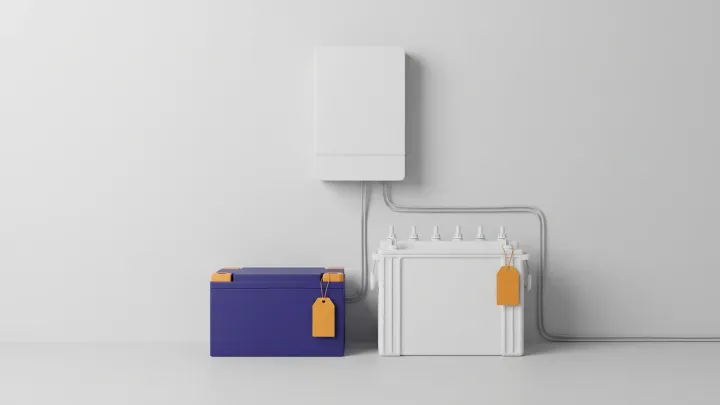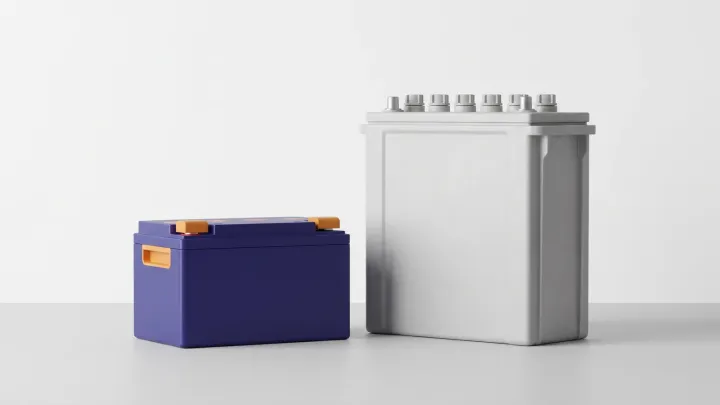

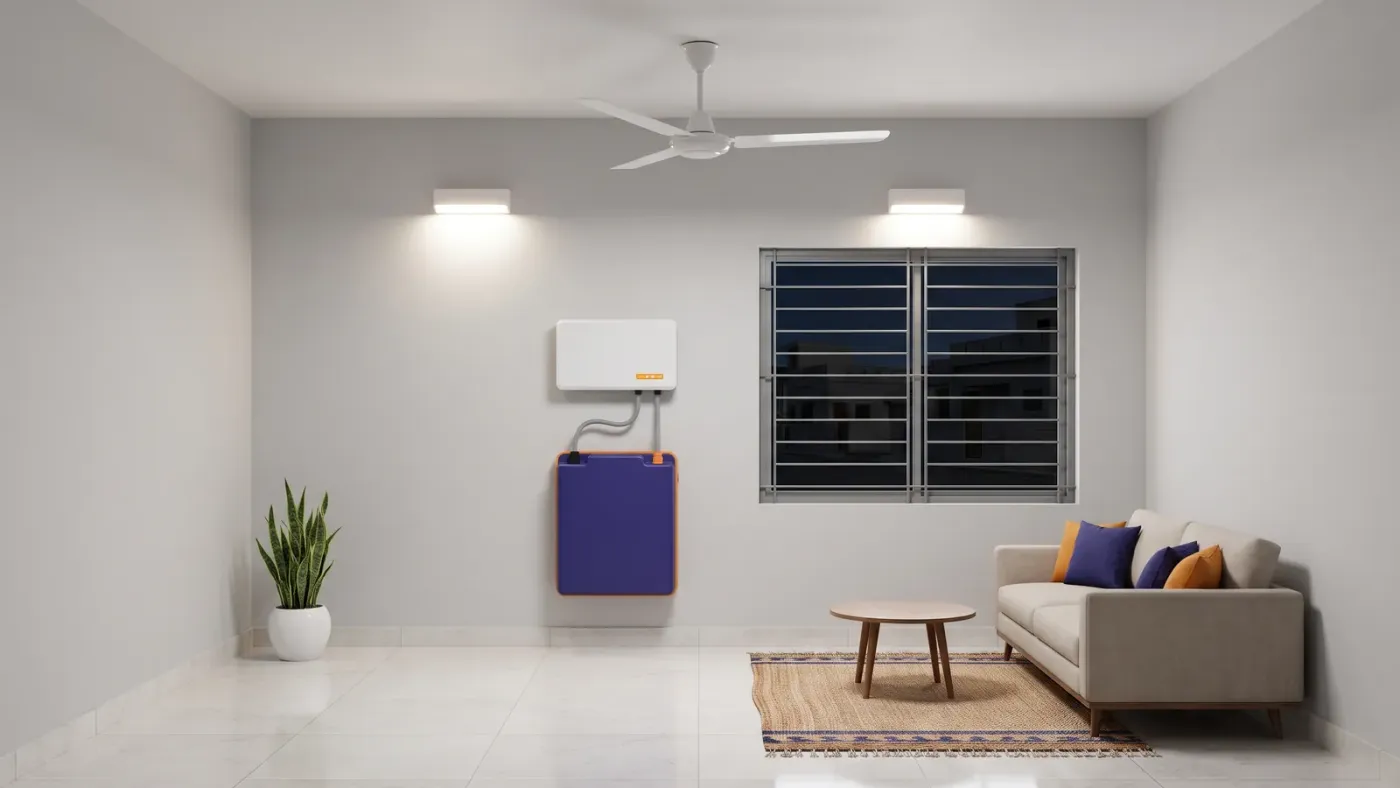
The best inverter and battery for your home is the pair that carries your real load and lasts through your usual power cut. You can work it out in five steps, starting from the watts your appliances draw. Then you choose a battery type on cycle life, weight, upkeep and price.
Key Takeaways
- Size from the watts your appliances draw, because a model name may not match the rating. Add up the watts, divide by 0.8 to get VA, and add a margin if a fridge or pump will run.
- A 1BHK or 2BHK load of up to about 400 W fits a 12V, 1100 VA inverter. A 3BHK with a fridge, at about 750 W, suits a 24V system.
- Size the battery in kWh from your load and the hours you need. About 80% of a Shakti battery's rated energy is usable; ask other makers for their figure.
- A tubular battery costs less on the day you buy it. Our Shakti is rated for 4,000 cycles at 80% depth of discharge, against 1,200 for Exide's Invatubular on the same basis, and it needs no water.
- Before you add lithium to an inverter you already own, look for a lithium mode in the manual. Before you buy any inverter, check its BIS registration under IS 16242.
How to choose the best inverter for your home
Work from your appliances to the inverter, then to the battery. Each step uses the answer from the one before, so do them in order. For a quick answer with your own appliances, try our battery backup calculator.
Step 1: Add up the load in watts
List what has to keep running in a power cut, then add up the watts of everything that runs at the same time. The rating label on each appliance is the most accurate figure. If you can't find it, makers publish typical values, and they differ a little. V-Guard's sizing guide lists 75 W for a ceiling fan, 15 W for an LED bulb, 15 W for a Wi-Fi router and 80 W for an LED TV up to 43 inches (V-Guard). Luminous's 2BHK example uses 70 W for a fan, 10 W for an LED and 100 W for a TV (Luminous, September 2026).
Our calculator uses 10 W for an LED bulb, 75 W for a ceiling fan, 100 W for an LED TV, 150 W for a fridge and 15 W for a router. The examples in this guide use those figures.
Step 2: Convert watts to VA
Inverters are sold by VA, so divide your load in watts by the power factor. V-Guard says most home-inverter makers assume 0.8. Luminous gives the example 400 W ÷ 0.8 = 500 VA, and adds that 0.8 is not fixed, so follow the maker's own sizing guidance (Luminous, September 2026). V-Guard adds a 25% margin for the surge when a motor starts: VA = (W × 1.25) ÷ 0.8 (V-Guard). On that formula a 400 W load needs 625 VA.
We recommend using the margin if a fridge, mixer or water pump will run on the inverter. Then pick the next standard size up. Luminous lists 600, 700, 900 and 1100 VA as standard home sizes (Luminous).
Step 3: Choose a 12V or 24V system
Home inverters up to about 1100 VA usually run on one 12V battery. Larger ones usually run on 24V; the battery voltage is on the inverter's spec sheet. A 24V system takes a pair of 12V lead-acid batteries in series or one 24V lithium battery. The higher voltage halves the current for the same power. A 750 W load draws about 59 A from a 12.8V battery (750 ÷ 12.8) but about 29 A from a 25.6V battery (750 ÷ 25.6), which means less heat in the cables and connections.
As a rough rule, once your load with margin goes past 1100 VA, move to a 24V inverter.
Step 4: Size the battery in kWh
A battery's energy in watt-hours is its voltage times its amp-hours. A 12.8V 100Ah battery stores 1,280 Wh, or 1.28 kWh. To find the size you need, multiply your load by the hours of backup, then divide by the share of energy you can use. For our Shakti lithium batteries that share is about 80%. For a tubular battery, ask the maker what depth of discharge its rating assumes.
Here is an example. A 400 W load for 5 hours needs 2,000 Wh at the appliances. Divided by 0.8, that is 2,500 Wh, so a 2.56 kWh battery (12.8V 200Ah) covers it. Halve the load and the backup roughly doubles.
For the hours, plan for the longest cut you usually get. Average supply in 2025 was 22.6 hours a day in rural areas and 23.4 hours in urban areas, up from 12.5 hours in rural areas in 2014, according to Power Ministry figures reported by SolarQuarter (February 2025). By simple subtraction, that still leaves rural homes about 1.4 hours a day without power on average. An average says nothing about when a cut comes or how long one cut lasts, so your own street is the better guide.
Step 5: Choose a pure sine wave inverter and check its BIS registration
Inverter makers advise a pure sine wave output for most homes. Luminous says a square wave makes fan motors hum and builds up heat that shortens appliance life, and calls it safe only for simple lights and fans. It also says a sine wave inverter costs more (Luminous, September 2026). V-Guard says a square wave causes humming on inductive loads such as fans and mixer grinders and needs care with computers (V-Guard). Both companies sell sine wave inverters, and the Luminous page gives no test data, so read this as manufacturer guidance.
Before you buy, check the inverter's BIS registration under IS 16242. The Bureau of Indian Standards' compulsory registration list includes IS 16242 (Part 1):2014 for UPS and inverters rated up to 10 kVA (BIS, updated October 2026).
Why an inverter's model name is not its VA rating
The number in an inverter's name is often not its rating. The Luminous Zelio+ 1100 is a good example: its product page lists 900 VA, a 756 W maximum load, a pure sine wave and one 12V battery (Luminous, retrieved 1 November 2026). 756 W is the most it can carry. With the margin from Step 2, plan for about 575 W on it (900 × 0.8 ÷ 1.25).
Always compare the VA and the maximum load in watts on the spec sheet. Our Prakash 1100 is rated 1100 VA and 880 W, and 880 W is 1100 VA × 0.8, which shows the usual power factor at work.
Best inverter battery for home: flat plate, tubular or lithium
Home inverter batteries come in three types: flat plate, tubular and lithium. Livguard calls flat plate batteries the shortest-lived type (Livguard, updated December 2025). The table uses each maker's own figures.
| Type | Rated life (maker's figure) | Water | Weight example |
|---|---|---|---|
| Flat plate | Shortest-lived type (Livguard) | Regular distilled-water checks against the water indicator (Livguard) | Not compared here |
| Tubular | Exide Invatubular: 1,200 cycles at 80% depth of discharge, 66-month warranty (Exide). Livguard: "up to five years" on one page, 5–7 years with regular care on another | Needs top-ups; Luminous lists "lower water top-up frequency" with no interval (Luminous) | Luminous RC 18000 Pro, 150Ah tall tubular: 52.5 kg filled (Luminous) |
| Lithium (LFP) | Halovolt Shakti: 4,000 cycles at 80% depth of discharge, 5-year warranty | None: no acid and no gas | Shakti 12 (1.28 kWh): 11 kg. Shakti 12 Plus (2.56 kWh): 23 kg |
Both cycle ratings are at 80% depth of discharge, so they share that basis. The makers' pages don't say what end-of-life capacity or test conditions each one used. Livguard's two life figures come from its blog posts on replacing an inverter battery (November 2025) and inverter battery types, so we give the range.
The weights are not a like-for-like pair, because the batteries hold different amounts of energy. They still show what you lift into place, and a sealed lithium battery has no acid to spill and no gas to vent.
Tubular has a real advantage on price. Luminous, which sells both types, says on its own lithium page that lead-acid is still the lower upfront cost (Luminous). For the full comparison, read lithium vs tubular inverter battery.
Will a lithium battery work with my inverter?
The best lithium battery for an inverter is one the inverter can charge correctly, so check your inverter before you buy. Look in the manual or the settings menu for a battery-type option called "lithium" or "Li-ion". Some product pages don't mention lithium at all. The Zelio+ 1100 page, for example, names flat plate, tubular and VRLA batteries and says nothing about lithium.
When the inverter has a lithium mode, select it. When it doesn't, the inverter's maker can tell you whether lithium is supported, and for a Shakti battery our support team checks your model number before you order. Shakti batteries are made for the usual 12V and 24V home inverters in India. Whichever inverter does the charging, the battery's BMS guards the cells against overcharge, deep discharge, short circuits and high temperature. The voltage has to match: the 12V Shakti 12 or 12 Plus goes on a 12V inverter, and the 24V Shakti 24 or Shakti 24 Plus takes the place of the two tubulars on a 24V inverter.
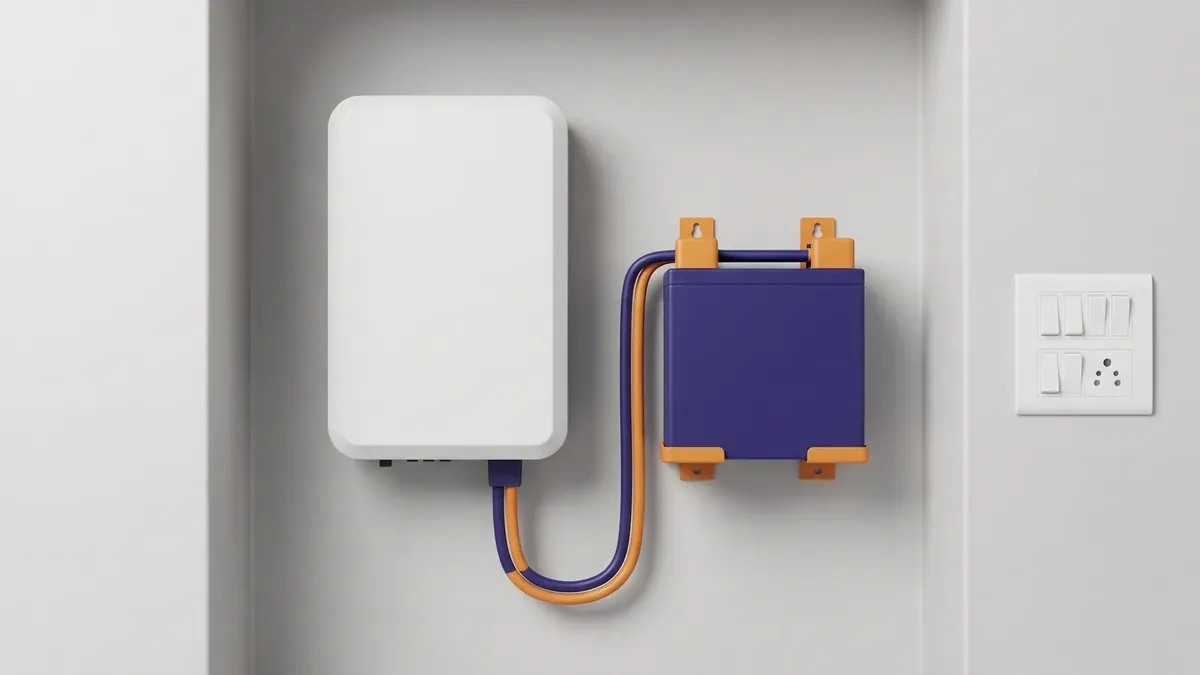
If you are buying new, a lithium battery inverter in India comes in two forms. One is an inverter with the battery built in, such as the Luminous Li-ON 1250 or our Urja. The other is a lithium-ready inverter with a separate battery, such as the Prakash 1100 with a Shakti 12. Luminous also sells its Helios lithium batteries separately (Luminous), and Livguard's site names a Lithium X 1500 (Livguard).
Inverter and battery size for 1BHK, 2BHK and 3BHK homes
These sizes use our calculator's wattages and about 80% usable battery energy, the figure for our Shakti batteries, before inverter losses. Backup times are rounded down. The battery sizes are for lithium; for a tubular battery, work through Step 4 with the depth of discharge its maker gives. You can compare the models in our full range of inverters and lithium inverter batteries.
| Home | What runs in a power cut | Load | Inverter size | Battery size | Backup | Halovolt example |
|---|---|---|---|---|---|---|
| 1BHK | 2 fans (150 W), 4 LED lights (40 W), Wi-Fi router (15 W), TV (100 W) | 305 W | 1100 VA, 12V | 1.28 kWh lithium (12.8V 100Ah) | a little over 3 hours | Prakash 1100 + Shakti 12, or the Urja on its own |
| 2BHK | 3 fans (225 W), 6 LED lights (60 W), TV (100 W), router (15 W) | 400 W | 1100 VA, 12V | 2.56 kWh lithium (12.8V 200Ah) | about 5 hours | Prakash 1100 + Shakti 12 Plus |
| 3BHK | 5 fans (375 W), 11 LED lights (110 W), TV (100 W), router (15 W), fridge (150 W) | 750 W | 2200 VA, 24V | 2.56 kWh or 5.12 kWh lithium (25.6V 100Ah or 200Ah) | about 2.5 hours, or about 5 hours | Prakash 2200 + Shakti 24 or Shakti 24 Plus |
Here is the 1BHK working. Two fans, four LED lights and a router come to 205 W, and the calculator's 100 W TV takes the flat to 305 W. A 1.28 kWh lithium battery holds about 1.02 kWh of usable energy (1.28 × 0.8), which runs 305 W for a little over 3 hours. An efficient smaller TV brings the load near 250 W, and the same battery then lasts about 4 hours. Check your TV's rating label for its real figure.
The VA check explains the jump to 24V. With V-Guard's 25% margin, 305 W needs about 477 VA and 400 W needs 625 VA, both well inside an 1100 VA inverter. The 3BHK's 750 W, with a fridge compressor to start, needs about 1,172 VA, which is more than an 1100 VA inverter can give, so it moves to a 2200 VA, 24V inverter.
A shop or office has different loads, such as a billing computer and a printer. For those, see how to size an inverter for a shop or office.
Inverter and battery price in India: tubular and lithium compared
A tubular combo costs the least to buy. These are the makers' own prices on 1 November 2026, including taxes.
| Setup | Inverter | Battery | Price |
|---|---|---|---|
| Luminous Zelio+ 1100 + RC 18000 Pro, bought separately | 900 VA, 756 W | 150Ah tall tubular | ₹22,598 (₹8,199 + ₹14,399) |
| Halovolt Prakash 1100 + Shakti 12 | 1100 VA, 880 W | 1.28 kWh LFP | ₹28,450 |
| Halovolt Urja | 1100 VA, 880 W | 1.28 kWh LFP, built in | ₹28,800 |
| Luminous Li-ON 1250 | 1100 VA | 1,280 Wh lithium, built in | ₹39,999 |
| Halovolt Prakash 1100 + Shakti 12 Plus | 1100 VA, 880 W | 2.56 kWh LFP | ₹44,900 |
| Halovolt Prakash 2200 + Shakti 24 | 2200 VA, 1760 W | 2.56 kWh LFP | ₹51,000 |
Luminous prices are from its product pages for the Zelio+ 1100, the RC 18000 Pro and the Li-ON 1250. Halovolt prices are from our catalogue on 1 November 2026; Halovolt is the Rajkot lithium battery pack maker that publishes this guide. Livguard and Exide show their inverter and battery combos without prices on their sites (Livguard, Exide), so ask a dealer for a quote.
The rows are not identical. The tubular combo has a 900 VA inverter and a 150Ah battery, and the lithium setups have 1100 VA inverters and 1.28 kWh or more of LFP. Compare the price with the load and backup each one gives you. For what sets lithium prices, read lithium inverter battery price in India.
Every inverter for home and lithium battery we sell is listed with its rating and warranty. You can also put your own appliances into the battery backup calculator.
Sources
- Luminous, "How to determine inverter capacity for your home", 3 September 2026
- Luminous, "How to choose the best inverter for home: complete buying guide", 3 September 2026
- Luminous, "Difference between sine wave and square wave inverters", 2 September 2026
- Luminous, Zelio+ 1100 product page, retrieved 1 November 2026
- Luminous, Li-ON 1250 product page, retrieved 1 November 2026
- Luminous, Red Charge RC 18000 Pro product page, retrieved 1 November 2026
- Luminous, inverter batteries range page, retrieved 1 November 2026
- Luminous, lithium-ion batteries page, retrieved 1 November 2026
- V-Guard, "The complete inverter and battery sizing guide", undated, retrieved 1 November 2026
- V-Guard, "Know the difference" (sine wave and square wave inverters), undated, retrieved 1 November 2026
- Exide, "Know how to select the right inverter battery for your home", 26 June 2024
- Exide, batteries for inverter (combo listings), retrieved 1 November 2026
- Livguard, "How often should you replace your inverter battery", 6 November 2025, updated 26 December 2025
- Livguard, "Everything you need to know about inverter batteries", 2021, updated December 2025
- Livguard, inverter battery combo page, retrieved 1 November 2026
- Bureau of Indian Standards, Scheme-II compulsory registration scheme product list, updated 26 October 2026
- SolarQuarter, India's average electricity supply rises from 12.5 to 22.6 hours (Power Ministry figures), 22 February 2025
Halovolt prices and specifications are from our catalogue on 1 November 2026, including GST.
Frequently asked questions
Is a 150Ah battery enough for a home?
It depends on your load. A 12V 150Ah battery stores 1,800 Wh (12 × 150) on paper. If you use 80% of it, the depth Exide uses to rate its Invatubular cycles, that is 1,440 Wh: about 3.6 hours at 400 W or about 5.8 hours at 250 W, before inverter losses. Ask the maker for the backup its own chart gives at your load.
Is pure sine wave worth paying more for?
For most homes, the makers say yes. Luminous admits a sine wave inverter costs more, but both it and V-Guard say a square wave makes fans hum, and V-Guard names mixer grinders and computers as loads that need care. Luminous calls a square wave safe only for simple lights and fans. Every inverter in the price table above has a pure sine wave output.
Can I run an AC on a home inverter?
Not on a typical 900 VA or 1100 VA home inverter. Our calculator counts 1,500 W for a 1.5-ton AC, which needs 1,875 VA at 0.8, or about 2,344 VA with V-Guard's 25% start-up margin. With that margin, it is more than even a 2200 VA inverter can give. The AC would also use a 2.56 kWh lithium battery's usable energy in under 1.5 hours. Ask the inverter's maker before you plan AC backup.
How often should I add water to a tubular battery?
Follow the water level indicator and the maker's manual. Livguard says flat plate batteries need regular distilled-water checks against the indicator, and Luminous says its tubular batteries need top-ups less often, without giving an interval. A lithium battery has no water to top up.
Should I use one 24V battery or two 12V batteries?
A 24V inverter needs 24V, whichever way you supply it. With lead-acid, that means two 12V batteries in series. With lithium, one 24V battery such as the Shakti 24 replaces the pair. Check the inverter's battery voltage on its spec sheet before you buy either.