
A lithium inverter battery costs more on the day you buy it, but it delivers energy more cheaply over its rated life, weighs far less and needs no topping up. A tubular lead-acid battery is still the better buy on a tight budget, where power cuts are rare, or when you value a long warranty. We at Halovolt make the Shakti lithium batteries in these tables, so every competitor figure in the tables comes from that maker's own page, prices are as shown on 1 November 2026, and our calculations are set out in full.
Key Takeaways
- Compare energy in kWh, not Ah. A 12 V 150Ah tubular holds more energy on its label than a 12.8 V 100Ah lithium battery, so match it with a 200Ah lithium battery.
- Up front, a street-priced Luminous tubular costs about ₹9,500 to ₹10,000 per usable kWh against about ₹17,500 for a Shakti 12. Over each maker's rated cycles, the Shakti works out to about ₹4.4 per kWh delivered against about ₹16.1 for an Exide InvaTubular at MRP (our calculations).
- Many home inverters charge at voltages a lithium battery accepts, but the inverter maker may still specify lead-acid only. Check the manual, any lithium setting and any solar controller set to "flooded" before you swap.
- India's Battery Waste Management Rules 2022 cover both types. Return an old battery to the dealer or a registered recycler.
Compare kWh, not Ah: how to read lithium and tubular ratings
Energy in kilowatt-hours (kWh) decides how long a battery runs your load. You get it by multiplying the battery's voltage by its amp-hours (Ah). Lithium and tubular batteries are rated at different voltages, so their Ah figures don't compare directly.
- A 12 V tubular battery is rated at 12 V. A 150Ah tubular holds 12 × 150 = 1,800 Wh, or 1.8 kWh, on its label.
- A 12 V lithium (LFP) battery has four cells at 3.2 V each, so it is rated at 12.8 V. A 100Ah lithium battery holds 12.8 × 100 = 1.28 kWh.
Check the hour rating as well. Exide rates its InvaTubular batteries at C20, which means the capacity was measured over a 20-hour discharge. Livguard's FAQ gives a C10 (10-hour) rating for its IT1584TT, and Luminous does not state a basis on the pages we read. The same Ah measured over different hours comes from a different test, so ask the maker for the capacity at a rate close to your own load.
Then allow for how much of that energy you can use. Exide states its cycle claims at 80% depth of discharge (DoD), and our Shakti batteries are rated at 80% DoD too, so the calculations in this article count 80% of rated energy as usable for both. On that basis a 150Ah tubular gives about 1.44 kWh and a 100Ah Shakti about 1.02 kWh. To replace a 150Ah or 200Ah tubular without losing backup, look at a 200Ah lithium battery such as the Shakti 12 Plus (2.56 kWh). The battery backup calculator works out the size for your own appliances.
Lithium inverter battery vs tubular battery: datasheet comparison
Every row below comes from the maker's own product page or datasheet. Prices are what each site showed on 1 November 2026. Exide's pages list MRP only, and Luminous prices vary by pincode.
| Battery | Type | Rating | Energy (V × Ah) | Weight | Cycle claim | Warranty | Price seen 1 Nov 2026 |
|---|---|---|---|---|---|---|---|
| Exide InvaTubular IT500 | Tubular lead-acid | 150Ah @C20 | 1.8 kWh | 57.0 kg | Up to 1,200 @ 80% DoD | 48 months free + 18 pro-rata | ₹27,766 (MRP) |
| Exide InvaTubular IT750 | Tubular lead-acid | 200Ah @C20 | 2.4 kWh | 66.8 kg | Up to 1,200 @ 80% DoD | 48 months free + 18 pro-rata | ₹37,021 (MRP) |
| Exide InvaPlus Tubular | Tubular lead-acid | 100–150Ah @C20 | 1.2–1.8 kWh | 46–52 kg | 800 @ 80% DoD | 24 months free + 18 pro-rata | Not listed |
| Luminous Red Charge RC 18000 Pro | Tubular lead-acid | 150Ah (basis not stated) | 1.8 kWh | 52.5 kg ±5% | Not published | 24 months free + 24 pro-rata | ₹14,399 (MRP ₹17,400) |
| Luminous Red Charge RC 25000 | Tubular lead-acid | 200Ah (basis not stated) | 2.4 kWh | 58 kg ±5% | Not published | 18 months free + 18 pro-rata | ₹18,199 (MRP ₹21,100) |
| Livguard IT1584TT | Tubular lead-acid | 150Ah @C10 | 1.8 kWh | Not listed | "High cycle life", no count | 60 months free + 24 pro-rata | Not listed |
| Luminous Helios 12.8V 100Ah | Lithium (LFP) | 12.8 V 100Ah | 1.28 kWh | Not clearly stated | 3,000 (DoD not stated) | 60 months | ₹29,000 (MRP ₹40,000) |
| Halovolt Shakti 12 | Lithium (LFP) | 12.8 V 100Ah | 1.28 kWh | 11 kg | 4,000 @ 80% DoD | 5 years | ₹17,950 |
| Halovolt Shakti 12 Plus | Lithium (LFP) | 12.8 V 200Ah | 2.56 kWh | 23 kg | 4,000 @ 80% DoD | 5 years | ₹34,400 |
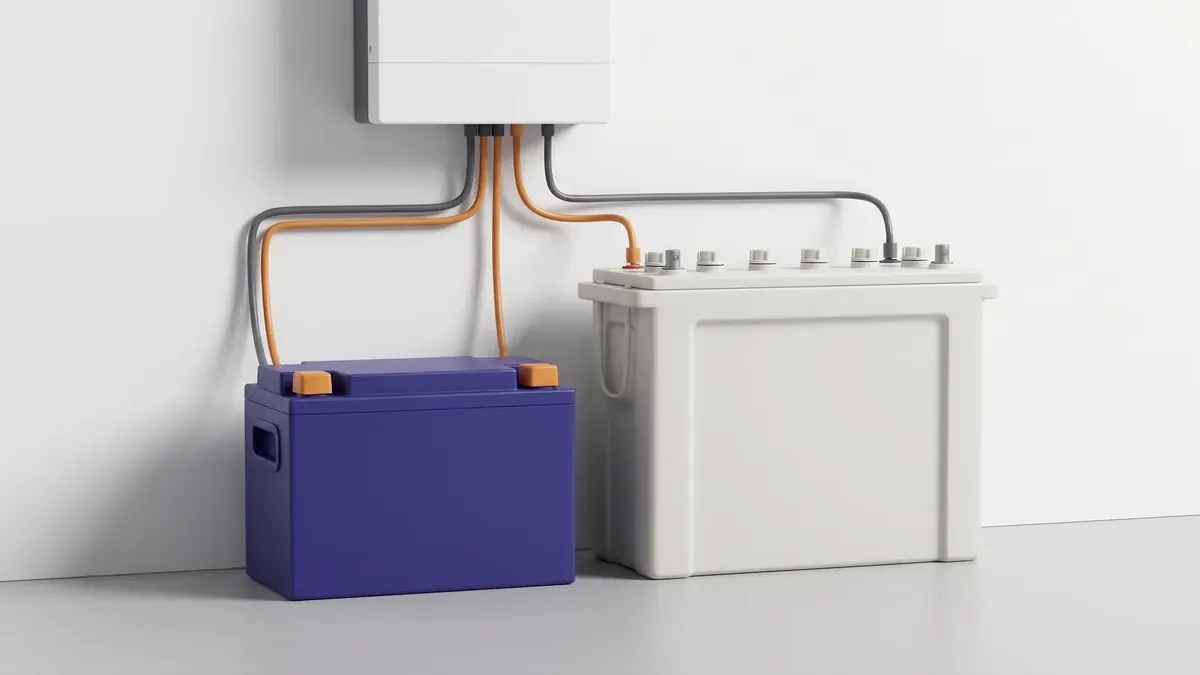
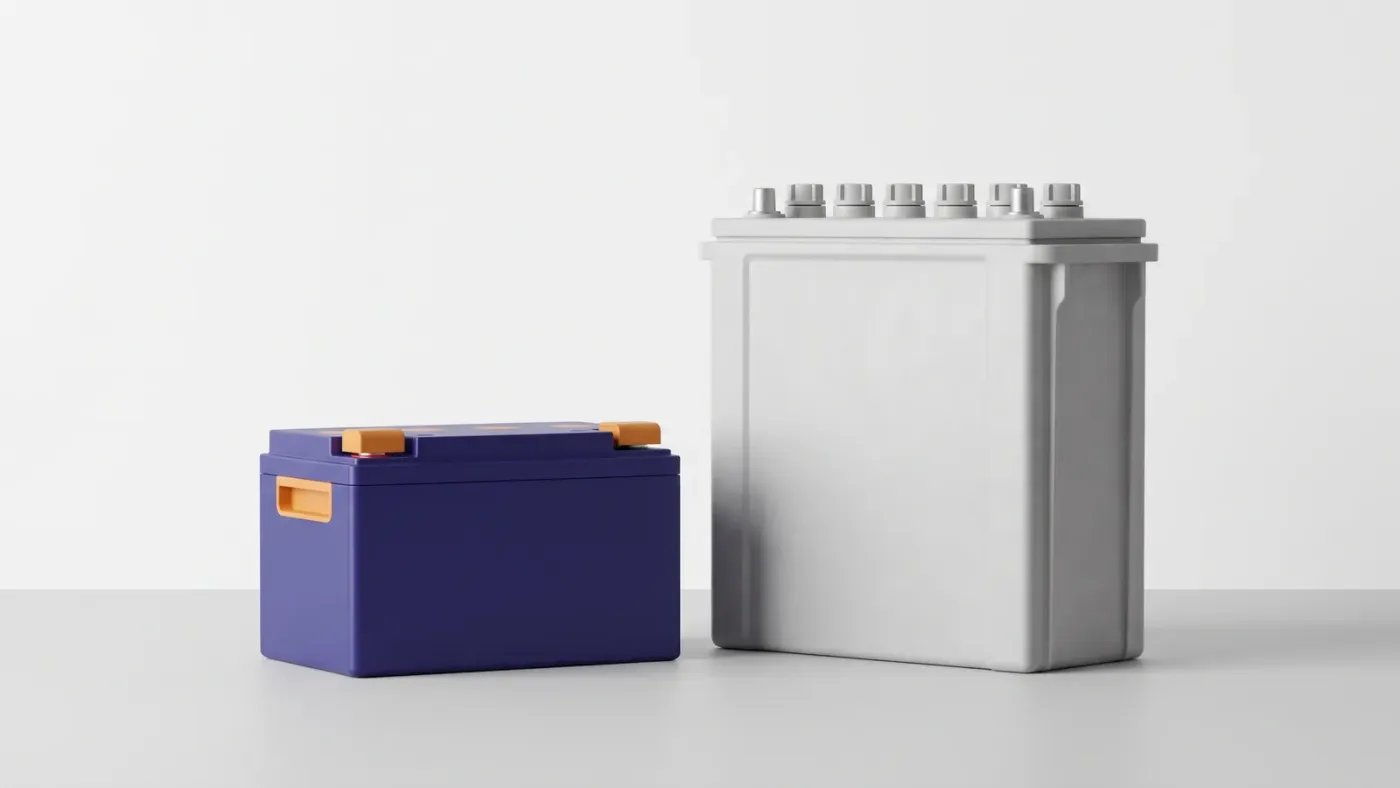
The weights differ most. For similar energy, the Shakti 12 Plus (2.56 kWh) weighs 23 kg and the Exide IT750 (2.4 kWh) weighs 66.8 kg. That matters in a flat without a lift, or when one person has to move the battery.
Tubular batteries last longer than many comparison pages suggest. Some quote 150 to 500 cycles for tubular, while Exide's own datasheet and product page claim 800 cycles for the InvaPlus and up to 1,200 for the InvaTubular, both at 80% DoD. Luminous and Livguard publish no cycle count on the pages we read, so we have not borrowed Exide's figure for them.
Compare the free-replacement months before the total. In a pro-rata period you pay part of the replacement price. Livguard and Shakti both give 60 free months, the Exide InvaTubular 48, and the two Luminous Red Charge models 24 and 18. Our warranty covers manufacturing defects and capacity loss below 70% of rated capacity within the period (Halovolt support), so read each maker's end-of-life definition before you compare years.
Lead acid vs lithium for home inverter: cost per kWh
Lithium costs more per usable kWh on the day you buy it and less per kWh delivered over its rated cycles. The calculations below use the prices and cycle claims in the datasheet table.
- Usable kWh = V × Ah × 80% ÷ 1,000
- ₹ per usable kWh, up front = price ÷ usable kWh
- ₹ per kWh delivered over rated life = price ÷ (cycle claim × usable kWh)
| Battery | Price used | Usable kWh | ₹ per usable kWh, up front | Cycle claim | ₹ per kWh delivered over rated life |
|---|---|---|---|---|---|
| Luminous RC 18000 Pro 150Ah | ₹14,399 | 1.44 | ₹9,999 | Not published | n/a |
| Luminous RC 25000 200Ah | ₹18,199 | 1.92 | ₹9,479 | Not published | n/a |
| Exide IT500 150Ah (MRP) | ₹27,766 | 1.44 | ₹19,282 | 1,200 | ₹16.1 |
| Exide IT750 200Ah (MRP) | ₹37,021 | 1.92 | ₹19,282 | 1,200 | ₹16.1 |
| Shakti 12 100Ah | ₹17,950 | 1.024 | ₹17,529 | 4,000 | ₹4.4 |
| Shakti 12 Plus 200Ah | ₹34,400 | 2.048 | ₹16,797 | 4,000 | ₹4.2 |
| Luminous Helios 100Ah | ₹29,000 | 1.024 | ₹28,320 | 3,000 | ₹9.4 (assumes 80% DoD) |
Keep these limits in mind when you read the table:
- Exide's figures are MRP, and street prices are usually lower. Even at half its MRP, the Exide IT500 would work out to about ₹8 per kWh delivered (₹13,883 ÷ 1,728 kWh), still about twice the Shakti 12's figure.
- Luminous publishes no cycle count for the Red Charge models, so their lifetime cost can't be worked out from their pages.
- Luminous does not state the DoD behind the Helios's 3,000 cycles, so its figure assumes 80%.
- Cycle claims are each maker's rating under its own test conditions. They are not a promise of how many cycles a battery will give in your home.
- Electricity used for charging is left out. Exide's solar catalogue gives a recharge factor of 110% for flooded tubular (Exide, 2016), which means you put back about 10% more Ah than you took out.
For the full lithium price list and what sets each price, see our guide to lithium inverter battery prices.
Lithium or tubular inverter battery: which suits your home
Is a lithium battery good for an inverter? It is when the battery works hard. A tubular battery is the better buy when you will not use the cycles you are paying for, or when the price today or the warranty length matters more.
- Daily or long power cuts, or a shop or office on backup most days: lithium. You use the cycles, which is where its lower cost per kWh shows. Its lower weight and sealed case also suit a flat on an upper floor or a battery that has to sit indoors.
- A tight budget: tubular. The Luminous RC 18000 Pro costs ₹14,399 and, as the kWh section shows, a 150Ah tubular holds more labelled energy than the ₹17,950 Shakti 12. Matching it with lithium takes the Shakti 12 Plus at ₹34,400.
- Rare power cuts: tubular. A home that runs its battery down twice a week uses about 520 cycles in 5 years (2 × 52 × 5), well short of even Exide's 1,200. There, years of life and the warranty matter more than the cycle count. Our guide to how long a lithium battery lasts covers calendar life as well as cycles.
- The longest warranty: tubular. Livguard's IT1584TT carries 84 months in total (60 free, 24 pro-rata), longer than the Shakti's 5 years.
Can a lithium ion battery be used for an inverter you already own?
Often, yes. The charge voltages of a typical 12 V home inverter, such as the 14.4 V boost in Exide's manual, sit inside the range LFP batteries accept. Whether the inverter maker approves lithium is a separate question. Some guides say you generally need a new "lithium-ready" inverter, so check yours against this list first.
- Read the battery section of the manual. Exide's Home Magic manual says to use "only deep-cycle lead acid batteries" (Exide manual, 19 Nov 2025). If yours says the same, ask the inverter maker or our support team before you switch. If neither confirms, keep a tubular or change the inverter; our guide to the best inverter and battery for home in India covers choosing both.
- Look for a lithium or multi-ion setting. V-Guard, for example, says its Smart Pro 1200 MiLi is "compatible with both 12V Lithium-ion, Multi ion and Lead-Acid batteries". If yours has such an option, select it.
- Check the charge voltages. Exide's manual gives a boost of 14.4 V ±0.2 and a float of 13.7 V ±0.2 on 12 V models (28.8 V and 27.4 V on 24 V). Battle Born, an LFP battery maker, recommends 14.4 V for charging its 12 V batteries and accepts 14.2–14.6 V, so the boost fits. It says LFP needs no float and that a float under 13.6 V is fine, so a 13.7 V float sits slightly above its guidance; this is one of the figures we check for your model.
- Note the charger current. With lithium, the inverter's charger sets the charge time. A Shakti accepts up to 100 A, so a 100Ah battery refills in about 4 hours on a 25 A charger, and in roughly 6 to 8 hours on the 13–17 A chargers in Exide's manual (our calculation: 100 Ah ÷ charger current).
- Note the low-battery cut-off. Exide's inverters stop at 10.5 V ±0.2. Send us your inverter's figure with its model so we can check it against the battery's own deep-discharge cut-off.
- Change a solar charge controller set to "flooded". Exide's flooded tubular profile charges at 2.60 V per cell, or 15.6 V on a 12 V battery, well above the 14.6 V top of Battle Born's range. Switch to a lithium or LFP profile, or set the charge to about 14.4 V.
Not sure about any point? Send the inverter's brand and model number to our support team and we will confirm before you order. Separately from that check, a Shakti battery's BMS protects the cells from overcharge, deep discharge, short circuit and overheating whichever inverter charges it. Shakti batteries come in 12V sizes, with the Shakti 12 for inverters up to 1100 VA, and 24V sizes that replace a pair of 12V tubulars; see the lithium inverter battery range.
Maintenance, placement and safety at home
A flooded tubular battery needs distilled-water top-ups and a ventilated spot away from sparks. A sealed lithium battery needs neither.
Luminous advises checking the water level every 2–3 months in the main text of its guide, and every 2–4 weeks in the same guide's FAQ, more often in summer (Luminous, 2 Sep 2026). It says water is lost "due to gassing and heat", and asks owners to use only distilled water and keep the battery in a cool, ventilated place.
Exide's inverter manual sets out plain safety rules for lead-acid. It warns that "working in vicinity of a lead acid battery is dangerous", says to "never smoke or allow spark or flame in vicinity of the batteries", and asks that the area around the battery be well ventilated. It also says not to install the inverter in the same compartment as the batteries. The same manual warns that a battery left discharged for more than a day or two sulphates, so recharge promptly after a long cut.
A Shakti battery uses LFP (lithium iron phosphate) cells, one of the most thermally stable lithium chemistries, in a sealed IP54 case. It has no acid to spill, no water to top up and no gas to vent, so it can sit indoors next to the inverter. Our technology page explains how the packs are built.
Recycling an old inverter battery
Return an old tubular battery to the dealer or a registered recycler, and do the same with a lithium battery when it reaches end of life. India's Battery Waste Management Rules 2022 cover all battery types under Extended Producer Responsibility (EPR). Producers register with the Central Pollution Control Board, and collected batteries may not go to landfill or incineration (IEA policy summary). The rules set material recovery targets of 60% for automotive and industrial batteries by 2026-27, and 90% for EV and portable batteries.
The WHO says no level of lead exposure is known to be safe. UNICEF and Pure Earth found that up to half of lead-acid batteries in low and middle-income countries are recycled unsafely, and that informal recycling is "a leading contributor" to child lead poisoning (UNICEF, 30 Jul 2020). Licensed recycling exists, so ask whoever takes your old battery where it goes.
Sources
- Exide Industries (Exide Care), Exide InvaTubular inverter battery range, IT500 and IT750 (undated product page)
- Exide Industries, Exide InvaPlus Tubular datasheet (undated PDF)
- Exide Industries, Exide Home Magic inverter user manual, 19 November 2025 (PDF)
- Exide Industries, tubular solar batteries catalogue, August 2016 (PDF)
- Luminous, Red Charge RC 18000 Pro product page (undated)
- Luminous, Red Charge RC 25000 product page (undated)
- Luminous, Helios 12.8V 100Ah product page (undated)
- Luminous, "Inverter battery water: everything you need to know", 2 September 2026
- Livguard, IT1584TT product page (undated)
- V-Guard, Smart Pro 1200 MiLi inverter product page (undated)
- Battle Born Batteries, "Charging Battle Born LiFePO4 batteries", 15 October 2023
- International Energy Agency, policy entry: Battery Waste Management Rules 2022 (India)
- World Health Organization, "Lead poisoning and health" fact sheet, 10 June 2026
- UNICEF and Pure Earth, press release on childhood lead poisoning, 30 July 2020
- Halovolt, Inverter & UPS batteries and support pages (our catalogue on 1 November 2026)
Product specifications and prices were read on each maker's site on 1 November 2026. All cost figures in this article are our own calculations from those numbers.
Frequently asked questions
Can I use a lithium battery in a normal inverter?
Shakti batteries work with standard 12V and 24V home inverters sold in India, but check your manual for a lead-acid-only instruction and run through the checklist above. If you are unsure, send us the inverter model.
Which gives more backup, a 150Ah tubular or a 100Ah lithium battery?
The 150Ah tubular, on its label, because it holds more energy than a 12.8 V 100Ah lithium battery. A 200Ah lithium battery such as the Shakti 12 Plus matches or beats it.
Is a lithium inverter battery safe to keep indoors?
A Shakti battery is designed to sit indoors next to the inverter, with LFP cells in a sealed IP54 case and no acid or gassing. A flooded tubular needs a ventilated spot away from sparks, per Exide's manual.
How long does a lithium inverter battery last compared with tubular?
On makers' own ratings, a Shakti is rated for 4,000 cycles at 80% DoD and an Exide InvaTubular for up to 1,200 at the same depth. At one full cycle a day, 4,000 cycles is more than 10 years. Real life also depends on heat and how deeply you discharge the battery, which our guide to how long a lithium battery lasts explains.
Is a lithium battery worth it if power cuts are rare?
Often not on cost alone, because you won't use most of its rated cycles. Lithium can still suit you if you want no water top-ups, less weight or a battery that sits indoors.