
A lithium battery lasts for a rated number of charge cycles, from about 500 in older phones to several thousand in LFP inverter and solar batteries, before its capacity falls to the maker's chosen end point, often 80% or 70%. How many years that takes depends on how often and how deeply you cycle it, how hot it runs and how long it sits fully charged. At the end of its rated life the battery still works, but it holds less charge.
Key Takeaways
- A cycle rating can only be compared with its conditions: the depth of discharge (DoD), the capacity left at the end and the test temperature. Ask for all three before you compare two batteries.
- Turning cycles into years is arithmetic: divide the rated cycles by the cycles you use in a year. Calendar ageing from heat and high charge runs alongside it, so treat the result as an estimate.
- In Sandia's 2020 tests, LFP cells lasted far more cycles than NMC and NCA cells and were barely affected by full-depth cycling.
- Heat and long spells at 100% charge speed up ageing. Keep batteries shaded and ventilated, and store spares part-charged.
- At end of life, India's battery waste rules require producers to collect used batteries and recycle or refurbish them.
What battery cycle life means
Battery cycle life is the number of full charge and discharge cycles a battery delivers before its capacity drops to an agreed end point. Partial use adds up. Lab studies such as Sandia's count equivalent full cycles, so two discharges of half the battery count as one cycle.
The end point is a convention, and makers choose different ones. Apple designs its devices to keep 80% of their original capacity at a stated number of cycles (Apple). Standard US electric car warranties run 8 years or 100,000 miles, often to 70% capacity (Recurrent, November 2025). A battery counted to 70% shows more cycles than the same battery counted to 80%, so figures measured to different end points can't be compared directly.
A complete rating also states how deep each cycle went and how warm the test was. The 2026 draft of India's telecom lithium battery standard shows what that looks like: 80% capacity retained after 3,500 cycles at 80% DoD, 25 °C and a C/5 rate (clause 3.19, TEC draft GR, 2026). Our guide to lithium batteries for telecom towers covers the full draft. Industrial batteries for telecom, UPS and energy storage also fall under IEC 62620, whose public page does not list the cycle test conditions (IEC Webstore). Ask the supplier which conditions sit behind their number.
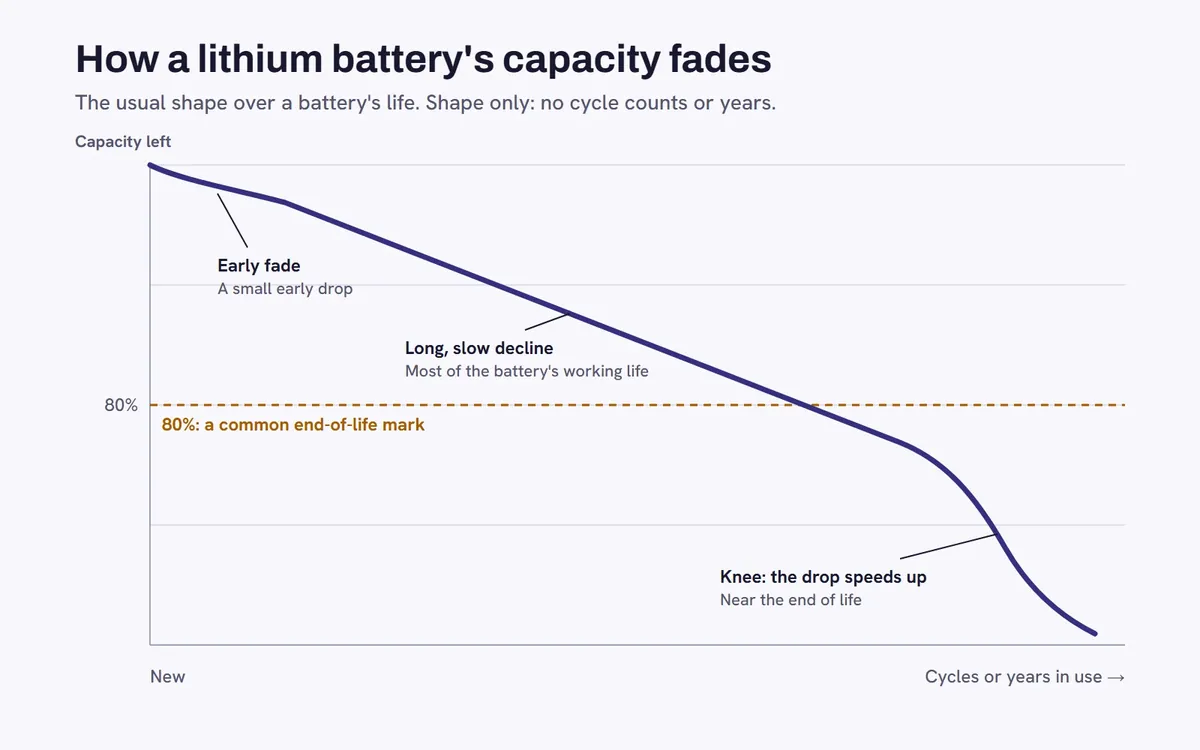
Capacity doesn't fall off a cliff at 80%. Recurrent describes EV battery fade as an S-curve: some early fade, a long slow phase close to a straight line, then a sharper drop near the end of life (Recurrent).
Shakti inverter batteries and Gati EV batteries are rated for 4,000 cycles @ 80% DoD, and Surya batteries for 6,000 cycles @ 80% DoD. Those ratings state the depth of discharge. When you compare quotes, ask every supplier for the capacity left at the end of the rated cycles and the test temperature. Ours is 80% at 25 °C, and it is in each battery's specifications.
Lithium battery life in years for phones, inverters, solar and EVs
Phones, inverters, solar systems and vehicles use lithium cells in very different ways, so their lives differ. The table puts the public figures side by side. The last column is our arithmetic at the stated use. It makes no promise about how long a particular battery will last.
| Battery | Rated or measured life | Source | Years at the stated use (arithmetic) |
|---|---|---|---|
| iPhone 14 and earlier | 80% capacity at 500 full cycles | Apple | About 1.4 years at one full cycle a day |
| iPhone 15 models, iPad, Mac notebooks, Apple Watch | 80% capacity at 1,000 full cycles, "under ideal conditions" | Apple | About 2.7 years at one full cycle a day |
| Shakti lithium inverter batteries (LFP) | 4,000 cycles @ 80% DoD | Our catalogue | About 11 years at one cycle a day |
| Surya solar batteries (LFP) | 6,000 cycles @ 80% DoD | Our catalogue | About 16 years at one cycle a day |
| Vidyut 240 storage cabinet (LFP) | 6,000 or 8,000 cycles | Our catalogue | About 16 or 22 years at one cycle a day |
| Gati e-rickshaw batteries (LFP) | 4,000 cycles @ 80% DoD | Our catalogue | About 11 years at one full cycle a day, about 5.5 years at two |
| Passenger EVs (field data) | Average loss of 2.3% a year, about 81.6% health after 8 years | Geotab, April 2026 | Measured on the road, not a rating |
Geotab's figures come from more than 22,700 EVs across 21 models (Geotab, April 2026). Its FAQ puts average EV battery life at "around 13 years or more", without showing how it reached that figure. Recurrent, drawing on a community of more than 30,000 cars that does not represent every EV, found battery replacement rates under 4% overall and 0.3% for 2022 and newer models. It says full EV battery lifespans aren't known yet (Recurrent, November 2025).
Both datasets show slow, mostly steady fade. They cover passenger cars, not e-rickshaws, so treat them as a guide to how lithium packs age on the road rather than a forecast for a rickshaw battery.
How to turn battery cycle life into years
Divide the rated cycles by the number of cycles you use in a year. The result is the years of cycling the rating covers. It is a rough estimate and makes no promise about your battery.
How you use the battery changes the answer a lot:
- Inverter with a long cut every evening. If each cut uses most of the battery, count one cycle a day. A 4,000-cycle battery covers about 11 years of that.
- Inverter with short, occasional cuts. If an average day uses about a quarter of the battery, that is roughly one equivalent full cycle every four days, or about 90 a year. On paper the cycles would last for decades, so calendar ageing (the slow loss that comes with time, heat and charge level) is likely to end the battery's life before the cycle count does.
- E-rickshaw charged twice a day. That is 730 cycles a year, so a 4,000-cycle pack covers about 5.5 years of cycling.
Real batteries drift from this arithmetic in both directions. Shallow cycles usually give more cycles than a rating measured at deeper discharge. Heat, long spells at full charge and frequent fast charging use up life sooner.
The warranty is the figure a maker commits to. Ours are 5 years on Shakti and Surya batteries, 3 or 5 years (your choice) on Gati packs and 10 years on the Vidyut 240 cabinet. Whoever you buy from, get the warranty's end-of-life definition, such as a capacity percentage, in writing.
LFP vs NMC battery life
LFP (lithium iron phosphate) cells usually last more cycles than NMC (nickel manganese cobalt) cells and cope better with deep cycling. NMC cells store more energy for their weight, which matters when a pack has to be light or small. LFP suits home backup, solar storage and telecom, where long life matters most. We build packs in both chemistries, and our page on how LFP and NMC battery packs are built explains how we choose between them. For the full comparison, read our LFP vs NMC guide.
The clearest public comparison is a 2020 Sandia National Laboratories study (Preger et al., Journal of The Electrochemical Society). It cycled commercial 18650 cells at 15, 25 and 35 °C, across three depth-of-discharge windows (40–60%, 20–80% and 0–100%) and at discharge rates from 0.5C to 3C.
| Chemistry (cell tested) | Equivalent full cycles to 80% capacity |
|---|---|
| LFP (A123, 1.1 Ah) | 2,500–9,000 |
| NMC (LG HG2) | 200–2,500 |
| NCA (Panasonic NCR18650B) | 250–1,500 |
Sandia also reported these results:
- Most LFP figures are extrapolated, because the LFP cells had not reached 80% capacity when the study ended.
- Life varied by thousands of cycles within one chemistry, even inside the cell maker's specifications.
- Deeper cycles meant faster fade for every cell, and NMC and NCA were more sensitive. Full 0–100% cycling barely affected LFP.
- Discharge rate made little difference for LFP and NMC.
- Between 15 and 35 °C, LFP faded faster when warmer, while NMC faded more slowly, so temperature does not act the same way on every chemistry.
These were small cylindrical cells, unlike the large prismatic cells in storage and EV packs. The NMC range describes that one cell and is not typical of every NMC pack.
Battery University's estimates show the same pattern for depth of discharge: the shallower each cycle, the more cycles a cell gives. Its figures are counted to 70% capacity, give no method and sit far below modern LFP datasheets, so use them for the trend only (Battery University BU-808, updated October 2023).
What shortens lithium battery life
Heat, time spent at full charge, deep discharge, frequent fast charging and the wrong charger all age a lithium battery faster. Most of them are in your control.
Heat
Heat speeds up ageing. Battery University gives lithium-ion charging limits of 0 to 45 °C and notes that "prolonged exposure to heat reduces longevity" (BU-410, updated March 2022). In Geotab's EV data, cars in hot climates (more than 35% of days above 25 °C) lost about 0.4% more capacity a year than others. In an Indian home the hot spots are a loft, a tin-roofed shed or a sunny balcony. On an e-rickshaw it is a battery bay parked in the sun all afternoon.
Sitting at full charge
A lithium battery kept full ages faster than one kept part-charged, and heat makes the gap wider. Battery University's storage figures show the capacity left after one year (BU-702, updated October 2021):
| Storage temperature | Stored at 40% charge | Stored at 100% charge |
|---|---|---|
| 0 °C | 98% | 94% |
| 25 °C | 96% | 80% |
| 40 °C | 85% | 65% |
| 60 °C | 75% | 60% (after only 3 months) |
Field and lab data point the same way. In Geotab's data, EVs that spent a lot of time at extreme states of charge lost 2.0% a year, against 1.4% for those that rarely did. For LFP cells, Dalhousie University researchers found that a lower average state of charge gave less fade, whatever the depth of discharge, in tests run at 40 °C and 55 °C to speed up ageing (ECS webinar, January 2025).
An inverter or solar battery has to stay charged, because a full battery is your backup. For those, the practical step is to keep the battery cool.
Deep discharge
Running a pack to empty every day uses up its cycles faster, as the Sandia and Battery University data above show. Leaving a battery flat for a long time can damage it for good. Battery University warns against leaving a lithium-ion cell below 2.0 V for any length of time (BU-702).
Fast charging and the wrong charger
Frequent high-power fast charging speeds up fade in EVs. Geotab found that cars using DC fast charging in under 12% of sessions lost 1.5% a year, while those using high-power fast charging often lost 3.0% a year and would reach about 76% health after 8 years.
The charger has to suit the battery. Lithium-ion "cannot absorb overcharge", and chargers built for different lithium chemistries "are not compatible" (BU-409, updated October 2021). Gati packs are sold without a charger, so use one matched to the pack's voltage and chemistry.
How to make a lithium battery last longer
These are our recommendations for inverter, solar and EV owners, based on the data above:
- Keep it shaded and ventilated. Avoid lofts, sun-facing walls and closed metal boxes.
- Size the battery so it isn't stretched. A larger battery covers the same load at a shallower depth of discharge, and you can avoid running it to empty. The battery backup calculator works out the size for your appliances.
- Store a spare at about 40% charge in a cool place, and never leave a pack flat for weeks.
- Use the right charging setting. If your inverter has a lithium or Li-ion battery setting, select it. For an EV pack, use a charger matched to its voltage.
- Fast-charge an EV only when you need to. Slow charging is gentler for daily use.
How a battery pack's build affects its life
Cells set the ceiling on a pack's life, and the way the pack is built decides how close it gets to that ceiling. At our Rajkot plant we test every incoming cell lot, then grade the cells by capacity and internal resistance so each pack is built from a matched set. Every cell is laser-welded to its busbar, so there are no bolted joints to loosen under vibration and joint resistance stays low.
Each pack has a BMS matched to the cells, chosen for each pack and calibrated on our line. It applies over- and under-voltage, current and temperature limits to every cell group. It also balances the cells, which keeps them at the same state of charge so the weakest cell does not limit the whole pack. Inverter and rack packs shed heat through an aluminium enclosure, and packs for fast-charging fleets and commercial storage use forced air or liquid cooling for Indian summers. The Technology page covers each step.
What happens when a lithium battery reaches end of life
It keeps working with less capacity. A battery at 80% of its original capacity gives roughly 80% of its original backup. A Shakti 12 on a Prakash 1100 runs a 250 W load for about 4 hours when new, so at 80% capacity it would run the same load for a little over 3 hours. If that is still enough for you, you don't have to replace it the day it crosses a line. Watch for faster fade near the end of the S-curve.
The main sign that a battery is wearing out is shorter backup time. If the same load now runs for noticeably less time than it did when the battery was new, its capacity has dropped. Time a familiar load, such as your usual evening fans and lights, now and then so you have something to compare. Gati packs also connect to a Bluetooth app, so e-rickshaw owners can check the pack from their phone.
A tubular lead-acid battery costs less up front. We compare the two over their working lives in lithium vs tubular inverter battery, and our lithium inverter battery price guide explains what drives the price.
When you do replace a lithium battery, don't put it in the bin. India's Battery Waste Management Rules 2022 cover EV, portable, automotive and industrial batteries. As summarised by the IEA, producers must register with the Central Pollution Control Board (CPCB), collect used batteries and recycle or refurbish them, and "cannot send collected batteries to landfills or for incineration" (IEA, updated November 2025). The IEA lists material recovery targets for EV batteries rising from 70% in 2024-25 to 90% in 2026-27 by dry weight. Later amendments are reported to have changed some targets, so check the current text, and ask the seller how they take back old batteries.
Sources
- Apple, Batteries: service and recycling (current page)
- Recurrent, How long do EV batteries last?, 11 November 2025
- Geotab, EV battery health study of 22,700+ vehicles, 28 April 2026
- Preger et al., "Degradation of commercial lithium-ion cells as a function of chemistry and cycling conditions", Journal of The Electrochemical Society 167, 120532, 2020
- Sandia National Laboratories, publication record for Preger et al., 2020
- Battery University, BU-808: How to prolong lithium-based batteries, updated 11 October 2023
- Battery University, BU-702: How to store batteries, updated 27 October 2021
- Battery University, BU-410: Charging at high and low temperatures, updated 1 March 2022
- Battery University, BU-409: Charging lithium-ion, updated 25 October 2021
- The Electrochemical Society, webinar on how the operating window affects LFP/graphite cells (Dalhousie University), 22 January 2025
- TEC, draft GR "Lithium-Ion Battery for Telecom Applications" (2026 draft, PDF)
- IEC Webstore, IEC 62620:2014+AMD1:2023, secondary lithium cells and batteries for industrial applications
- IEA, Battery Waste Management Rules 2022 (policy entry), updated 2 November 2025
Frequently asked questions
How many years does a lithium battery last?
It depends on the battery's cycle rating and how often you use it. Divide the rated cycles by the cycles you use in a year. An LFP inverter battery rated for 4,000 cycles at 80% depth of discharge covers about 11 years at one full cycle a day. A phone designed to keep 80% capacity for 500 cycles reaches that point in under a year and a half of daily charging. Heat and long spells at full charge shorten the real figure.
How many charge cycles does a lithium battery have?
From a few hundred to several thousand, depending on the chemistry, depth of discharge, temperature and the capacity end point used. Apple designs the iPhone 14 and earlier to keep 80% capacity at 500 full cycles, and newer devices at 1,000. In Sandia National Laboratories' 2020 tests, LFP cells reached 2,500 to 9,000 equivalent full cycles to 80% capacity, against 200 to 2,500 for the NMC cells.
Is it bad to charge a lithium battery to 100%?
A full charge is normal use. Keeping a lithium battery full for long periods, especially in heat, ages it faster, so keep backup batteries cool.
Does a lithium battery lose capacity when not used?
Yes. Lithium batteries age with time as well as with use, which is called calendar ageing, and it runs faster at high temperature and high charge. Store a spare battery at about 40% charge in a cool place, and don't leave it flat for long.
Which lasts longer, LFP or NMC?
LFP usually lasts more cycles. In Sandia National Laboratories' 2020 study of commercial cells, LFP reached 2,500 to 9,000 equivalent full cycles to 80% capacity, against 200 to 2,500 for NMC, and full-depth cycling barely affected it. NMC stores more energy for its weight, so it suits packs where weight and space matter most. Results vary widely from cell to cell, so compare datasheets measured under the same conditions.