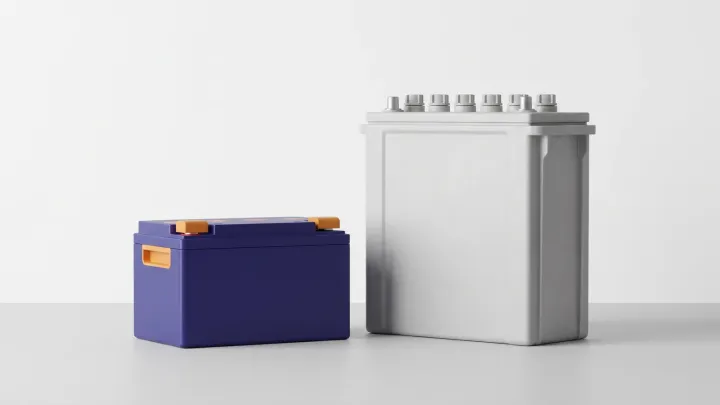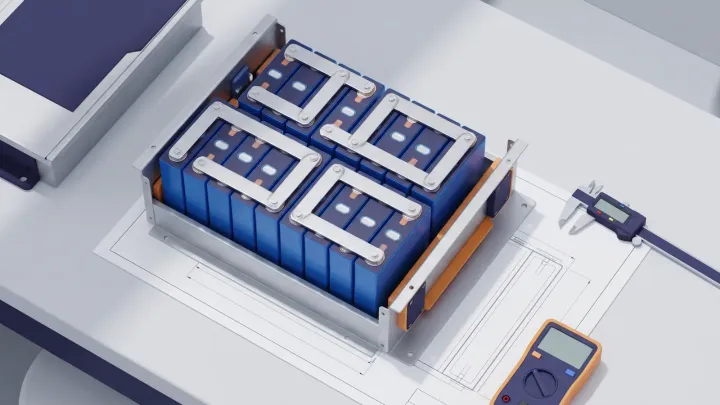


LFP and NMC are two types of lithium-ion battery, named after the material in the cathode. LFP (lithium iron phosphate, also written LiFePO4) usually costs less per kWh and contains no cobalt or nickel, so it usually suits home backup, solar storage, telecom, e-rickshaws and forklifts. NMC (lithium nickel manganese cobalt oxide) stores more energy per kg and per litre, so it is the usual pick where weight and space are tight, and it remains common in electric scooters and cars even as LFP gains. We design and manufacture both, and the 12 batteries in our catalogue are LFP, so read our view with that in mind.
Key Takeaways
- Choose NMC when each kg or litre counts. Choose LFP when the battery stays put or gets cycled hard every day and cost per kWh matters more than weight.
- A cycle rating means little on its own. Compare two batteries only at the same depth of discharge (DoD), temperature, charge rate and end-of-life capacity.
- LFP reacts later and more slowly in a fire test, but its vent gas ignites at a lower concentration. Pack design matters in both chemistries.
- In Sandia's tests, LFP's fade rate rose with temperature between 15 and 35 °C and NMC's fell, though LFP was still projected to reach more cycles.
What is an LFP battery (LiFePO4, lithium iron phosphate)?
An LFP battery is a lithium-ion battery whose cathode is lithium iron phosphate. "LFP", "LiFePO4 battery" and "lithium iron phosphate battery" all mean the same chemistry. It is one type of lithium-ion battery, so "LFP vs lithium-ion" compares one type with the whole family.
An LFP cell is 3.2 V nominal and charges to 3.65 V (EVE LF105 specification, December 2019). Four cells in series make 12.8 V, which is why a 12V LFP battery can sit close to the range of a lead-acid inverter, as our lithium vs tubular inverter battery guide explains. Fifteen or sixteen cells make the 48 V and 51.2 V packs covered in our 48V lithium battery price guide.
LFP took over 55% of EV batteries deployed worldwide in 2025 and over 90% of stationary battery storage installations (IEA, Global EV Outlook 2026).
What is an NMC battery?
An NMC battery uses a cathode that blends nickel, manganese and cobalt. The numbers in a name such as NMC532 give the ratio of those metals: the cathode formula is Li[Ni0.5Mn0.3Co0.2]O2 (Aiken et al., Journal of The Electrochemical Society, May 2022). NMC811 has much more nickel and much less cobalt.
An NMC cell has a higher voltage than an LFP cell. LG's HG2 specification (October 2014) gives 3.60 V nominal and 4.20 V at full charge, and Sandia National Laboratories measured that cell's cathode as a nickel-rich NMC811. That higher voltage and a higher capacity per gram are where its energy advantage comes from (Aiken et al., above).
The voltage also means an NMC pack needs its own design. Thirteen cells give about 47 V and charge to 54.6 V, while three give 12.6 V at full charge and four give 16.8 V (our calculation). Neither of those sits as neatly on a 12V inverter's charger as four LFP cells do.
Outside China, almost 80% of EV batteries deployed in 2025 used nickel-containing chemistries, a group that includes NMC (IEA).
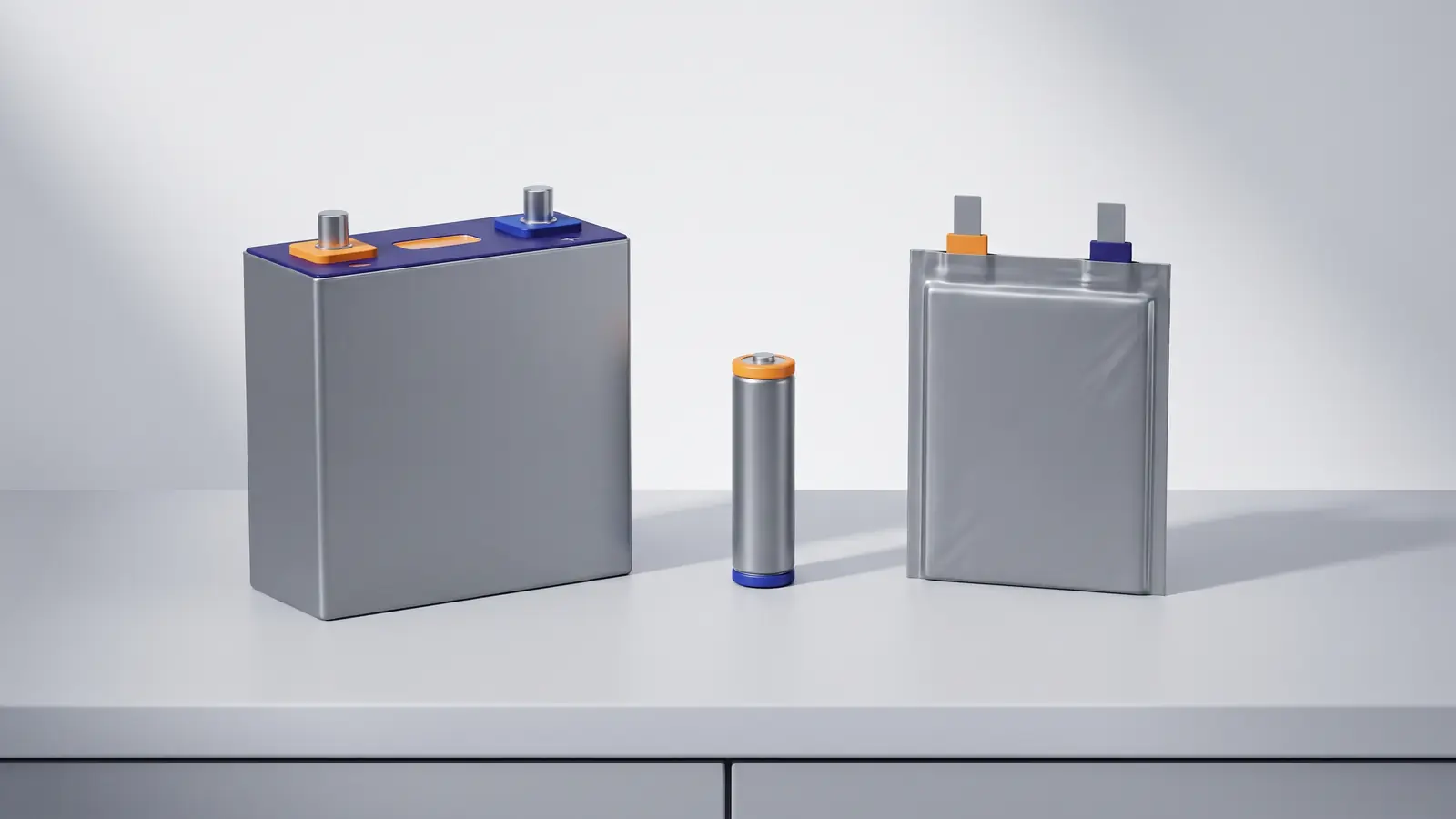
LFP vs NMC comparison table
Results change from cell to cell, so this table uses named tests and datasheets. We chose the EVE LF105 and LG HG2 because their specifications are public and Sandia tested the same LG cell. EVE is one of the makers we buy cells from. The HG2 is a high-power 18650 cell, so it does not show the highest energy NMC can reach. Neither cell stands in for every LFP or NMC cell.
| Measure | LFP (LiFePO4) | NMC | Source and date |
|---|---|---|---|
| Energy density, IEA's figures | Up to 205 Wh/kg, latest generation | 265 Wh/kg, stated without a test basis | IEA, 2026 |
| Energy by weight, two named cells | About 170 Wh/kg | About 230 Wh/kg | EVE LF105, Dec 2019; LG HG2, Oct 2014 (our calculation) |
| Energy by volume, same cells | About 350 Wh/L | About 630 Wh/L | Same sheets (our calculation) |
| Cell weight for 5 kWh, same cells | About 29 kg | About 22 kg | Cells only (our calculation) |
| Lab cycle life at 80% DoD, to 80% of rated energy | 2,400 | 1,520 | PNNL, Aug 2022 |
| Calendar life assumed for grid systems | 16 years | 13 years | PNNL, Aug 2022 |
| Self-heating onset, 21700 cell at full charge | About 124 °C | About 86 °C | KIT, Apr 2023 |
| Thermal runaway start, same test | About 256 °C | About 198 °C | KIT, Apr 2023 |
| Peak temperature, same test | About 499 °C | About 592 °C | KIT, Apr 2023 |
| Lower flammable limit of vent gas (inert atmosphere) | 6.2% | 7.9% to 9.2% | Bugryniec et al., 2024 |
| Average pack price worldwide, 2025 | $81/kWh | $128/kWh | BloombergNEF, Dec 2025 |
| Allowed charging temperature | 0–55 °C | 0–50 °C | EVE LF105; LG HG2 |
| Allowed discharge temperature | -20–55 °C | -20–75 °C, at the cell surface | EVE LF105; LG HG2 |
| Cobalt and nickel in the cathode | None | Both | Cathode formulas; IEA, 2026 |
| Where supply is concentrated | LFP cathode: almost entirely China | Cobalt: DRC. Nickel: Indonesia | IEA, 2026; SMM, citing INSG, June 2025 |
LFP vs NMC energy density and weight
NMC's clearest advantage is energy for its weight and size. At the IEA's figures, 5 kWh of cells weighs about 24 kg in LFP and about 19 kg in NMC (our calculation), before adding a case or BMS.
By volume, the EVE cell holds about 350 Wh/L (336 Wh in its 130.3 × 36.7 × 200.5 mm case) and the LG cell about 630 Wh/L (10.8 Wh in an 18.3 × 65 mm cylinder), both our calculation. Round cells leave gaps in a pack, which that figure does not count.
The gap between real products can be small. Ather now fits its smaller Rizta with either a 2.7 kWh LFP pack or a 2.9 kWh NMC pack, depending on cell supply, with the same claimed 123 km IDC range (Autocar India, 16 July 2026).
Weight matters when a vehicle has to carry the battery or a person has to lift it. On a wall or in a rack, the extra weight usually costs little.
Worked example: a home battery for 400 W over 5 hours
A home that wants to run 400 W of fans, lights and a TV through a 5-hour power cut needs 2 kWh of usable energy. At the 80% our ratings use, that means 2.5 kWh of rated energy (our calculation). Our Shakti 12 Plus, an LFP battery we make, holds 2.56 kWh in 23 kg and runs about 400 W for about 5 hours.
The cells for 2.56 kWh weigh about 15 kg at the EVE cell's density and about 11 kg at the LG cell's, a difference of about 4 kg. At the IEA's figures, the difference is about 3 kg (our calculation). A high-energy NMC cell would save more, because the LG cell is built for power. For a battery that stays in one place, that saving is small. This is arithmetic on cell weights and does not describe a product in our catalogue.
LFP vs NMC cycle life: compare only at the same DoD and temperature
Cycle life depends so much on test conditions that a headline number can mislead. Check these before you compare two ratings:
- Depth of discharge: how much of the battery each cycle uses. Our own ratings use 80%, while LFP cells allow 90 to 100%.
- Temperature: most ratings are measured at 25 °C, which is cooler than many Indian battery rooms in summer.
- Charge and discharge rate: written as C-rate, where 1C would fill or empty the cell in about an hour.
- Voltage window: a cell kept away from its full voltage usually lasts longer, as the Dalhousie cells covered below show.
- End of life: the capacity left when the count stops, usually 80% and sometimes 70% or 60%.
- Tested or extrapolated: how many cycles were actually run.
| Battery | Rated cycles | Conditions stated |
|---|---|---|
| EVE LF105 cell (LFP) | 3,500 | 25 °C, 1C charge and discharge, 3.65 V to 2.5 V, to 80% of nominal capacity |
| LG HG2 cell (NMC) | 300 at 10 A, 200 at 20 A | 4 A charge, 4.2 V to 2.5 V, to 70% of nominal capacity; these are high discharge rates, about 3.3C and 6.7C |
| Halovolt Shakti 12 (LFP, our product) | 4,000 | 80% DoD, 80% of capacity left, 25 °C |
| Halovolt Surya 48 and 51 (LFP, our products) | 6,000 | 80% DoD, 80% of capacity left, 25 °C |
These rows use different rates, voltage limits and end points, and the LG figures are minimums at high power, so they show how ratings are written and do not rank the cells. Our pack ratings are at 80% DoD, while the EVE datasheet runs the cell across its full voltage range, so our 4,000 and the cell's 3,500 are not measured the same way.
The US Pacific Northwest National Laboratory (PNNL) shows how much the source matters. Laboratory data in its 2022 assessment gave 2,400 cycles for LFP and 1,520 for NMC at 80% DoD.
Figures reported by suppliers, after PNNL's DoD adjustment, ran from 2,475 to 6,250 for LFP and from 3,750 to 6,000 for NMC, so a good NMC system built for storage can overlap with LFP.
PNNL adds that high figures partly come from accelerated testing and are extrapolated from a limited number of cycles. It also says most warranties limit use to one full cycle a day.
Sandia tested three small commercial 18650 cell types under the same conditions. LFP was projected to reach 2,500 to 9,000 equivalent full cycles to 80% capacity, because most LFP cells had not got there when the study ended. The LG HG2 reached 200 to 2,500 (Preger et al., 2020). The gap shrank when Sandia counted energy delivered, because the LFP cell held about 3.6 Wh and the NMC cell about 10.8 Wh (our calculation from Sandia's table). NMC also proved more sensitive to full-range 0 to 100% cycling.
To turn cycles into years, see how long a lithium battery lasts.
LFP vs NMC safety: thermal runaway and vent gas
Thermal runaway is a self-feeding overheating reaction inside a cell. The best direct comparison we read is from Karlsruhe Institute of Technology (KIT), which tested commercial 21700 cells, and the table above gives its temperatures at full charge. In nail penetration tests, LFP showed no thermal runaway at any state of charge, while NMC did at 30%, 50% and 100% charge.
Our Technology page uses KIT's figures: about 256 °C for LFP and about 198 °C for NMC, a gap of about 60 °C.
LFP is not free of fire risk. At full charge, KIT's LFP cells still went into runaway, and the authors note that the slower reaction can make an event harder to detect, so a BMS has to be set up for it.
Vent gas is the other half of the picture. A 2024 review of 60 studies found median gas volumes of 519 L/kWh for NMC and 126 L/kWh for LFP in air, and 573 and 368 L/kWh in an inert atmosphere. LFP's gas has more hydrogen, and its lower flammable limit is 6.2%, against 7.9% to 9.2% for NMC, so the review rates LFP as the greater flammability hazard.
Because LFP cells flame less often, that gas is more likely to escape unburnt and build up, which raises the risk of a vapour cloud explosion. The review also found too little data on large 10 to 100 Ah LFP cells, the size many storage packs use.
So ask any seller how cells are separated, how gas is vented, what the BMS cuts off and how the pack was tested. Our Technology page sets out our own protection levels.
LFP vs NMC cost per kWh and raw material supply
LFP packs averaged $81/kWh worldwide in 2025 and NMC packs $128/kWh, so LFP was about 37% cheaper (BloombergNEF; our calculation). The IEA says the LFP gap was more than 40% and that part of it comes from stationary storage, which mostly uses LFP and has lower energy density needs. These are global averages for all buyers, and they are not Indian shop prices.
Cost per kWh delivered is a fairer test than purchase price. Divide the price by kWh, DoD and cycles. With PNNL's lab figures at 80% DoD, that is about 4.2 US cents per kWh for LFP and about 10.5 for NMC. With the higher supplier-based figures PNNL also uses (4,550 and 4,805 cycles), it is about 2.2 and 3.3 cents. Both are our own rough calculations from global averages, and they leave out the inverter, installation and any value from lower weight.
Raw materials carry different risks. The DRC supplies almost two-thirds of the world's cobalt, and cobalt prices doubled in a year after its export ban and quotas (IEA). Indonesia accounted for an estimated 61.6% of global nickel production in 2024 (SMM, citing the International Nickel Study Group, June 2025). LFP avoids both metals, but production of LFP cathode materials is almost entirely in China (IEA).
In India, Tata's Agratas plans to start making NMC cells at Sanand by early 2027 and is building an LFP pilot line there (Bloomberg via Deccan Chronicle, August 2026).
LFP vs NMC in hot and cold weather
Heat is the bigger question in most of India, and the answer depends on the kind of damage you mean. Across 15 to 35 °C, Sandia found that the capacity fade rate rose with temperature for LFP and fell for NMC while cycling. Sandia still ranked LFP highest for cycle life at every condition, mostly on projections, and its data stops at 35 °C. For batteries sitting unused, Sandia's survey of earlier studies found less fade at lower temperatures in LFP and NMC alike, so a cool, shaded spot helps both.
Research cells can reverse the usual ranking. Dalhousie University built NMC532 cells to run at only 3.8 V with a special electrolyte, and they outlasted its LFP cells at 40, 55 and 70 °C. The authors still expect LFP to stay ahead on initial cost and safety, and these were lab cells rather than products you can buy (Aiken et al.).
Ask for cycle data at 35 to 45 °C, as well as at 25 °C, from any seller of either chemistry. Fast-charging fleets may also need active cooling.
Cold is where two sources lean towards NMC. The IEA says sodium-ion does significantly better than lithium-ion at low temperatures, "particularly LFP chemistries". An NREL report on EVs in Fairbanks, Alaska, says NMC is best for cold-weather use because of its higher voltage and range, for long-range EVs. NREL's own data comes from Tesla vehicles and is no head-to-head test.
The cell sheets we read do not settle it. EVE promises at least 70% of capacity at -20 °C and 1C, measured down to 2.0 V. LG allows discharge down to -20 °C and its specification gives no capacity figure there.
Charging below 0 °C is outside both the EVE and LG sheets. Low temperature promotes lithium plating on the graphite anode, as Sandia describes, which is why a BMS should stop charging in that range. In India this mostly concerns high-altitude sites such as Ladakh and Spiti.
Which battery should you choose for home, solar, telecom, EV and forklift?
These are our own judgements from the data above.
| Use | Usually suits | Why | Read next |
|---|---|---|---|
| Home inverter backup | LFP | It stays in one place, so weight costs little, and 12.8 V suits a 12V inverter | Lithium inverter batteries (our Shakti range) |
| Solar storage | LFP | Daily cycling makes cost per kWh delivered the main number | Solar batteries (our Surya range) |
| Telecom towers | LFP | TEC's lithium-ion guideline names LFP as an example. NMC could help where a roof limits weight, if the operator accepts it | Lithium battery for telecom towers |
| E-rickshaws | LFP | Deep daily cycles and tight budgets, on a vehicle that can carry the weight | E-rickshaw lithium battery price |
| Electric scooters | NMC where range must fit a tight space, LFP on cost | Makers use both, as shown below | Electric scooter battery price |
| Electric cars | NMC for the most range per kg, LFP for lower cost | Nickel chemistries lead outside China, and LFP leads worldwide | Below |
| Compact or weight-limited packs | NMC | Each kg and litre counts, and NMC holds more energy in both | Energy density section above |
| Forklifts | LFP | A counterbalance forklift needs weight at the back, so lighter cells gain little | 80V forklift case study |
TVS says the iQube uses NMC (TVS iQube FAQ). Ather's 3.5 kWh packs use NMC and its smaller Rizta takes either chemistry (Autocar India). Greaves has standardised on LFP across its Ampere range (The Week, April 2026). Autocar India reported that Mahindra's BE 6e and XEV 9e use LFP packs of 59 and 79 kWh, so LFP can reach large car packs (Autocar India, 21 November 2024). Whichever chemistry an EV pack uses, ask for its AIS-156 Phase II certificate.
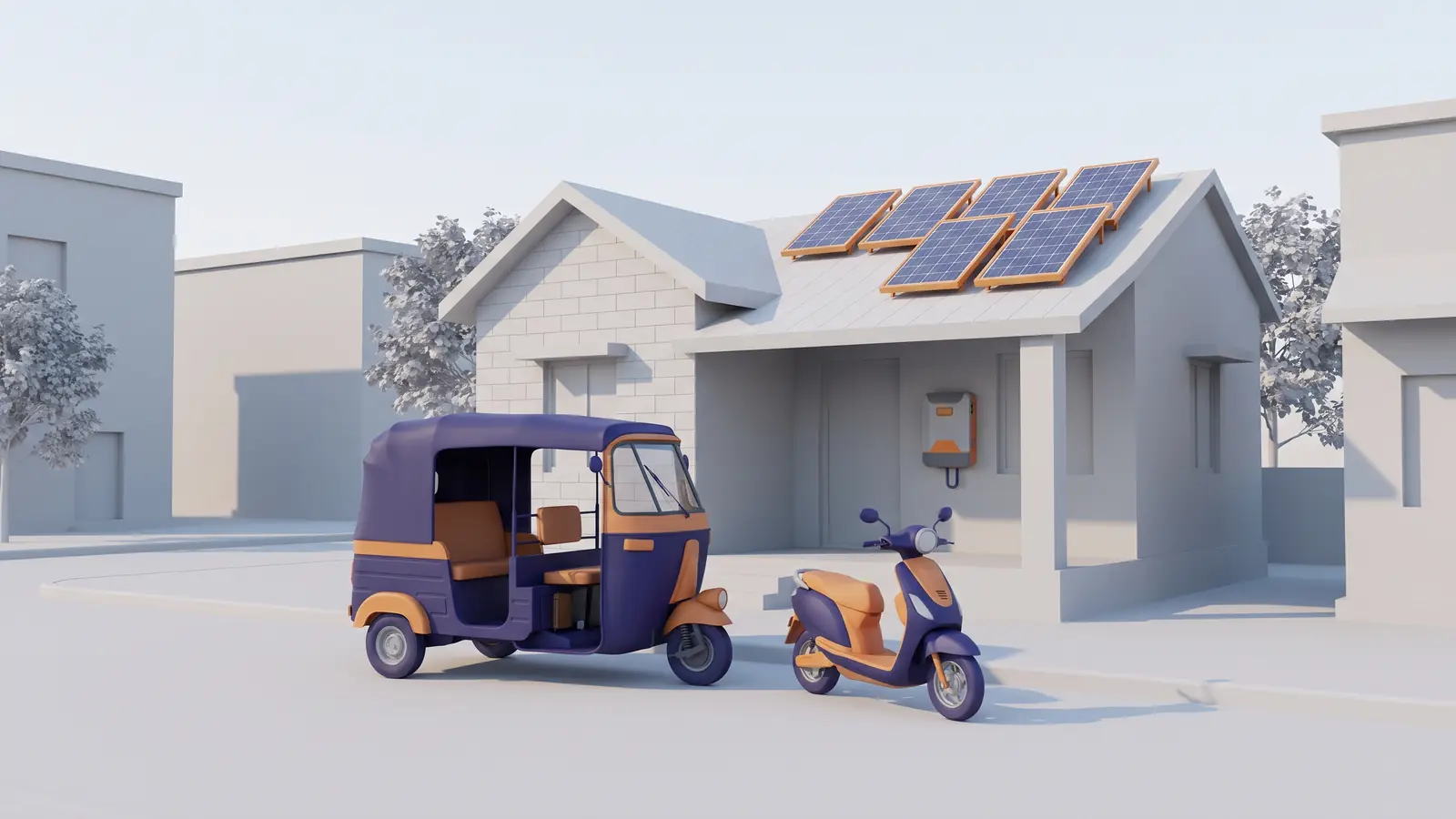
LFP and NMC battery packs at Halovolt
We design and manufacture LFP and NMC lithium battery packs. The 12 batteries in our catalogue, including the Shakti, Surya and Gati ranges, are LFP batteries. Send your voltage, space, weight limit and duty cycle through the quote form. How we check cells and match a BMS to each pack is on the Technology page.
What we could not confirm
- Cold results: we found no independent test comparing commercial LFP and NMC cells side by side at -20 °C.
- Indian retail prices: we found no published India-wide LFP vs NMC price figure.
- Telecom NMC: we did not confirm whether Indian operators or TEC accept NMC for tower backup.
Sources
- IEA, Global EV Outlook 2026, electric vehicle batteries, May 2026
- BloombergNEF, lithium-ion battery pack prices fall to $108 per kilowatt-hour, 9 December 2025
- PNNL, 2022 Grid Energy Storage Technology Cost and Performance Assessment, PNNL-33283, August 2022 (PDF)
- Preger et al., Sandia National Laboratories, Degradation of Commercial Lithium-Ion Cells as a Function of Chemistry and Cycling Conditions, 2020 (PDF)
- Ohneseit et al., Karlsruhe Institute of Technology, Thermal and Mechanical Safety Assessment of Type 21700 Lithium-Ion Batteries, Batteries, 22 April 2023
- Bugryniec et al., Review of gas emissions from lithium-ion battery thermal runaway failure, Journal of Energy Storage, 2024
- Aiken et al., Dalhousie University, Li[Ni0.5Mn0.3Co0.2]O2 as a Superior Alternative to LiFePO4 for Long-Lived Low Voltage Li-Ion Cells, Journal of The Electrochemical Society, 9 May 2022
- EVE Energy, LF105 product specification, version F, 2 December 2019 (PDF, reseller copy)
- LG Chem, INR18650HG2 product specification, BCY-PS-HG2-Rev0, 13 October 2014 (PDF, reseller copy)
- SMM, Current status and future trends of the global nickel industry, citing INSG data, 30 June 2025
- NREL, Electric Vehicle and Charging Infrastructure Assessment in Cold-Weather Climates: A Case Study of Fairbanks, Alaska, NREL/TP-5400-92113, January 2025 (PDF)
- TEC, standards and specifications list (guideline TEC/GL/FA/LIB-801/01/JUL-20), as read for our telecom guide, 31 October 2026
- The Week, Electric scooter boom: is India's EV two-wheeler market maturing?, 11 April 2026
- Autocar India, Ather scooters get new battery packs, LFP cells on Rizta, 16 July 2026
- Autocar India, Mahindra BE 6e, XEV 9e battery, power, charging details revealed, 21 November 2024
- TVS Motor, iQube FAQ, read 4 November 2026
- Deccan Chronicle (Bloomberg), Tata's battery unit turns to own tech for making lithium cells, 4 August 2026
Frequently asked questions
Is LiFePO4 the same as LFP?
Yes. LFP, LiFePO4 and lithium iron phosphate all name the same battery chemistry, and it is a type of lithium-ion battery. An LFP cell is 3.2 V nominal. Four cells in series make a 12.8 V battery, and fifteen or sixteen make a 48 V or 51.2 V pack.
Which lasts longer, LFP or NMC?
LFP usually lasts more cycles, but it depends on the cells and the test. PNNL's 2022 lab figures gave 2,400 cycles for LFP and 1,520 for NMC at 80% depth of discharge. Supplier figures after PNNL's adjustment ran from 2,475 to 6,250 for LFP and from 3,750 to 6,000 for NMC, so they overlap. Compare ratings only at the same depth of discharge, temperature, charge rate and end-of-life capacity.
Is an LFP battery safer than an NMC battery?
At cell level, LFP reacts later and more slowly. In a 2023 Karlsruhe Institute of Technology test of 21700 cells at full charge, thermal runaway started at about 256 °C for LFP and about 198 °C for NMC. LFP is not free of risk: a 2024 review of 60 studies put the lower flammable limit of its vent gas at 6.2%, against 7.9% to 9.2% for NMC, and rated LFP the greater flammability hazard. Pack design matters in both chemistries.
Which is better for a home inverter or solar battery, LFP or NMC?
LFP usually suits both. A home or solar battery stays in one place, so its extra weight costs little, and frequent cycling makes cost per kWh delivered the main number. Four LFP cells also make 12.8 V, which sits close to the range of a 12V inverter. NMC's weight and space advantage matters less on a wall or in a rack. Check any battery against your inverter's manual.
Does Halovolt make LFP or NMC batteries?
We design and manufacture both LFP and NMC lithium battery packs. The 12 batteries in our catalogue, including the Shakti, Surya and Gati ranges, are LFP. For a quote, send your voltage, space, weight limit and duty cycle through our OEM quote form.