
Battery pack design runs in a set order: write the brief, choose the cell, work out the series and parallel layout, then select the BMS and design the cooling, enclosure and connections around them. The pack then goes through a prototype, validation, a pilot, certification to the standards its market requires, and series production. The steps loop back often, because a different cell changes the cell count, heat load, BMS and cost (BatteryDesign.net).
Key Takeaways
- Size a custom pack for the end of its life. The brief should state the usable energy and peak power you still need once the cells have aged.
- Series count sets the voltage and parallel count sets the capacity. The worked example turns a 60V brief into a 19-cell layout.
- Heat changes what a cell datasheet promises. One public LFP specification gives 6,000 cycles at 25 °C and 2,500 at 45 °C.
- Choose target certifications at the brief stage. In India, AIS-156 covers L-category vehicles and AIS-038 Rev 2 covers M and N, and both set rules for vents, fuses, cell certification and traceability.
- A small pilot finds fit and charging problems before a fleet order.
What goes in a custom battery pack brief?
The brief is the list of numbers every later decision gets checked against. These are the nine items we ask for when someone wants a custom lithium battery pack.
| Item | What to state | What it decides |
|---|---|---|
| Voltage | The system's minimum and maximum, along with nominal | The series count |
| Capacity | Usable energy needed when the pack is old | The parallel count |
| Peak current | How many amps, for how many seconds | Cell, BMS, fuse and busbars |
| Space | A drawing with connector and service access | Often the cell format |
| Weight | The limit, with mounting parts included | Can move you from LFP to NMC |
| Duty cycle | Load through the day, charges a day, shifts | Heat load and cycle count |
| Temperature | Lowest and highest ambient, including parking in the sun | Cooling and charge limits |
| Target certifications | Vehicle category or end use, and export markets | Design rules from day one |
| Annual volume | Pilot quantity and yearly estimate | Fixtures, cell sourcing and price |
BatteryDesign.net's sizing guide puts the rule in one line: "Requirements must be met at end of life, not beginning of life." If you can't share drawings yet, ask for an NDA first. We offer them.
Cell selection: LFP or NMC, prismatic, cylindrical or pouch
Chemistry. NMC stores more energy for its size. The IEA's global EV data for 2024 put LFP's pack energy density about one-fifth lower by mass and one-third lower by volume than NMC, and its packs almost 30% cheaper per kWh (IEA, 2025). LFP usually lasts more cycles. A Sandia-led study reported 2,500 to 9,000 equivalent full cycles for LFP cells (many extrapolated) and 200 to 2,500 for NMC, on small 18650 cells that don't represent every pack (Preger et al., 2020). When weight and space are tight, NMC can earn its higher price. We design and manufacture both, and our LFP vs NMC guide compares them.
Format. Battery University's 2019 overview is a fair general starting point (BU-301a).
| Format | Strengths | Trade-offs |
|---|---|---|
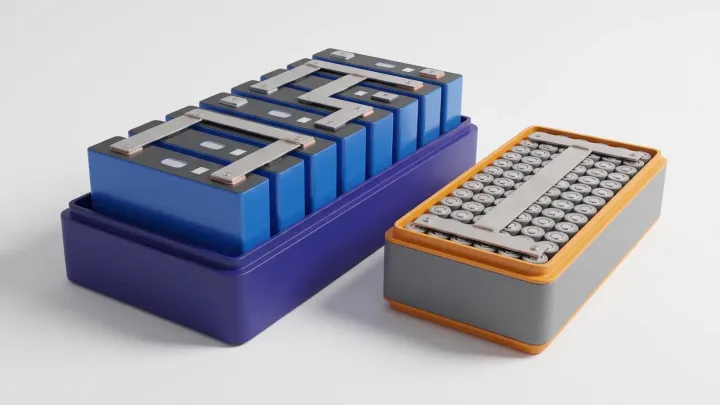
| Cylindrical | Good mechanical stability; doesn't change size; gaps between cells can carry cooling | Those gaps waste space |
| Prismatic | Uses space well; flexible sizing | Needs a growth allowance and a firm enclosure; rated less efficient in thermal management; can cost more to make |
| Pouch | Light; 90 to 95% packaging efficiency | Can swell; humidity and high temperature can shorten life |
Datasheet conditions. Read the test conditions along with the numbers. EVE's public LF280K specification is a useful example (we buy from EVE among others, and this says nothing about the cell in any given pack). It lists 3.2V, a 3.65V charge limit, a 2.5V discharge limit, 1C maximum current, charging from 0 to 55 °C, and cycle life of 6,000 at 25 °C against 2,500 at 45 °C, both to 80% capacity (EVE, 2021). The test description puts the cell under a preset 300 kgf force while the table row says "without fixture", so ask the cell maker what clamping the rating assumes.
We test each incoming cell lot, then grade cells by capacity and resistance into matched sets.
Series and parallel layout: a worked calculation
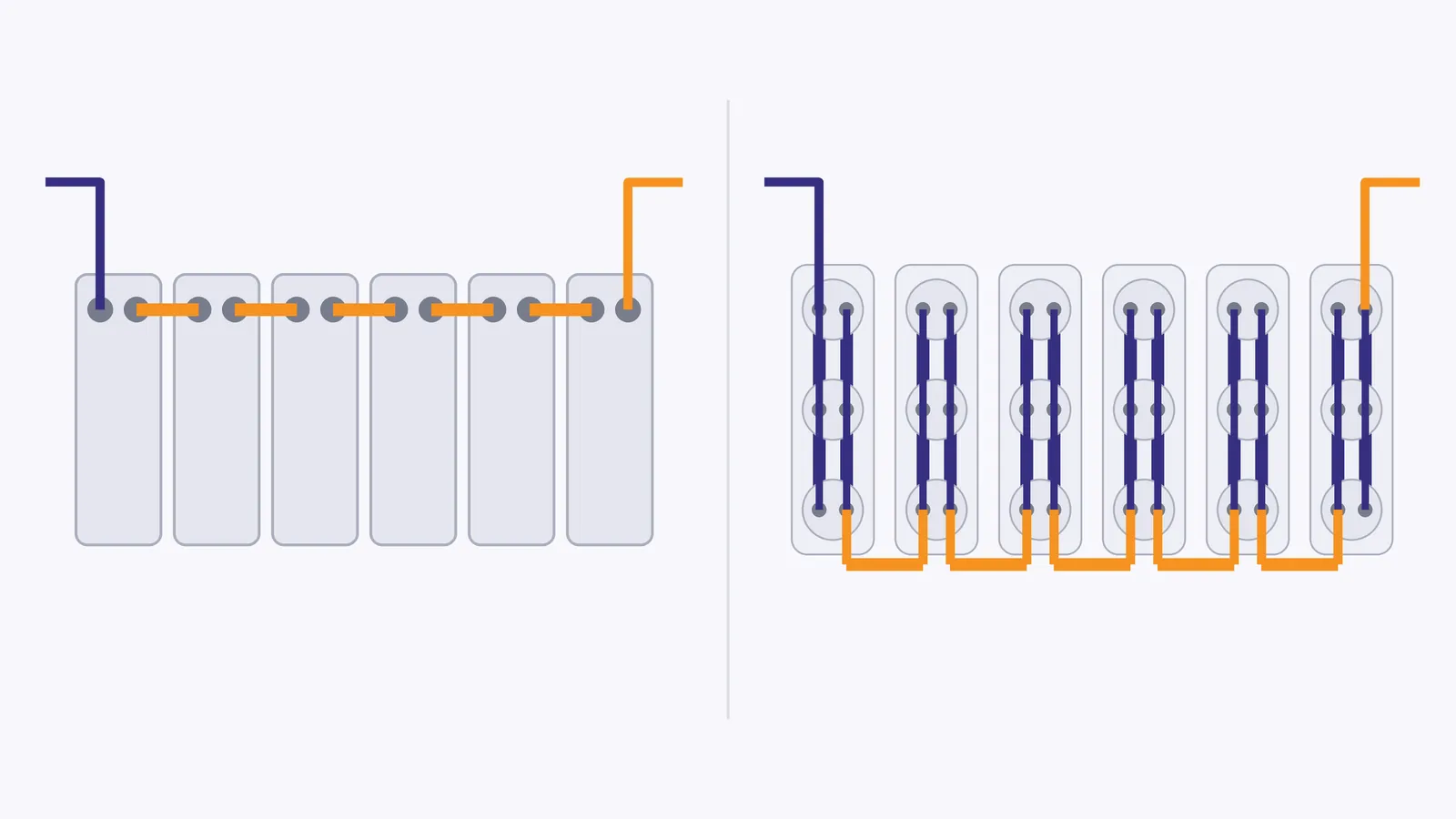
Cells in series add voltage, and cells in parallel add capacity. This example is made up for this guide: a 60V cargo three-wheeler whose controller accepts 45V to 72V, needing 5.5 kWh usable when the pack is old, with 8 kW peak and 3 kW continuous power.
We assume a 3.2V LFP cell with the limits quoted above, 80% capacity at end of life, an 80% usable window (the depth our own ratings use) and 0.5 mΩ cell resistance when aged. Every result is our calculation, following BatteryDesign.net's pack sizing method.
| Check | Working | Result |
|---|---|---|
| Series count | 60 ÷ 3.2 = 18.75, rounded up | 19 in series, 60.8V nominal |
| Voltage window | 19 × 3.65 and 19 × 2.5 | 69.35V to 47.5V, inside the controller's range |
| Rated energy needed | 5.5 kWh ÷ 0.8 ÷ 0.8 | 8.59 kWh |
| Capacity needed | 8,594 Wh ÷ 60.8V | 141 Ah |
| Cell options | One 150Ah cell, or three 50Ah in parallel | 19S1P (19 cells) or 19S3P (57 cells), both 9.12 kWh |
| Energy check when old | 9.12 × 0.8 × 0.8 | 5.84 kWh, above the 5.5 kWh target |
| Peak current | 8,000 W ÷ 47.5V | 168 A, or 1.12C |
| Continuous current | 3,000 W ÷ 60.8V | 49 A, or 0.33C |
| Heat in 19S1P | Current² × 0.5 mΩ × 19 cells | About 269 W at peak, 23 W continuous |
| First mass estimate | 19 × about 2.8 kg × 1.2 to 1.8 | About 64 to 96 kg |
The 2.8 kg scales the LF280K's 5.22 kg to 150Ah (our assumption). The multiplier for everything around the cells is a rule of thumb from BatteryDesign.net.
With NMC cells at an assumed 3.6V, 60 ÷ 3.6 rounds up to 17 in series, or 61.2V. BatteryDesign.net's 4.2V and 2.5V limits give 71.4V to 42.5V, so discharge would have to stop at the controller's 45V (our calculations).
In this example, peak current, heat and parallel cells need a second look:
- The peak fails a 1C limit. At 1.12C, this cell would need a published pulse rating to pass, or more capacity.
- Heat follows the square of the current. Peak heat is about 12 times the continuous figure, so how long the peak lasts matters. Charging at 1C (150 A) would produce about 214 W for about an hour (our calculation), which may decide the cooling on its own.
- Parallel cells bring their own problems. Small differences in resistance mean each cell carries a different current (BatteryDesign.net). In an MIT test at 4.5C, a 20% resistance mismatch cut lifetime by 40% (Gogoana et al., 2014). A Warwick model of 15 parallel cells found interconnection resistance had the largest effect on imbalance (Piombo et al., 2022).
Our custom-size cargo e-rickshaw packs are 60.8V 132Ah, and 60.8V is 19 × 3.2V. Our 80V 400Ah forklift packs hold 32 kWh, and 80V is 25 × 3.2V (our calculations, showing only the series count at 3.2V per cell).
BMS selection and calibration
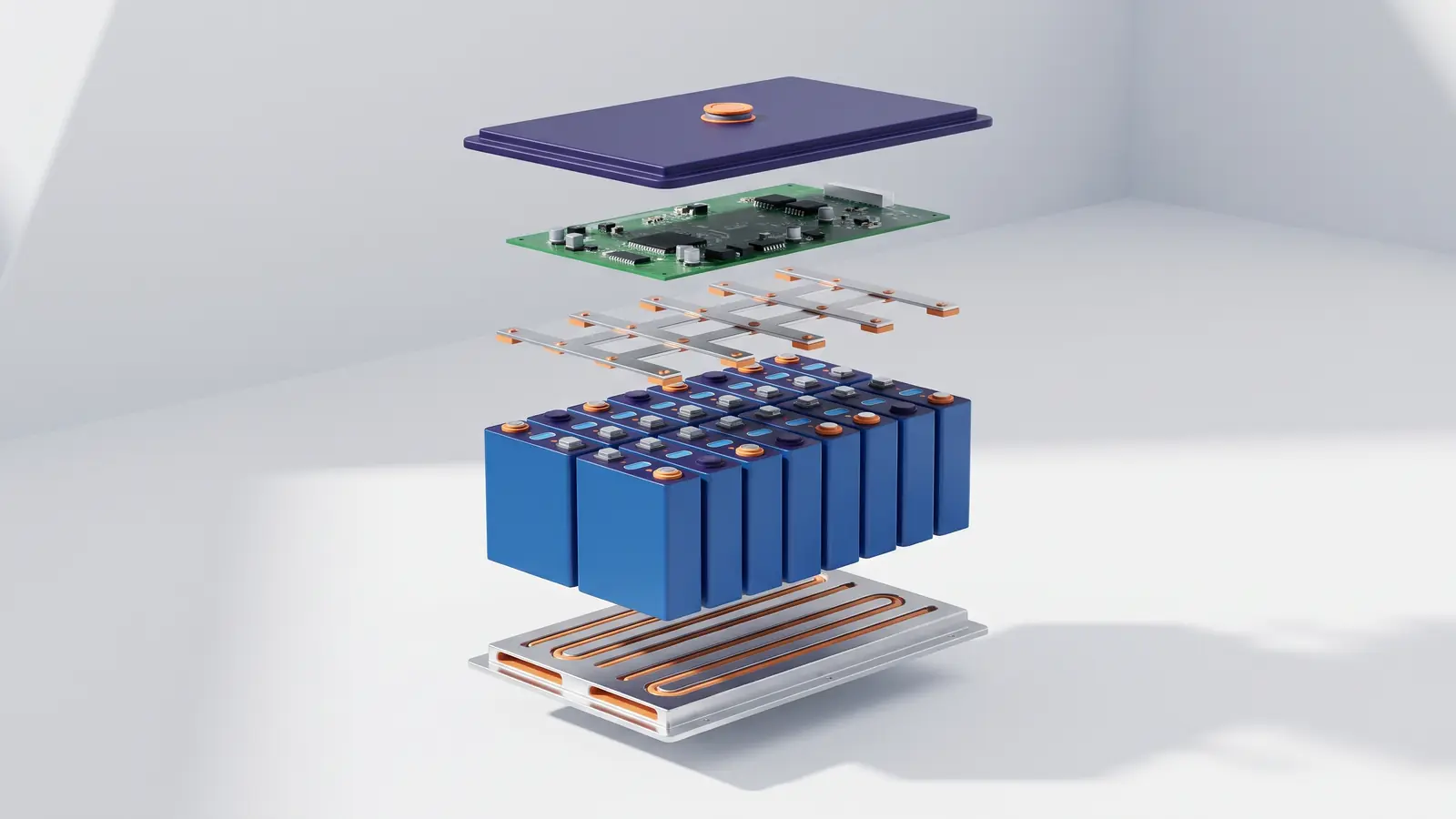
The battery management system (BMS) comes after the layout, because the layout sets its specification.
- Cells and current. It must support your series count, the cell's voltage limits, and both continuous and peak current (49 A and 168 A above).
- Sensing. BatteryDesign.net's rule of thumb is cell voltage accuracy of ±5 mV or better, and it notes that "the BMS can only protect what it can see" (BMS guide).
- State of charge. LFP's voltage curve is very flat from about 20 to 90% charge, which makes state of charge hard to estimate from voltage (Tang et al., 2020).
- Balancing. Passive balancing bleeds charge from high cells through a resistor. Active balancing moves charge between cells and is more complex (BU-803a). On our packs, balancing is passive as standard and active on some, including the cargo packs above.
- Communication. Agree how the pack talks to the vehicle, inverter and charger.
We choose a BMS matched to the cells, voltage and peak current, set its protection limits and calibrate it on our line.
Thermal design: passive, forced air and liquid cold plates
Cooling keeps cells within their limits and close to one another in temperature. NREL researchers found that module interconnects add significant heat, and that a 5 kWh pack showed large temperature differences caused by poor cooling arrangements (Saxon et al., 2024).
| Method | How it works | Trade-off |
|---|---|---|
| Passive | Thermal pads carry heat to an aluminium case | The rule of thumb is low power and ambient below 35 °C. Hotter sites need a gentle load and a check at the hottest ambient (our view) |
| Forced air | A fan moves air through or around the pack | An air path is harder to seal to a high IP rating (our view) |
| Liquid cold plate | Water-glycol runs through plates beside the cells | Leak risk, and pump energy to weigh against cooling gain |
The 35 °C rule of thumb and the leak risk come from BatteryDesign.net's cooling options. An Aalborg University study notes that pressure drop tracks pumping power, so flow trades against energy use (Madani et al., 2020). AIS-038 also requires coolant joints inside M and N category batteries to be leak proof.
We use passive designs for inverter, rack and most two-wheeler packs, and forced air or liquid cold plates for fast-charging fleets and commercial storage running at high C-rates through Indian summers.
Mechanical design and enclosure: IP54 to IP67
The enclosure has to fit the space, hold the cells, survive vibration and manage water and gas. Where the pack lives sets the IP rating, defined in IEC 60529. The terms below follow SCHURTER's IEC 60529 table and the standard's contents page:
| Rating | Dust | Water |
|---|---|---|
| IP54 | Dust protected | Splashing |
| IP65 | Dust tight | Jetting |
| IP67 | Dust tight | Temporary immersion, 0.15 m to 1 m |
For road vehicles in India, AIS-156 and AIS-038 Rev 2 require water ingress testing to IPX7 with the battery at 100% charge, with no fire or explosion. Both also require:
- A pressure release vent. BatteryDesign.net separates everyday pressure equalisation from emergency relief, and lists condensation control under sealing (enclosure guide).
- Cell spacing. The gap serves heat transfer and isolates a failed cell, and depends on cell type and capacity.
Our forklift packs needed a modified battery tray, and the cargo packs were built to the vehicle's battery space. Our design work uses 3D CAD, FEA for vibration and drop, and CFD for heat, and our enclosures are rated IP54 to IP67.
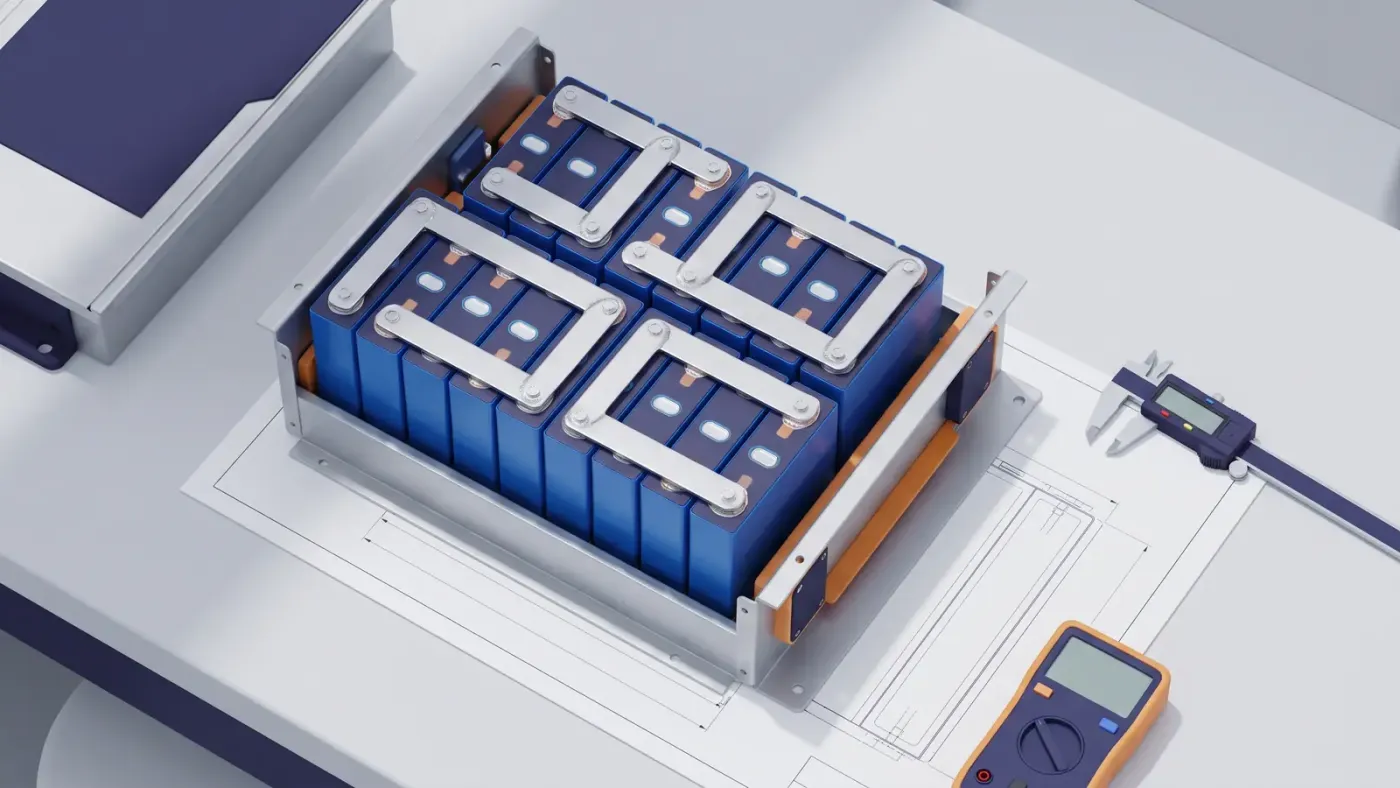
Battery pack assembly: laser welding and busbars
A January 2026 review of tab-to-busbar joining concludes that no single process is best for every pack (Choi et al., 2026). Laser welding is fast and precise, but spatter, pores and brittle mixed-metal layers need close control. Resistance welding is cost-effective but suffers from electrode wear. Ultrasonic welding limits porosity, with results that depend on thickness and tool wear.
The UK's AMRC reported laser-welded joints of 0.03 to 0.08 mΩ, with porosity, blowholes and cracking as defects to control (AMRC, 2025). At the example's 168 A peak, a 0.08 mΩ joint gives off about 2.3 W (our calculation), and a defective weld runs hotter.
For busbars, BatteryDesign.net's rule of thumb starts copper at 5 A/mm², with aluminium needing about 1.6 times the cross-section (busbar guide). The example's 49 A gives a first estimate of about 10 mm² of copper or 16 mm² of aluminium, and 150 A charging needs about 30 mm² or 48 mm² (our calculations). The same guide warns that resistance rises as bolted joints relax.
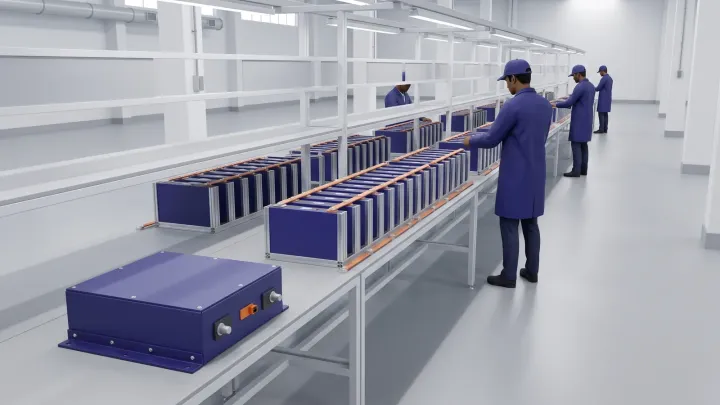
We laser-weld every cell to its busbar, record weld power and depth, and sample pull strength from every welding run. The trade-off is repair: a welded pack is harder to rework than a bolted one if you plan to replace single cells in the field (our view).
Prototype, validation, pilot and series production
Prototype. A working sample shows whether the design fits and runs. We take a design to a working prototype in 4 weeks, on the production line. Later stages depend on your test plan, standards and programme, so we commit to no fixed time for them.
Validation. Testing checks the design against the brief. General Motors' paper on the Chevrolet Volt pack splits validation into durability and environmental testing, electrical performance, and warranty lifecycle (Adams et al., 2011). We run cycle, abuse, vibration, thermal shock and IP testing in-house, and our packs are validated against thermal runaway propagation.
Pilot. Packs go into real work before anyone commits to a fleet. One cargo e-rickshaw project ran on 5 vehicles first and has since passed 100 packs with a repeat order. The forklift project started with 2 trucks, which put the pack, tray, display reading and charger into daily work before 38 more moved over. Minor faults came up and were fixed. Our minimum order is low enough for a pilot of this size.
Series production. Every pack has to repeat what passed validation. AIS-156 and AIS-038 require a traceability record for each pack and verification at type approval and conformity of production. At our Rajkot plant, prototypes and volume orders pass the same three test gates, and capacity is 500 MWh+ a year.
Battery certification: AIS-156, AIS-038, IEC 62133, IEC 62619, UN 38.3 and BIS
Which standards apply depends on the end use.
| Standard | Applies to | Design effect or scope |
|---|---|---|
| AIS-156 Amendment 3 | L-category electric vehicles in India: two-wheelers, three-wheelers, quadricycles (ARAI guide) | Adds at least 4 temperature sensors, an alarm at 60 °C and a thermal propagation test |
| AIS-038 Rev 2 Amendment 3 | M and N category electric vehicles in India | The traction battery rules below |
| IEC 62133-2 | Portable sealed lithium cells and batteries | Safe operation in intended use and foreseeable misuse |
| IEC 62619 | Telecom, UPS, energy storage, forklifts, AGVs, rail, marine; road vehicles excluded | Safety tests for industrial cells and batteries |
| UN 38.3 | Transport of lithium cells and batteries | Altitude, thermal, vibration, shock, external short circuit, crush or impact, overcharge and forced discharge tests |
| BIS IS 16046 (Part 2):2018 | Portable sealed lithium cells and batteries, listed with IEC 62133-2:2017 | Check with your lab whether it applies |
Both AIS amendments (AIS-156, AIS-038) also set these traction battery rules:
- Cells certified to IS 16893 Parts 2 and 3 by a NABL-accredited lab or notified agency, with at least one C/3 cycle on record
- A microcontroller-based BMS that meets AIS 004 Part 3 EMC requirements and is verified for charge, discharge, temperature, current and short-circuit protection
- Active paralleling, other circulating current mitigation, or fuses or bond wires for parallel cells
- A safety fuse or circuit breaker in addition to the BMS
- A charger with voltage cut-off, soft start, earth leakage detection and BMS communication
- At least one month of critical pack data logged
The AIS-156 thermal propagation test starts a thermal runaway in one cell and passes only with no evidence of fire or explosion. The pack also needs an audio-visual warning, which the text says must activate at least 5 minutes before thermal propagation such as fire or explosion (AIS-156). Telecom packs have their own requirements, covered in our telecom battery guide.
Our quality system is certified to ISO 9001. Our OEM packs hold IEC 62133, AIS-156 Phase II, UN 38.3 and BIS (IS 16046), and we share certificates with buyers on request. Phase II is the second stage of these AIS-156 rules, dated 31 March 2023 in the ARAI guide. We also support certification to IEC 62619. Ask your test agency, and any maker you use, whether an existing certificate covers your new design.
What are the common battery pack design mistakes?
- Sizing to a new pack. BatteryDesign.net calls ignoring ageing one of the most common and most expensive sizing errors, and warns against sizing to total energy instead of usable energy. Our cycle life guide covers what ageing does.
- Checking peak power with new-cell resistance. BatteryDesign.net says to use the end-of-life figure.
- Trusting 25 °C datasheet capacity. BatteryDesign.net's rule of thumb is 10 to 30% lower in real conditions; we found no peer-reviewed figure. EVE's specification shows the pattern: at least 97% of rated capacity at 1C, and 70% at -20 °C, a test that alone uses a 2.0V cut-off in place of 2.5V.
- Mismatched cells. Battery University calls mismatch "a common cause of failure in industrial batteries" and suggests ±2.5% capacity tolerance.
- Changing the design after testing. The US regulator PHMSA says any change that would lead to a failed UN 38.3 test makes a new type (PHMSA guide). Freeze cells, BMS and layout before formal testing where you can.
How we work on custom lithium battery packs
We publish this guide and we build these packs, so compare our answers with other makers'. Our list of lithium battery manufacturers in India can help with a shortlist. We work in three ways:
- Build to print. You bring drawings, specifications and a test plan, and we manufacture to your design.
- Co-development. You bring your product, duty cycle and targets, and we share the engineering from concept to series production.
- Private label. You bring your brand, enclosure colour and packaging, and we build an existing Halovolt pack under it.
Send your brief through our OEM quote form.
What we could not confirm
- We read the public scope pages for IEC 60529, IEC 62133-2 and IEC 62619, not the paid standards, so the IP table gives no test durations.
- The AIS texts here are the September 2022 amendments. Check with your test agency whether later notifications changed them.
- For PHMSA's guide and UN Manual section 38.3 (an older revision), we read only an extract.
- We could not find the LF280K specification on EVE's own site, so the link is a copy hosted on a forum.
- We found no authoritative statement on whether BIS compulsory registration covers traction or industrial packs.
Sources
- BatteryDesign.net, Battery pack sizing (undated, read 4 November 2026)
- BatteryDesign.net, Cells in parallel (updated October 2026)
- BatteryDesign.net, Battery management system (read 4 November 2026)
- BatteryDesign.net, Battery cooling options (first published 20 June 2022)
- BatteryDesign.net, Pack enclosure (undated, read 4 November 2026)
- BatteryDesign.net, Busbars (undated, read 4 November 2026)
- IEA, Global EV Outlook 2025: electric vehicle batteries, 2025
- Preger et al., "Degradation of commercial lithium-ion cells as a function of chemistry and cycling conditions", Journal of The Electrochemical Society 167, 120532, 2020
- Battery University, BU-301a: Types of battery cells, updated 24 April 2019
- Battery University, BU-803a: Cell matching and balancing, updated 2 November 2021
- EVE Energy, LF280K product specification, version A, effective 16 January 2021 (copy hosted on a forum)
- Gogoana et al., "Internal resistance matching for parallel-connected lithium-ion cells and impacts on battery pack cycle life", Journal of Power Sources 252, 2014
- Piombo, Marco and Boyd, "Analysis of parallel connected lithium-ion cells imbalanced performance based on electrothermal modelling environment", IEEE VPPC, published 10 February 2022
- Tang et al., "Run-to-run control for active balancing of lithium iron phosphate battery packs", IEEE Transactions on Power Electronics 35(2), 2020
- Saxon et al. (NREL), "Li-ion battery thermal characterization for thermal management design", Batteries 10(4), 2024
- Madani, Schaltz and Kær, "Thermal analysis of cold plate with different configurations for thermal management of a lithium-ion battery", Batteries 6(1), 2020
- IEC Webstore, IEC 60529:1989+AMD1:1999+AMD2:2013, degrees of protection provided by enclosures (IP Code)
- SCHURTER, IP protection: IEC 60529, EN 60529 and DIN 40050, read 4 November 2026
- IEC 60529, edition 2.1, 2001, preview with contents page (VDE Verlag)
- Choi et al., "Tab-to-busbar interconnections in EV battery packs: an introductory review of typical welding methods", Micromachines 17(1), January 2026
- AMRC, Laser welding holds firm for electric vehicle battery joins, 25 March 2025
- Adams, Schlaupitz and Lucarelli (General Motors), "Approach to validation plan development for advanced battery systems in vehicle applications", SAE 2011-01-1366, 12 April 2011
- Amendment 3 to AIS-156, September 2022 (hosted by ACMA)
- Amendment 3 to AIS-038 Rev 2, September 2022 (hosted by ACMA)
- EVreporter, Guide to battery safety standards in India, compiled by ARAI, updated 28 September 2022
- IEC Webstore, IEC 62133-2:2017+AMD1:2021
- SIS, listing for IEC 62619:2022, approved 24 May 2022
- BIS, listing for IS 16046 (Part 2):2018, read 4 November 2026
- UNECE, UN Manual of Tests and Criteria, Rev. 5, section 38.3 (extract only)
- PHMSA, Lithium battery guide for shippers, file dated July 2023 (extract only)
Frequently asked questions
How do you calculate the series and parallel cells in a battery pack?
Divide the target voltage by the cell's nominal voltage to get the series count, then divide the rated energy you need by the pack voltage to get the capacity, and meet that capacity with one large cell or several in parallel. For a 60V pack with 3.2V LFP cells, 60 ÷ 3.2 rounds up to 19 cells, or 60.8V. Size the energy for end of life, then check that peak current stays within the cell's limit.
Should a custom battery pack use LFP or NMC cells?
It depends on whether weight and space or cost and cycle life matter more. The IEA's Global EV Outlook 2025 put LFP's pack energy density about one-fifth lower by mass and one-third lower by volume than NMC, and its packs almost 30% cheaper per kWh, on global 2024 EV data. LFP cells usually last more cycles. NMC suits packs where weight and space are tight. Halovolt designs and manufactures both.
Which certifications does a custom lithium battery pack need in India?
It depends on the end use. AIS-156 covers L-category electric vehicles and AIS-038 Rev 2 covers M and N categories. IEC 62619 covers industrial uses such as telecom, UPS, energy storage and forklifts, and excludes road vehicles. IEC 62133-2 and its Indian listing, IS 16046 (Part 2), cover portable sealed batteries. UN 38.3 covers transport. Confirm the current texts and what applies to your product with a test agency before design freeze.
How long does it take to design a custom battery pack?
Halovolt takes a pack from design to a working prototype in 4 weeks. Validation, pilot and certification follow, and their length depends on your test plan, target standards and vehicle programme, so Halovolt does not quote a fixed time for them. We found no reliable public figure for how long these later stages take in India.
What is the minimum order for a custom lithium battery pack?
It varies by maker, so ask each supplier. Halovolt offers a low minimum order and does not publish one fixed number. One of its cargo e-rickshaw projects started with a 5-vehicle pilot, and a forklift project started with 2 trucks before 38 more moved over. Pilots of this size test the fit and charging routine before a larger order.