
India has only a few lithium-ion cell plants commissioned, so we infer from the dated figures below that most companies called lithium battery manufacturers in India assemble packs from cells they buy. This list separates cell makers from pack makers and gives each company's product, plant, stated capacity and status, dated to the source. Halovolt Systems publishes this article and is one of the pack makers on the list.
Key Takeaways
- Mercom reported on 24 September 2026 that Exide Energy Solutions had commissioned the 6 GWh first phase of its cell plant. Reliance (40 GWh first phase) and Agratas (20 GWh, production targeted for 2027) are still building.
- Under the ACC PLI scheme, 40 GWh of the 50 GWh target was awarded, and only 1 GWh had been commissioned by March 2026, according to the Ministry of Heavy Industries.
- China is the main source of India's lithium-ion battery imports: 83.6% in FY2025-26 by one estimate.
- A "capacity" figure can mean cells or packs, and a plant that is commissioned or one that is only planned. Ask which before you compare makers.
- Check a maker's BIS registration under IS 16046-2, test reports that match your use, and its EPR registration with CPCB.
Lithium cell manufacturers vs battery pack manufacturers
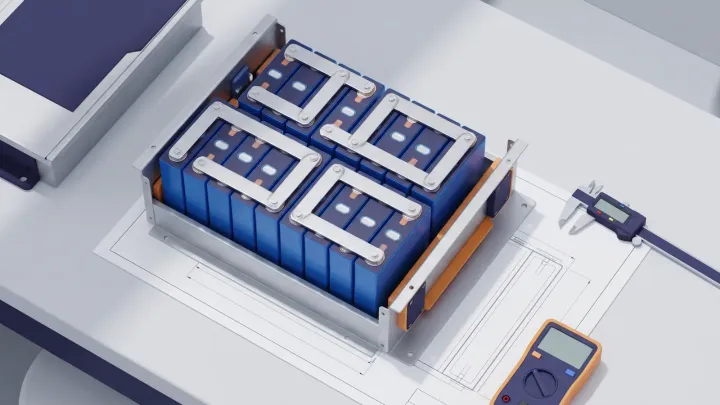
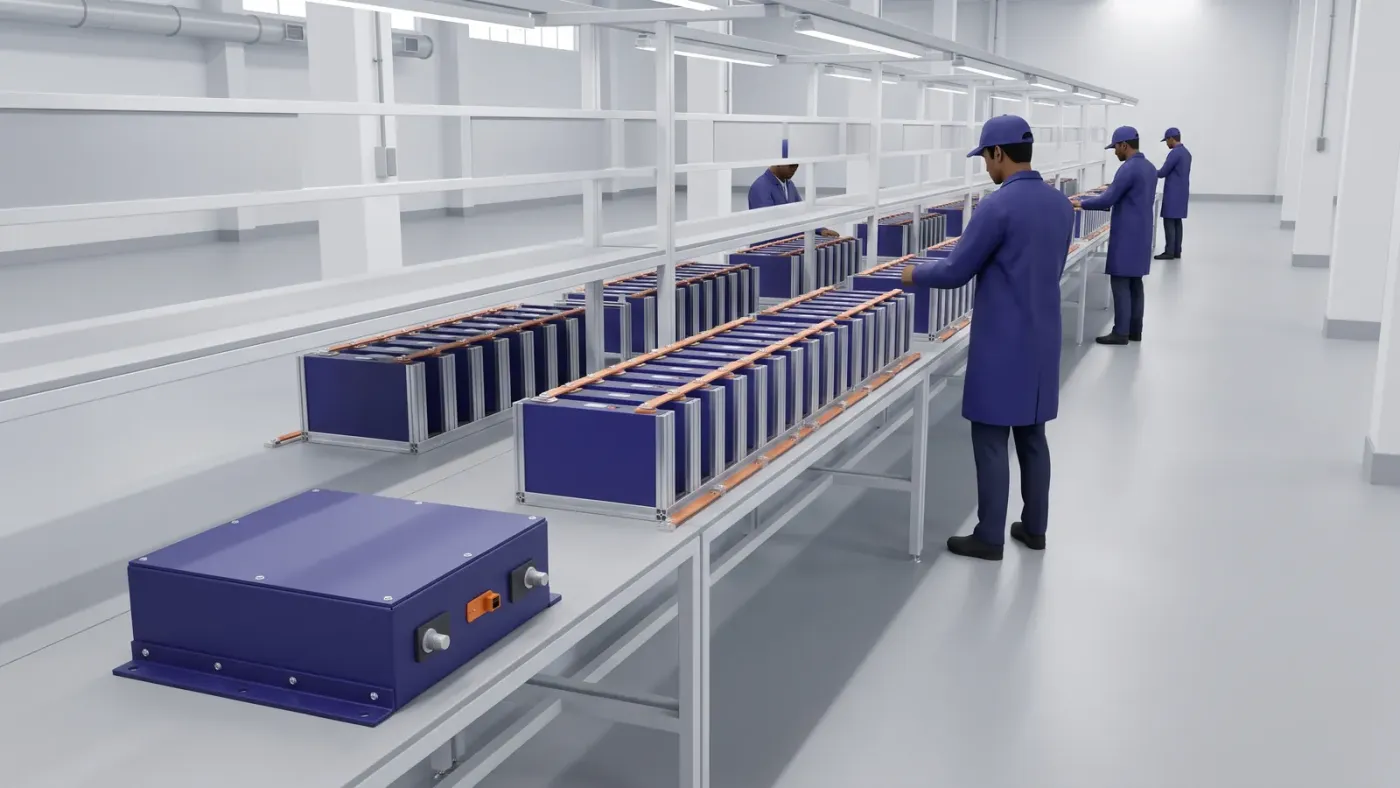
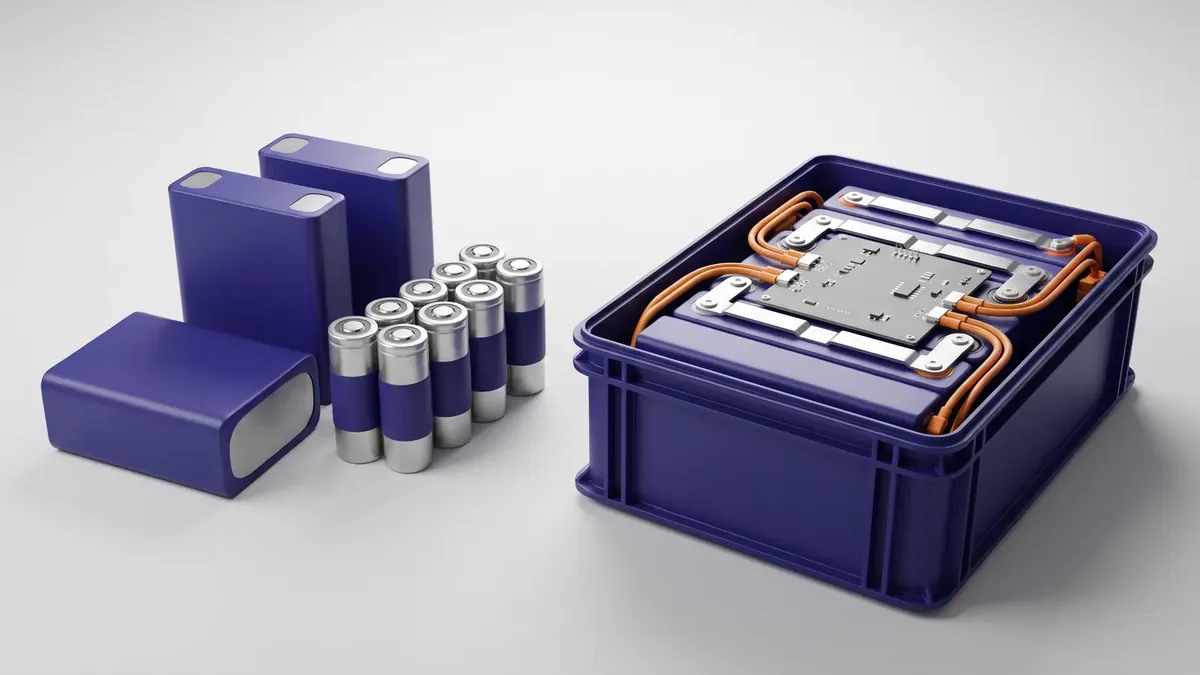
A cell maker produces the electrochemical cell itself: the electrodes, separator and electrolyte sealed in a can or pouch. A pack maker buys cells, then grades them, joins them into modules, adds a battery management system (BMS), fits the enclosure and tests the finished battery. Both are called lithium battery manufacturers, so the word alone does not tell you which one a company is.
When you buy, you need facts about both. The cells set the chemistry, cycle life and most of the safety margin. The pack maker decides how well those cells are matched, protected, cooled and tested. For how we, the publisher, build LFP and NMC packs, see how Halovolt builds a lithium battery pack.
Why we say most pack makers buy their cells
In our sources, only three companies had commissioned lithium-ion cell capacity in India by October 2026: Exide Energy Solutions (6 GWh Phase I), Ola Cell Technologies (1 GWh, as counted by the Ministry of Heavy Industries in March 2026) and Amara Raja (a 60 MWh qualification line). Most of the lithium-ion batteries India imports come from China (83.6% in FY2025-26 by one estimate), as the imports section below shows. From those facts we infer that most pack makers buy their cells. No source we read counts this directly, so treat it as our inference.
How the companies were chosen and ordered
We started from two published lists of Indian lithium battery makers that we could read in full, dated March 2025 and December 2022, and from the awardees of the government's ACC PLI scheme. We then added makers named in recent trade reports. We kept a company only if we read a dated source on its plant, capacity or certification. Each fact comes from the company's own site or release, or from trade or news reports.
Several names on those lists are not here. We did not research Okaya, Luminous, HBL or Loom Solar for this edition, and we could not verify a source for Log9. Leaving a company out says nothing about its products.
The companies are in alphabetical order within each group. The order is not a ranking. Capacity figures are the companies' own or as reported, and none is independently audited. Halovolt is a pack maker and is listed in that group, using the same fields as the others, with facts taken only from its own website.
Each entry's status uses one of these labels, based on the newest source we read:
- Operating: the company or a dated report describes current production.
- Commissioned: a source says the plant or phase was commissioned or inaugurated. We did not confirm commercial output.
- Under construction: the company or a report says building is under way.
- Awarded, not commissioned: capacity awarded under the ACC PLI scheme and not commissioned by the latest figure.
- Planned: announced, with no construction reported in our source.
- Older report: our newest source is from 2023 or 2024, so the current status is unknown.
Lithium-ion cell manufacturers in India
These companies make lithium-ion cells in India, or are building plants to make them. Several also make packs.
ACC Energy Storage (Rajesh Exports)
- Makes: advanced chemistry cells (ACC), under the government's ACC PLI scheme.
- Plant: not named in the source we read.
- Stated capacity: 5 GWh awarded under the scheme.
- Status: awarded, not commissioned. In March 2026 the Ministry of Heavy Industries (MHI) told Parliament that land had been acquired for all 40 GWh awarded and that only Ola's 1 GWh had been commissioned (pv magazine India, 25 March 2026).
Agratas (Tata group)
- Makes: lithium-ion cells for electric vehicles and energy storage.
- Plant: Sanand, Gujarat.
- Stated capacity: 20 GWh in the first phase.
- Status: under construction. Agratas said the steel frame was complete and production is targeted for 2027 (Agratas, 2 April 2026).
Amara Raja Energy & Mobility
- Makes: lithium-ion packs for EV makers and stationary storage, and cylindrical and prismatic cells for customers to validate.
- Plant: Giga Corridor, Divitipalli, Mahabubnagar, Telangana.
- Stated capacity: a 1.5 GWh pack plant and a 60 MWh Cell Customer Qualification Plant. The corridor plan is 16 GWh of cells and 5 GWh of packs.
- Status: pack plant commissioned (inaugurated August 2024, per an Amara Raja press release, 10 August 2024). Cell qualification plant commissioned in July 2026, at a cost of about ₹500 crore (Telangana Today, 15 July 2026). Full-scale cell plant planned, with ₹9,500 crore to be invested through 2031.
Exide Energy Solutions (Exide Industries)
- Makes: lithium-ion cells in multiple chemistries and form factors.
- Plant: Devanahalli, Bengaluru.
- Stated capacity: 6 GWh in Phase I.
- Status: commissioned. Mercom reported on 24 September 2026 that Phase I had been commissioned, and that Exide Industries' cumulative investment in the subsidiary is ₹4,902 crore (Mercom India). We found no confirmation that commercial production has started.
GODI India
- Makes: lithium-ion cells. Its LFP cells were certified to IS 16046-2:2018 and IEC 62133-2:2017, with BIS certification.
- Plant: Hyderabad.
- Stated capacity: none stated. The company said it plans "giga-scale" NMC and LFP production.
- Status: older report. Our newest source is from January 2024 (Mobility Outlook, 17 January 2024).
Ola Cell Technologies (Ola Electric)
- Makes: 4680-format NMC cells, which Ola calls "Bharat" cells. They were in 3 of Ola's roughly 9 to 10 vehicle models (SKUs) in August 2026, and Ola's 46100 LFP cell is BIS-certified (Inc42, 10 August 2026).
- Plant: Ola's cell gigafactory. The pages we read did not confirm its location.
- Stated capacity: 1 GWh initially, expandable to 20 GWh, on Ola's gigafactory page (undated). Ola holds a 20 GWh award under the ACC PLI scheme.
- Status: commissioned. MHI counted Ola's 1 GWh as commissioned in March 2026. Inc42 reported that cell production paused in Q1 FY27 (April to June 2026) to expand capacity from 2.5 GWh to 6 GWh, with 6 GWh due by September 2026. We found no confirmation that the expansion is complete. The figures differ by source and date.
Reliance New Energy (Reliance Industries)
- Makes: LFP cells and battery energy storage systems (BESS).
- Plant: Dhirubhai Ambani Green Energy Giga Complex, Jamnagar, Gujarat.
- Stated capacity: 40 GWh in phase 1, and a target of 120 GWh a year. Reliance holds 15 GWh of ACC PLI awards, in two awards of 5 GWh and 10 GWh.
- Status: under construction (company statement). Reliance said phase 1 was "on track for commissioning this year", with all equipment on site (ESS News, 22 June 2026). We found no confirmation that it has been commissioned.
TDSG (Suzuki, Toshiba and Denso joint venture)
- Makes: lithium-ion batteries. It has started local production of electrodes for hybrid vehicle batteries, with cells to follow.
- Plant: Gujarat.
- Stated capacity: no figure in the source we read.
- Status: operating for electrodes, which went into production in August 2025. Cell production was still to follow at the time of the source (New India Samachar, PIB, September 2025).
Lithium battery pack and system manufacturers in India
These companies build battery packs or storage systems from cells. One of them, Waaree, also plans a cell plant.
Battrixx (Kabra Extrusiontechnik)
- Makes: lithium-ion packs for e-mobility. In 2024 it announced BESS production using EVE Power cells.
- Plant: not named in the source we read.
- Stated capacity: 2 GWh.
- Status: older report. Our newest source is from May 2024 (pv magazine India, 30 May 2024).
Halovolt Systems (publisher of this article)
- Makes: LFP and NMC lithium battery packs, from inverter and solar batteries to EV and commercial storage packs. It does not make cells. Its site says it uses A-grade cells from makers such as EVE, Highstar, Gotion and Highpower.
- Plant: Avadh Industrial Park - B, Khambha, Lodhika, Rajkot, Gujarat.
- Stated capacity: 500 MWh+ (0.5 GWh+) of packs a year, on an eight-station line.
- Status: operating (company website), per the page on our work as a lithium battery manufacturer in Rajkot, read 1 November 2026. Halovolt's quality system is certified to ISO 9001. The OEM packs it builds hold IEC 62133, AIS-156 Phase II, UN 38.3 and BIS (IS 16046), and the Gati EV batteries in its shop hold AIS-156 Phase II.
iPower
- Makes: NMC and LFP packs for electric two-wheelers and three-wheelers.
- Plant: Kundli, Haryana.
- Stated capacity: no figure found.
- Status: older report. Our newest source is from April 2023, when it cleared the AIS-156 Amendment 3 Phase 2 requirement (EVreporter, 4 April 2023).
Trontek
- Makes: e-rickshaw and EV battery packs, and BESS from 215 kWh to 5 MWh.
- Plant: not named in the source we read.
- Stated capacity: no figure for current pack output. For BESS, a target of 12 GWh a year by 2028, starting with 3 GWh.
- Status: operating for packs and BESS products, as described in the report. The 12 GWh BESS capacity is a target (pv magazine India, 12 October 2026).
Waaree Energy Storage Solutions (Waaree Energies)
- Makes: BESS containers now. Packs and cells are planned.
- Plant: the source does not give the container plant's location. A 16 GWh integrated plant is planned at Rambilli, Anakapalli, Andhra Pradesh.
- Stated capacity: a 5.15 GWh container plant, a 5.15 GWh pack plant due in FY27 (by March 2027) and a 3.5 GWh cell plant with no date. The roadmap is 20 GWh by FY28.
- Status: container plant commissioned in July 2026; pack and cell plants planned (Mercom India, 16 July 2026).
India's lithium-ion battery imports and the ACC PLI scheme
India still depends on imports for lithium-ion batteries, and most come from China. China supplied 83.6% of India's lithium-ion battery imports in FY2025-26, according to a Koan Advisory and Institute of Chinese Studies report (Outlook Business, 12 September 2026). An earlier estimate by CEEW put China's share at "more than 85 percent" (ORF, 25 August 2025). Both figures cover lithium-ion batteries in general, so they do not show the share for cells alone.
The government's answer is the Production Linked Incentive (PLI) scheme for Advanced Chemistry Cell (ACC) battery storage. It was approved in May 2021 with ₹18,100 crore for 50 GWh of cell capacity. MHI's March 2026 statement to Parliament gave this progress (pv magazine India, 25 March 2026):
| ACC PLI scheme | Figure |
|---|---|
| Target (approved May 2021) | 50 GWh, ₹18,100 crore |
| Awarded, with land acquired | 40 GWh |
| Commissioned by March 2026 | 1 GWh (Ola Cell Technologies) |
The awards are shown in the cell makers' entries above. Exide Energy Solutions is not an awardee, so its Phase I plant falls outside these figures. March 2026 is the newest commissioned figure for the scheme that we could read in full.
Lithium battery rules in India: BIS, AIS-156 and EPR
A lithium battery maker in India may need to meet three sets of rules, depending on the product. It should be able to show you the paperwork for each one that applies.
BIS registration under IS 16046-2
IS 16046-2:2018 covers lithium cells and batteries under BIS's Compulsory Registration Scheme (CRS). Goods covered must be registered with BIS and carry the Standard Mark and registration number before they are made for sale, imported, sold or distributed, according to Nemko, a BIS-recognised test lab. We did not read the BIS notification itself for this edition, so check the current CRS product list before you buy.
AIS-156 for EV batteries
AIS-156 sets battery safety requirements for L-category vehicles: electric two-wheelers, three-wheelers and quadricycles. Its 2022 amendment added an IPX7 water test and a thermal propagation test. Phase 1 took effect on 1 December 2022 and Phase 2 on 31 March 2023 (EVreporter, from ARAI, updated 28 September 2022).
EPR under the Battery Waste Management Rules 2022
The Battery Waste Management Rules 2022 cover all battery types. Producers must register with the Central Pollution Control Board (CPCB) and meet extended producer responsibility (EPR) targets for collection and recycling. EV and portable batteries must reach 90% material recovery by 2026-27. EV batteries need at least 5% recycled content from 2027-28, rising to 20% by 2030-31. Batteries may not be sent to landfill or burned (IEA policy database, updated November 2025).
Telecom batteries have a further type-approval standard from TEC, covered in our guide to lithium batteries for telecom towers.
How to choose a lithium battery manufacturer
Ask every maker on your shortlist for the same documents, so you compare like with like. This checklist works whether the maker builds cells, packs or both.
BIS registration number. Ask for the CRS registration number under IS 16046-2 for both the cell and the battery, and check that it matches the model you are buying.
Cell maker and grade. Ask which company made the cells, for the cell datasheet, and how each incoming cell lot is tested.
Test reports that match the use. The report should be for the same model and the same job:
- IEC 62619 for industrial use, such as UPS, telecom, solar storage and forklifts.
- IEC 62133-2 for portable lithium batteries.
- AIS-156 Phase 2 for electric two-wheelers, three-wheelers and quadricycles.
- UN 38.3 for transport, when the battery is shipped.
EPR registration. Ask for the maker's or importer's CPCB registration under the Battery Waste Management Rules 2022.
Warranty terms (practical tip). Get the years, the cycle count at a stated depth of discharge, the end-of-life point (for example 80% of rated capacity) and whether a failed battery is replaced or repaired. Ask for these in writing.
BMS and communications. Ask what the BMS protects against, how it balances cells, whether it logs faults, and which protocol it uses (CAN or RS485) to talk to your inverter or vehicle controller.
After-sales support (practical tip). Ask who you call when something goes wrong, how fast they respond, and whether there is service in your city. A factory visit shows you the line and the test equipment before you place a large order.
What the capacity figure means. Check whether a stated GWh or MWh figure is cells or packs, and whether the plant is commissioned or only announced. Ask for the date of the figure.
Points 5 and 7 are our practical advice. We found no rule that sets them, and they decide what happens if a battery fails.
Sources
- Mercom India, "Exide commissions Phase I of 6 GWh lithium-ion cell plant", 24 September 2026
- Amara Raja, press release on the battery pack assembly plant and Customer Qualification Plant at its Giga Corridor, 10 August 2024
- Telangana Today, "Amara Raja commissions battery cell plant in Telangana", 15 July 2026
- Ola Electric, Gigafactory page (undated)
- Inc42, "Ola Electric's comeback quarter comes with a caveat", 10 August 2026
- Agratas, "Agratas crosses key construction milestone at Sanand facility", 2 April 2026
- ESS News, "Reliance Industries targets 120 GWh of annual battery manufacturing capacity", 22 June 2026
- pv magazine India, "Land acquisition completed for 40 GWh capacity awarded under PLI ACC scheme", 25 March 2026
- New India Samachar (Press Information Bureau), September 2025 issue, page 35
- Mobility Outlook, "GODI India gets LFP BIS certification for indigenous Li-ion cells", 17 January 2024
- pv magazine India, "Battrixx to use EVE Power's battery cells for energy storage production", 30 May 2024
- Halovolt, Manufacturing page, read 1 November 2026
- Halovolt, Technology page, read 1 November 2026
- EVreporter, "iPower clears AIS-156 Amendment 3 Phase 2 requirement", 4 April 2023
- pv magazine India, "Trontek targets 12 GWh annual BESS manufacturing capacity by 2028", 12 October 2026
- Mercom India, "Waaree commissions 5.15 GWh battery storage container manufacturing plant", 16 July 2026
- Outlook Business, "India's electronics push is growing, but so is its dependence on Chinese components" (reporting a Koan Advisory and Institute of Chinese Studies report), 12 September 2026
- Observer Research Foundation, "India's EV sector and the China challenge" (citing CEEW), 25 August 2025
- Nemko, BIS Compulsory Registration Scheme (undated)
- EVreporter, "Battery safety standards in India by ARAI", updated 28 September 2022
- International Energy Agency, Battery Waste Management Rules 2022, policy database entry, updated November 2025
- IEC Webstore, IEC 62619
- IEC Webstore, IEC 62133-2:2017, with Amendment 1 (2021)
Company statuses can change quickly, so check the newest report before you sign an order.
Frequently asked questions
Does India make lithium-ion cells?
Yes, at a small scale so far. Exide Energy Solutions, Ola Cell Technologies and Amara Raja have commissioned cell capacity in our sources, as their entries above show. Larger plants from Reliance and Agratas are under construction.
Which is the largest lithium battery manufacturer in India?
We found no neutral source that ranks Indian makers by actual output. In our sources, the highest commissioned cell figure is Exide's 6 GWh Phase I. The highest announced figure is Reliance's 40 GWh phase 1, with a 120 GWh target, but we found no confirmation that phase 1 has been commissioned.
Is BIS certification mandatory for lithium batteries in India?
Yes, for products covered by IS 16046-2 under BIS's Compulsory Registration Scheme, according to Nemko, a BIS-recognised lab. EV batteries for two-wheelers, three-wheelers and quadricycles must also meet AIS-156.
Where does India import lithium-ion batteries from?
Mostly China, at 83.6% of imports in FY2025-26 by one estimate and more than 85% by an earlier CEEW estimate. Both cover batteries in general, not cells alone.
Which companies make lithium batteries for e-rickshaws in India?
In this list, Trontek makes e-rickshaw packs. iPower makes packs for electric three-wheelers and cleared AIS-156 Phase 2 in April 2023. Halovolt sells Gati e-rickshaw batteries certified to AIS-156 Phase II. Whichever maker you choose, ask for the battery's current AIS-156 certificate and BIS registration.