
Key Takeaways
- TEC 67030:2024 is the type-approval standard for lithium-ion telecom batteries in India. A 2026 draft revision was open for comment until 6 October 2026, and no lithium-ion GR is on TEC's gazette-notified list yet.
- VRLA float life roughly halves for every 8–10 °C above 25 °C, per manufacturer guidance, and C&D Technologies notes that telecom sites peak around 40 °C in summer.
- A 15-cell LFP pack charges to 54.0 V, but its low end sits on the 40.5 V equipment floor. A 16-cell pack needs its charge held at 56.8 V or lower to stay under 57 V.
- TEC says telecom lithium batteries are normally not discharged beyond 80% of rated capacity. Size from that, add margins, then add one spare parallel group (N+1).
- Lithium batteries are stolen from towers too. TEC's guideline describes a software lock, and the 2026 draft lists movement alarms and GPS as purchaser options, so write the ones you want into the order.
Why telecom tower backup in India is moving from VRLA to lithium
India keeps adding towers, and every one needs backup. These are the Department of Telecommunications (DoT) counts.
| Date | Mobile towers | Source |
|---|---|---|
| 30 Dec 2023 | 786,590 | DoT, via Indian Infrastructure |
| 30 Dec 2024 | 816,763 | DoT, via Indian Infrastructure |
| 31 Oct 2025 | 8.43 lakh (843,000) | DoT year-end review, via Communications Today |
The same review counted 31.44 lakh mobile base stations (BTS) on 31 October 2025.
Grid supply has improved. Average rural supply rose from 12.5 hours a day in 2014 to 22.6 hours in 2025, and urban supply stands at 23.4 hours, according to the Power Minister (PTI via The Week, June 2025). Batteries still cycle often. TEC's 2016 lithium-ion GR (TEC standards list) and the 2026 draft (TEC consultations) both expect 4–5 cycles to 80% depth of discharge (DoD) a month in metros, and more in semi-urban and rural areas.
Diesel adds pressure. An industry estimate puts 75–80% of towers as relying "directly or indirectly" on diesel generators, with tower loads from 1 kW to 8.5 kW (tele.net, November 2024). The draft National Telecom Policy 2025 targets 30% of towers on renewable energy by 2030 (Voice&Data, July 2025). Moving sites off diesel puts more of the backup job on the battery.
High temperatures shorten VRLA life. Its float life roughly halves for every 8–10 °C above 25 °C, per manufacturer guidance from EnerSys and C&D Technologies. C&D notes that telecom sites peak around 40 °C in summer and that conventional VRLA lasts 2–5 years outdoors.
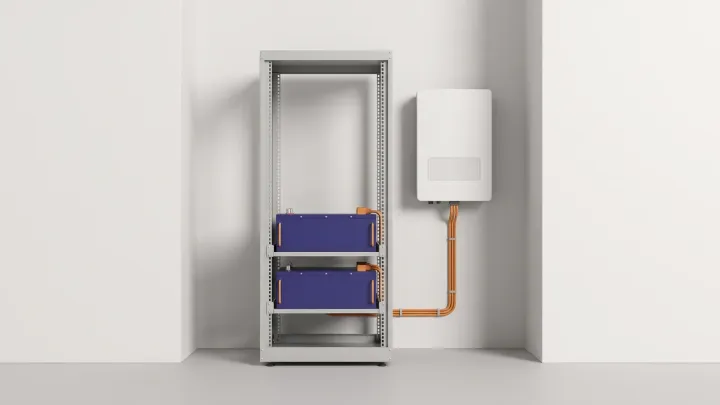
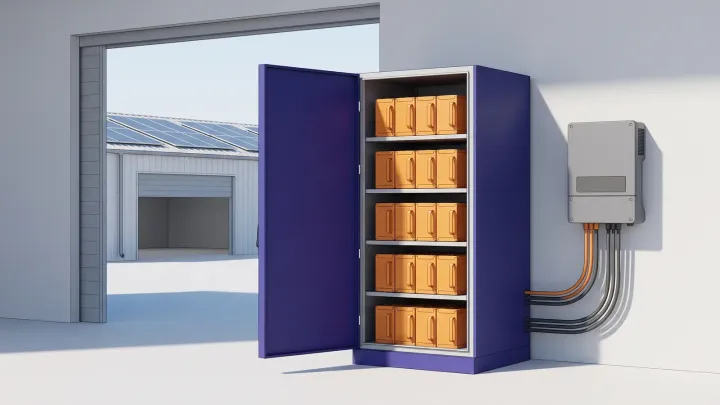
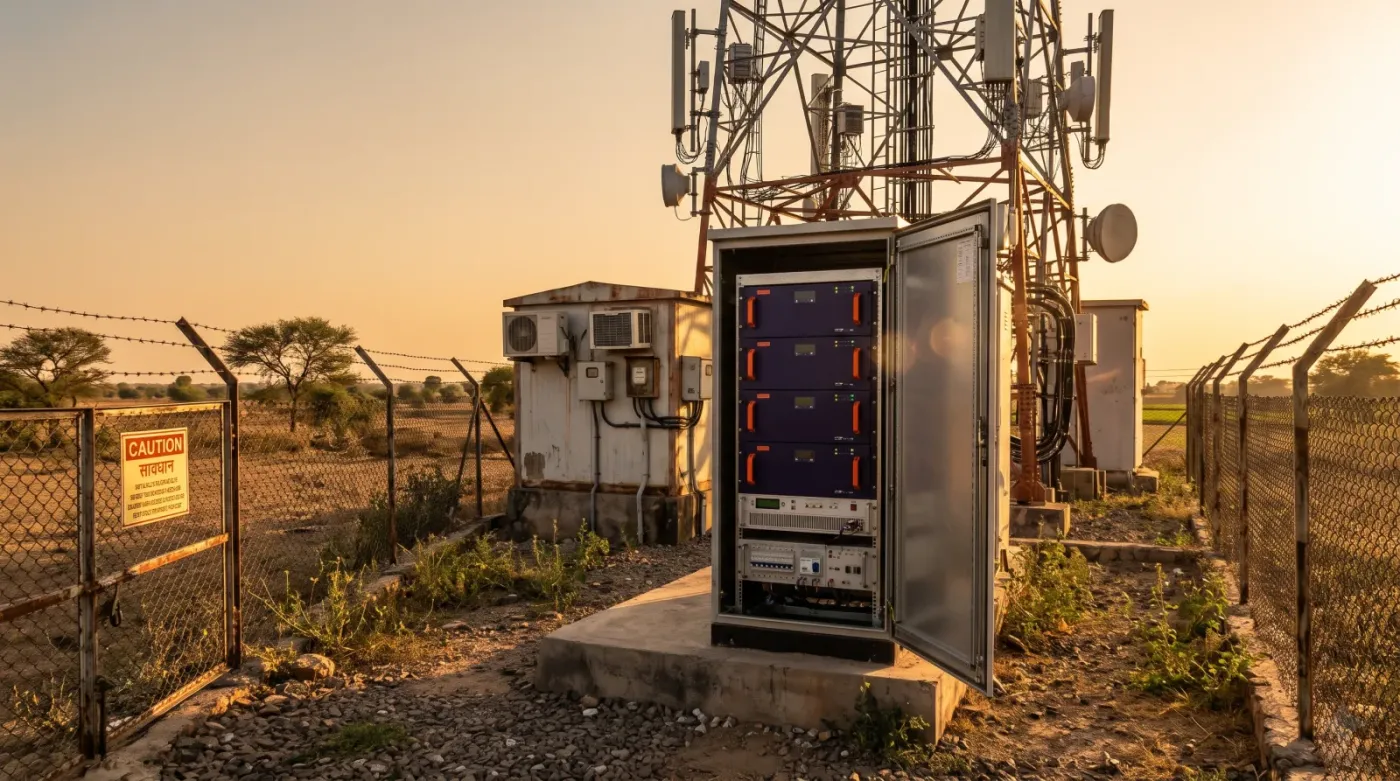
BSNL is buying lithium at scale. One BSNL tender covered 25,000 lithium-ion modules of 100 Ah and 48 V, housed in 2,500 IP55 racks of eight modules each (pv magazine India, January 2026). We found no public figure for the share of Indian sites that has switched so far.

What TEC requires from a lithium telecom battery
TEC 67030:2024, "Lithium Ion Battery for Telecom Applications", was issued on 28 March 2024 for type approval. It replaced the 2016 GR, TEC/GR/TX/LIB-001/01 (TEC standards list). A revision, TEC 67030:2026, was open for comment from 7 August to 6 October 2026 and will supersede the 2024 version (TEC consultations). TEC's VRLA GR, TEC 67010:2026, was gazette-notified on 6 August 2026, while no lithium-ion GR appears on that list (TEC gazette-notified standards).
The clauses below come from the 2026 draft, the latest text TEC has published. Check the final text before you write a tender.
| Topic | Requirement in the 2026 draft |
|---|---|
| Cells | 3.2 V nominal per cell; LFP named as an example positive material (cl. 2.10, 3.0) |
| Module voltage | 12 V, 24 V or 48 V |
| Depth of discharge | Normally not discharged beyond 80% of rated capacity (also in the 2016 GR) |
| Cycle life | 80% capacity retained after 3,500 cycles at 80% DoD, 25 °C, C/5 (cl. 3.19) |
| Link to the SMPS (the site's rectifier power plant) | Modbus over RS485 mandatory; RS232, Ethernet, USB, CAN or wireless as the purchaser specifies (cl. 6.6) |
| Outdoor racks | IP55 per IEC 60529 |
| Cell safety | Cells must meet IEC 62619 limits |
| Anti-theft | Optional: alarm when BMS communication fails, gyroscope movement detection, GPS location (cl. 5.2) |
The 2016 GR asked for more than 2,000 cycles at 80% DoD at a 35 °C average. The 2026 draft tests at 25 °C, so the two cycle figures are not directly comparable.
LFP vs VRLA for telecom backup
At hot sites, VRLA's weak point is heat, as the EnerSys and C&D guidance above shows. LFP's case rests on cycling and on a battery management system (BMS) that reports to the site controller. LFP life also depends on temperature, DoD and charge rate (C-rate, where C/5 means a current that would empty the battery in five hours), so ask for data at your own site conditions. We found no neutral study that compares lifetime cost directly.
| Factor | LFP lithium | VRLA |
|---|---|---|
| Cells in a -48 V string | 15 or 16, at 3.2 V nominal | 24, at 1.8–2.3 V each (TEC guideline) |
| Effect of heat | Life changes with temperature (Sandia); ask for the maker's data | Float life roughly halves for every 8–10 °C above 25 °C; 2–5 years outdoors (EnerSys, C&D) |
| Cycle life reference | 3,500 cycles to 80% capacity at 80% DoD, 25 °C, C/5 (the 2026 draft) | Ask the maker for cycles under the same test conditions |
| Monitoring | BMS reports to the SMPS over Modbus RS485 (the 2026 draft) | No BMS of its own |
| Mixing | Can run in parallel with batteries of other types and ages (TEC guideline) | Can stay in service beside a new lithium bank |
| Indian standard | TEC 67030:2024 type approval; not gazette-notified | TEC 67010:2026, gazette-notified |
For a fair price comparison, divide each quote by the years of service you expect at your site's temperature. A VRLA bank that lasts 2–5 years outdoors may have to be replaced more than once over the period you plan for.
15 or 16 cells: matching an LFP pack to a -48V system
The cell count decides whether a 48V lithium battery fits your plant's voltage window. TEC's lithium-ion guideline, TEC/GL/FA/LIB-801/01/JUL-20, applies the ETSI EN 300 132-2 interface: 40.5–57 V at the equipment input. The operator sets the plant's own range inside that, for example 42–56 V (TEC standards list).
Lead-acid fits easily: 24 cells at 1.8–2.3 V give 43.2–55.2 V. LFP cells run from 2.7 V to 3.7 V across their full range, with 3.2 V nominal, 3.6 V end-of-charge and about 2.8 V end-of-discharge, per the guideline. Neither 15 nor 16 cells lands cleanly.
| 15 cells (15S) | 16 cells (16S) | |
|---|---|---|
| Nominal voltage | 48.0 V | 51.2 V |
| Full charge at 3.6 V per cell | 54.0 V | 57.6 V |
| Full range at 2.7–3.7 V per cell | 40.5–55.5 V | 43.2–59.2 V |
| Problem against 40.5–57 V | Bottom end sits on the 40.5 V floor; the guideline calls it too low | Top end exceeds 57 V |
| Fix in the TEC guideline | Raise the end-of-discharge voltage (less usable DoD) or add a boost converter | Hold the pack at partial state of charge, at most 3.55 V per cell (56.8 V) |
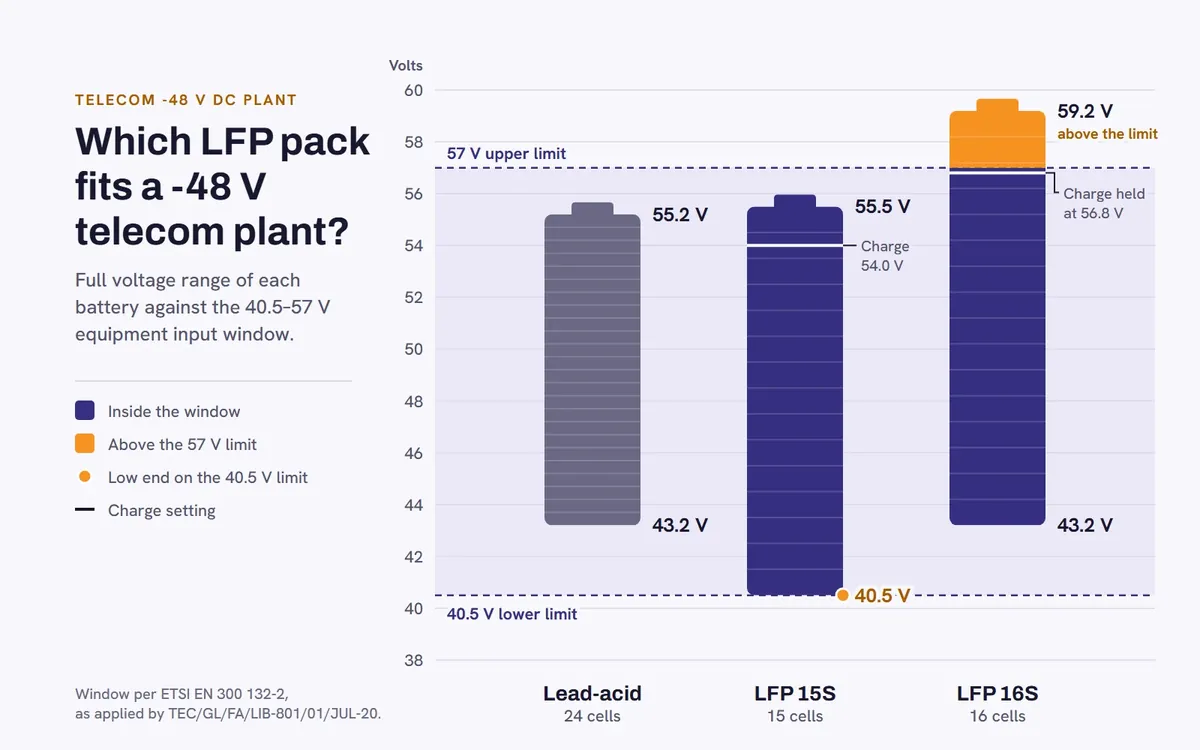
A 15-cell pack charged at 54.0 V matches TEC 66160:2024, the hybrid (AC+DC) UPS GR, which sets 54.0 V or as the purchaser specifies. A 16S pack can work if you control the charge voltage at the plant.
Where Halovolt's Surya packs fit
Both packs below sit in our 48V lithium battery range for rack and telecom use, and our 48V lithium battery price guide compares them with other makers.
The Surya 48 is a 15-cell LFP pack: 48 V, 100 Ah, 4.8 kWh, with a 54 V charge voltage. It has CAN, RS485 and Bluetooth ports, mounts on a wall or in a 19-inch rack (3U), and allows up to 16 units in parallel. It weighs 40 kg, operates at 0–55 °C and carries a 5-year warranty. As with any 15-cell pack, check its low-voltage cut-off against your plant's minimum.
Surya 48 is rated IP54. The 2026 draft asks for IP55 on outdoor racks, so an outdoor site needs it inside an IP55 cabinet. Modbus protocol support is not claimed for its RS485 port, so confirm the protocol with your SMPS controller before you order. TEC type approval is not claimed either; if your tender requires it, ask any supplier for the certificate.
The Surya 51 is the 16-cell version: 51.2 V nominal, 57.6 V charge. That is above the 57 V limit, so on a -48 V plant the charge must be held at or below 56.8 V, and the supplier should confirm the pack accepts that setting.
The Vidyut 240 cabinet (240 V, 200 Ah, 48 kWh) suits 240 V DC telecom plants, as the battery cabinet of a larger system (what a BESS is). It does not connect directly to a -48 V DC plant, but a Vidyut-style pack also comes at 48 V nominal for those sites, by quote. For a different cell count, enclosure or protocol, ask for a custom telecom pack quote, or read how an LFP battery pack is built.
How to size a lithium battery bank for a telecom tower

Size the bank from energy first, then check current and redundancy. IEEE 485 is the established sizing practice for lead-acid (IEEE SA). Its lithium counterpart, IEEE P3163, is an active project with no published standard yet (IEEE SA). The margins below are a common practice borrowed from lead-acid sizing, not a lithium standard.
Inputs you need
- DC load in kW, measured at the plant. Industry figures range from 1 kW to 8.5 kW per tower.
- Backup hours, set by the operator. The 2016 GR covered "between 2 to 72 hours".
- Usable DoD, a design choice you set. TEC says telecom lithium-ion is normally not discharged beyond 80%.
- Temperature correction, from the cell maker's data for your site.
- Ageing factor: lead-acid practice uses 1.25, meaning the battery is replaced at 80% of rated capacity (TSEWG TP-4, 2008).
- Design margin: 10–15% is typical in the same lead-acid practice.
For a quick first estimate, try the battery backup calculator, then do the full working.
Worked example: a 2 kW, -48 V site (hypothetical)
This is an example only. Assume a 2 kW DC load, 4 hours of backup, 80% usable DoD, a shelter held near 25 °C (temperature factor 1.0, an assumption to replace with maker data) and a 10% design margin. Each module is 48 V, 100 Ah, 4.8 kWh.
| Step | Working | Result |
|---|---|---|
| Energy at the load | 2 kW × 4 h | 8.0 kWh |
| Allow for 80% usable DoD | 8.0 ÷ 0.80 | 10.0 kWh |
| Ageing factor 1.25 | 10.0 × 1.25 | 12.5 kWh |
| Temperature factor (assumed 1.0) | 12.5 × 1.0 | 12.5 kWh |
| Design margin 10% | 12.5 × 1.10 | 13.75 kWh |
| Modules needed | 13.75 ÷ 4.8 = 2.86 | 3 modules |
| Add N+1 | 3 + 1 | 4 modules (19.2 kWh nominal) |
The 2026 draft also ends its cycle-life test at 80% capacity retention, so the 1.25 ageing factor lines up with that end point.
Checking current and N+1
At 48 V the 2 kW load draws about 41.7 A (2,000 ÷ 48). At the 42 V low end of the example plant range it draws about 47.6 A (2,000 ÷ 42). Compare that with the module's continuous discharge rating. At the 42 V low end, with all four modules in service, each carries about 12 A; with one out, the remaining three carry about 16 A each.
The TEC guideline writes the bank's power as Pn = N × Ps: the number of parallel groups (N) times the power of one group (Ps), with up to 32 groups. It recommends N+1, so the remaining groups still carry full power when one reaches 100% DoD. Here energy sets the count at three. The fourth module keeps 14.4 kWh (3 × 4.8) available if one drops out, above the 13.75 kWh target.
When new, the four modules hold about 15.4 kWh within the 80% limit (19.2 × 0.8). That is roughly 7.7 hours at 2 kW, and the surplus shrinks as the cells age.
Does lithium stop battery theft?
No. Lithium batteries are stolen from towers too. In Nagpur, police recovered 82 lithium batteries linked to 27 tower thefts, each valued at around Rs 90,000 (The Hitavada, August 2023). The industry body DIPA said nearly 3,000 battery banks and cells and 450 diesel generators were stolen in the last fiscal year, with losses of Rs 1.25–1.5 billion (Rs 125–150 crore) (tele.net, June 2024). Delhi Police arrested 52 people and recovered 414 remote radio units (RRUs), 110 baseband units (BBUs) and 161 batteries (The Tribune, October 2024).
A lithium pack's BMS can make a stolen battery less useful. The TEC guideline describes a software lock: after the battery is disconnected from the power-system controller, it locks (72 hours by default, configurable from 8 to 720 hours), with an unlock function set in the BMS. The 2026 draft lists alarms on BMS communication failure, gyroscope movement detection and GPS location as purchaser options. A guideline is not binding and the draft's options are chosen by the buyer, so name each feature you want in the purchase order.
Procurement checklist for a telecom lithium battery
- Type approval. If your tender needs it, ask for the TEC 67030:2024 certificate, and track the final 2026 revision.
- Cell safety. Ask for IEC 62619 or IS 16805 test reports, and note which edition was used.
- Voltages. Get the series count (15S or 16S), charge voltage and low-voltage cut-off, and check them against your plant range.
- SMPS link. Confirm Modbus over RS485 with your controller make and ask for the register map.
- Cycle life with conditions. Ask for cycles at a stated DoD, temperature and C-rate, and compare with the 2026 draft's 3,500 cycles at 80% DoD, 25 °C and C/5.
- Enclosure. Outdoor racks need IP55 per IEC 60529; a lower-rated pack needs an IP55 cabinet.
- Anti-theft. Specify the lock period, communication-loss alarm, gyroscope and GPS if you want them.
- Parallel limit and warranty. Check the maximum modules in parallel for your N+1 plan, and get the warranty's end-of-life definition (for example 80% of rated capacity) in writing.
Sources
- Department of Telecommunications year-end review, reproduced by Communications Today, 20 December 2025
- Indian Infrastructure, telecom tower installations to 30 December 2024, 31 December 2024
- PTI via The Week, Power Minister on electricity supply hours, 10 June 2025
- tele.net, decarbonisation strategies for the tower industry, 6 November 2024
- Voice&Data, Draft National Telecom Policy 2025, 24 July 2025
- TEC, standards and specifications list (TEC 67030:2024, TEC 66160:2024, TEC/GL/FA/LIB-801/01/JUL-20 and the 2016 GR TEC/GR/TX/LIB-001/01)
- TEC, consultations (draft GR TEC 67030:2026)
- TEC, draft GR "Lithium-Ion Battery for Telecom Applications" (2026 draft, PDF)
- TEC, gazette-notified standards
- IEC Webstore, IEC 62619:2022
- Bureau of Indian Standards, IS 16805:2018
- IEEE SA, P3163 project page
- IEEE SA, IEEE 485-2020
- DoD Tri-Service Electrical Working Group, TSEWG TP-4 "Stationary Battery and Charger Sizing", 2008
- Lightwave, EnerSys article on backup battery costs, 12 December 2017
- C&D Technologies, white paper on large-format VRLA batteries for high-temperature environments (undated)
- Sandia National Laboratories, Preger et al., study of commercial lithium-ion cell degradation by chemistry and cycling conditions, 2020
- pv magazine India, BSNL lithium battery contract, 2 January 2026
- The Hitavada, Nagpur tower battery thefts, 30 August 2023
- tele.net, DIPA on theft losses and insurance, 4 June 2024
- The Tribune, Delhi Police arrests over mobile tower equipment theft, 31 October 2024
The TEC facts in this guide were read from TEC's own documents in October 2026.
Frequently asked questions
Can a lithium battery run in parallel with an existing VRLA bank?
Yes. TEC's lithium-ion guideline, TEC/GL/FA/LIB-801/01/JUL-20, says lithium-ion can run in parallel with batteries of other types and ages. Before you mix them, confirm the plant's charge voltage suits both banks and the lithium BMS is connected to the controller.
What charge voltage does a 48V lithium telecom battery use?
TEC 66160:2024, the hybrid (AC+DC) UPS GR, sets 54.0 V or as the purchaser specifies, and its sizing example charges a 48 V lithium-ion battery at 0.2C and 54 V. That equals 15 LFP cells at 3.6 V each. A 16-cell pack on a -48 V plant should stay at or below 56.8 V, per the TEC guideline.
Which safety standard should a telecom lithium battery meet?
Look for IS 16805. It is identical to IEC 62619:2017, the safety standard for industrial lithium cells and batteries. The current edition, IEC 62619:2022, names telecom and UPS in its scope, and the 2026 draft requires cells to meet IEC 62619 limits. If a supplier offers an IS 16046 certificate instead, check its scope on the BIS portal before you accept it.
How many cycles should a telecom lithium battery last?
The 2026 draft asks for 80% capacity after 3,500 cycles at 80% DoD, 25 °C and C/5. A cycle rating means little without its test conditions. Sandia National Laboratories (Preger et al., 2020) found that DoD, temperature and C-rate changed the time to 80% capacity by thousands of hours and cycles within the same chemistry. The TEC guideline also gives, as an example, 10,000 kWh of cumulative discharge energy for a 100 Ah, 48 V battery, about 2,080 full discharges of 4.8 kWh. Asking for a throughput figure gives you a second way to compare offers.