
BESS stands for battery energy storage system: batteries, a battery management system (BMS), a power converter, controls, an enclosure and fire protection, working as one unit that stores electricity and returns it when a site needs it. An Indian business can size one from the load it must keep on and the hours it must run, at sizes from about 20 kWh to several MWh. We found no public Indian benchmark for what such a system costs, and the vendor price tables that state a size band, which cite no data, differ about 2.7 times at 1 MWh (our calculation), so treat the figures below as starting points for quotes.
Key Takeaways
- Size from the load that must stay on and the hours it must run. Usable energy is voltage × Ah × 0.8, and hours are usable energy ÷ load.
- Check power as well as energy. A BESS with enough kWh can still trip if its converter or battery current can't carry your peak kW.
- Tender prices such as ₹1.81 lakh per MW per month are service fees over many years, so they can't price a system for your factory.
- A diesel generator (DG) still suits long outages. A BESS earns more where it is used often, for example for daily solar shifting and short cuts.
What is a BESS? Full form and the parts of the system
People often use the word for the battery alone, so a quote for "a BESS" can cover very different things.
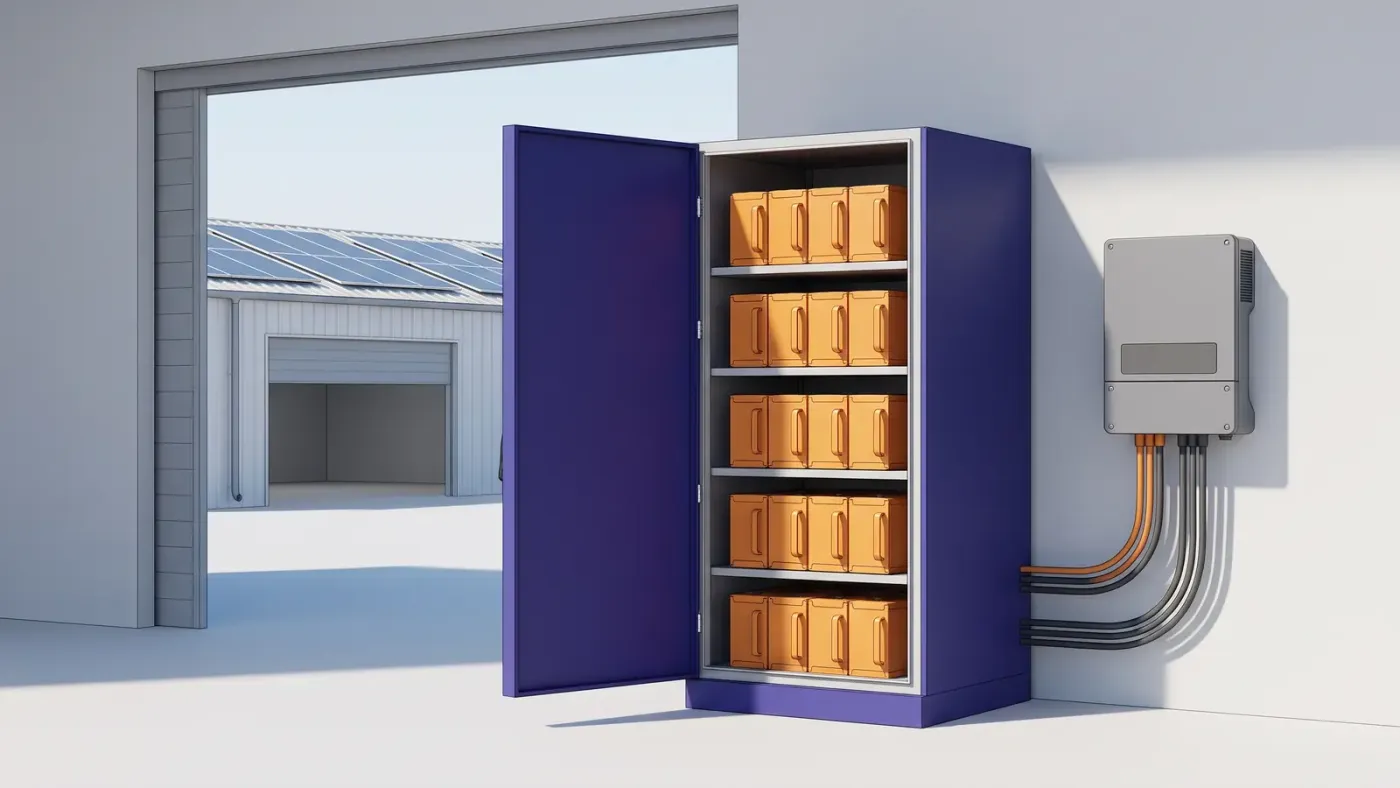
| Part | What it does | What to ask |
|---|---|---|
| Battery | Stores the energy, as LFP or another cell chemistry | Rated kWh, usable kWh, cycle life at a stated depth of discharge (DoD) and temperature |
| BMS | Watches cell voltage, current and temperature, and disconnects the battery when a limit is crossed | Does it report to the converter over CAN or RS485? |
| PCS or inverter | The power conversion system changes DC to AC and back, so the battery can charge and feed the load | Rated kW, surge rating, grid and DG sync, and whether it is in the price |
| EMS | The energy management system decides when to charge and discharge, for example to hold a demand limit | Which modes it supports, and whether a portal is included |
| Enclosure and cooling | Protects the cells from dust, water and heat | IP rating, operating temperature, air or liquid cooling |
| Fire safety | Detects gas, smoke or heat and suppresses a fire | What is supplied, what the site must add, and who signs off |
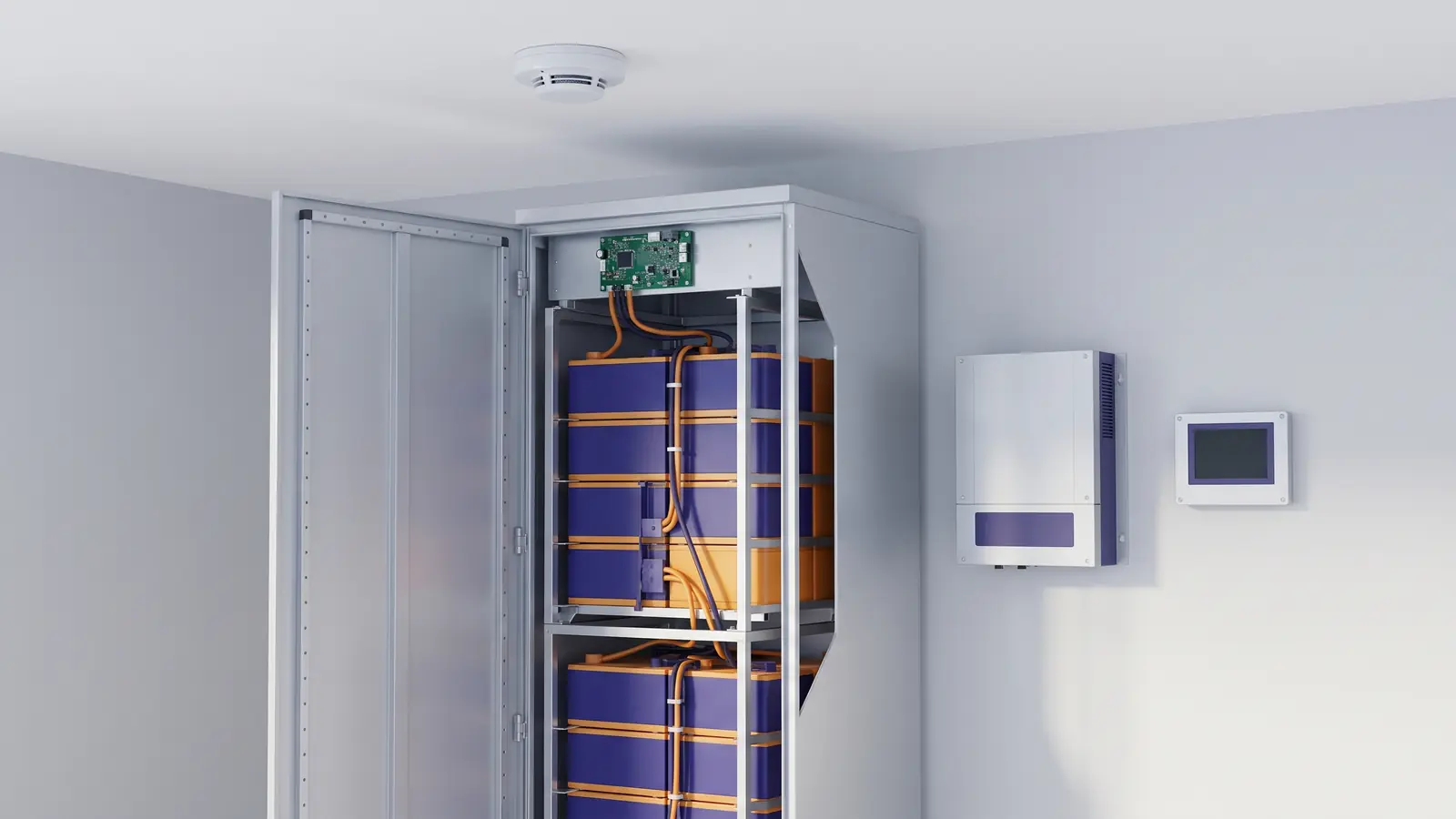
The Central Electricity Authority's safety amendment regulations of 2026 add a BESS chapter from 1 April 2027, according to Energetica India. As reported, installations above 650 V must have an independent third-party fire audit, automatic fire suppression in every battery container, gas and smoke detection and a design that stays safe after two independent failures. Systems at or below 650 V must meet relevant standards. The report doesn't say how the chapter treats behind-the-meter systems in factories. Ask your EPC contractor and electrical inspector how it applies to your site.
What does a BESS do for a business?
Backup during power cuts
The battery carries the load through a cut and recharges when the grid returns. Our case study of a 96 kWh system at a Rajkot anodizing plant reports no production stops during outages in its first six months, and one minor fault, which was fixed remotely. The plant gave no savings figures, so we publish none.
Peak shaving and time-of-day tariffs
Peak shaving means discharging during your highest-demand minutes so the bill sees a lower peak. India's consumer rules set floors for time-of-day (ToD) tariffs: for commercial and industrial users above 10 kW, the state commission's peak tariff must be at least 1.2 times the normal tariff, and the solar-hours tariff at least 20% below it. These apply to the energy charge (Rule 8A, Electricity (Rights of Consumers) Rules, in the PIB compendium of electricity rules, 2023). Your state's tariff order sets the real numbers and hours. Gujarat's FY 2026-27 order, for example, widened a 60 paise per unit daytime discount to 11 am to 5 pm and extended it to HT consumers of the state discoms, according to DeshGujarat (March 2026).
With a made-up ₹7 per kWh normal tariff, the legal floors give ₹8.40 at peak and ₹5.60 in solar hours. Delivering 100 kWh at peak every day, after charging at 90% round-trip efficiency, saves about ₹218 a day or about ₹80,000 a year (our calculation). Over ten years that is about ₹8 lakh. A system with 100 kWh usable is 125 kWh rated, which costs ₹12.5 lakh even at the lowest rate in the vendor tables below, ₹10,000 per kWh. On these numbers ToD shifting alone would not repay the battery, so count it with backup, demand charges and solar.
Demand charges are separate and depend on your state's tariff. To estimate the saving, multiply the kVA you can reliably shave by the rate per kVA on your bill and by 12. If your tariff bills on the month's highest reading, one missed peak can cancel that month's saving.
More use of rooftop solar
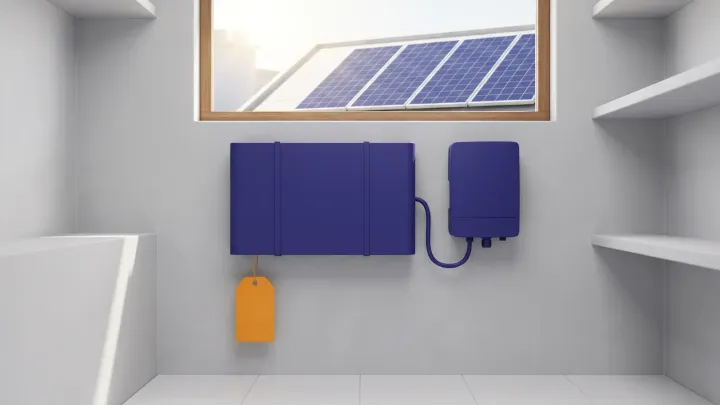
A battery stores daytime solar that would otherwise be exported or lost, and returns it in the evening. A Pune manufacturer with 500 kW of rooftop solar and a 600 kW/1.2 MWh battery reported grid imports falling 11.1%, from about 180 MWh to 160 MWh a month (Mercom India, August 2026). That figure is for the solar and battery together, so the battery's own share isn't isolated, and the project's cost and payback were not disclosed. Sites that use most of their solar during the day get less from a battery, as one industry executive notes in pv magazine India (July 2026). Maharashtra's renewable and storage policy, notified on 18 March 2026, requires projects above 100 kW to provide storage of at least 50% of their renewable capacity for two hours (Energetica India, September 2026). That report doesn't cover rooftop or captive projects, so check yours.
Fewer diesel generator hours
The same Pune site reported diesel use of about 50 to 100 litres a month after commissioning. Mercom gives the earlier figure inconsistently, so we can't state the exact cut. To price your own DG hours, divide the litres in your logbook by the units it generated, then multiply by your local diesel price. Diesel was ₹95.20 a litre in Delhi and ₹97.83 in Mumbai on 4 November 2026 (PPAC). Fuel is only part of a DG's cost: a 2022 study for Tamil Nadu put the total at ₹49.58 to ₹57.63 per kWh in its scenarios (pv magazine India, September 2022).
How do you size a BESS from load and hours?
Start with the load that must stay on. Then use the formula our own ratings use:
Backup hours = voltage × Ah × 0.8 ÷ load in watts
The 0.8 is 80% DoD. LFP cells allow 90% to 100%, but 80% is the figure we rate at, so ask each supplier which figure their hours assume. For example, a 240V 200Ah battery on a 10 kW load gives 240 × 200 × 0.8 ÷ 10,000 = 3.84 hours (our calculation).
To work backwards, multiply load by hours for the usable kWh, then divide by 0.8 for the rated kWh.
| Load that must stay on | Hours | Usable kWh needed | Rated kWh at 80% DoD |
|---|---|---|---|
| 5 kW | 2 | 10 | 12.5 |
| 20 kW | 3 | 60 | 75 |
| 50 kW | 1.5 | 75 | About 94 |
| 100 kW | 2 | 200 | 250 |
| 500 kW | 2 | 1,000 | 1,250 |
These are our calculations and they leave out losses. As a guide to margin, the IEEFA and JMK Research tariff model assumes 5% inverter losses and 90% round-trip efficiency (IEEFA and JMK Research, May 2026). For small loads, our battery backup calculator works from an appliance list.
Then check these before you accept a size:
- Power. Compare the battery's continuous current and the converter's kW with your peak, including motor starts.
- Recharge time. If cuts come close together, the battery has to refill between them. Check the charge current and the grid or solar power available to supply it.
- Ageing. Capacity falls over the years. If you need the same hours in year ten, add margin now. Our guide on how long a lithium battery lasts explains how cycles, DoD and temperature affect this.
Commercial BESS sizes in India
There is no standard set of commercial sizes. These bands come from vendors' own classes and from projects reported in the press.
| Size | How it is described | Example |
|---|---|---|
| 20 to 60 kWh | "Small commercial" (CLN Energy) | None found to cite |
| 64 to 480 kWh | "Industrial C&I" (CLN Energy) | None found to cite |
| 1 to 5 MWh | "Containerised" (CLN Energy) | 1.2 MWh in Pune, above; 5 MWp of solar with 4 MWh for ACG in Maharashtra (IEEFA EnergyWatts, September 2026) |
| 10 MWh and above | "Larger projects" (Zetwerk) | None found to cite |
BESS cost in India: utility tender prices
Battery energy storage system cost is quoted in several units, so check which one a figure uses. Grid-scale tenders in India are mostly priced per MW per month: the developer builds and runs the system, and the buyer pays that monthly charge for 12 to 20 years (IEEFA and JMK Research, May 2026). The ₹ per kW column is our own division.
| Tender (date) | Size | Tariff per MW per month | ₹ per kW per month |
|---|---|---|---|
| Lowest 2-hour, 2025 (IEEFA and JMK) | 2-hour | ₹1.48 lakh | ₹148 |
| NVVN Kerala, reported February 2026 (Energetica India) | 250 MW/500 MWh | ₹1.81 lakh | ₹181 |
| TNGECL Tamil Nadu, reported February 2026 (Energetica India) | 375 MW/1,500 MWh | ₹3.15 lakh | ₹315 |
| GUVNL Gujarat, awarded August 2026 (IEEFA EnergyWatts) | 450 MW/900 MWh | ₹2.32 lakh | ₹232 |
| WBSEDCL West Bengal, awarded August 2026 (IEEFA EnergyWatts) | 500 MW/2,000 MWh | ₹4.35 lakh to ₹4.39 lakh | ₹435 to ₹439 |
The per kWh figure you may have seen in headlines is a different measure. The Ministry of Power told the Rajya Sabha in December 2025 that recent bids came to about ₹2.1 per kWh without viability gap funding at two cycles a day, and about ₹2.8 at 1.5 cycles (PTI in The Week, 15 December 2025). That figure prices each unit moved through the battery, so it can't serve as a purchase price.
IEEFA and JMK Research benchmark a viable 2-hour, 2-cycle tariff at ₹2.3 lakh per MW per month and put nearly 75% of the 2-hour capacity allocated in 2025 in their risky category.
Dated figures for utility capital cost:
- About $125 per kWh all-in for 4-hour or longer utility projects outside China and the US, as of October 2025, of which about $50 is installation and grid connection (Ember, December 2025).
- For equipment alone, stationary storage packs at $70 per kWh in 2025 (BloombergNEF, December 2025; the release doesn't state the regional mix), and landed LFP cells in India at ₹5,824 to ₹6,301 per kWh in August 2026, which IEEFA EnergyWatts gives as $61 to $66 at its rate of ₹95.47 to the dollar. The cell figure includes freight and duties and comes a year later, so don't subtract one from the other.
C&I BESS installed cost in India: no public benchmark
We found no public Indian benchmark for the installed cost of commercial and industrial (C&I) systems. The table below is vendor estimates only: four companies that sell storage, none citing a data source for its prices. DC&T Global and Zetwerk publish the same rates band for band, so count them as one estimate. We can't tell whether one drew on the other.
| Vendor estimate (date) | Size | Installed ₹ per kWh | Stated scope |
|---|---|---|---|
| CLN Energy (reviewed September 2026) | 20 to 60 kWh | ₹13,000 to ₹26,000 | Planning range, GST not mentioned |
| CLN Energy | 64 to 480 kWh | ₹10,000 to ₹20,000 | Cells, PCS, BMS, fire suppression, cooling; civil works unclear |
| CLN Energy | 1 to 5 MWh | ₹12,000 to ₹21,000 | Racks, cooling, PCS, fire suppression, SCADA |
| DC&T Global (5 August 2026) and Zetwerk (23 September 2026) | DC&T: 100 to 500 kWh. Zetwerk: "small C&I" | ₹30,000 to ₹40,000 (Zetwerk adds "+") | DC&T excludes GST and DISCOM interconnection. Zetwerk warns some quotes leave out grid connection |
| Both | 500 kWh to 2 MWh | ₹25,000 to ₹32,000 | Same |
| Both | 2 to 10 MWh | ₹20,000 to ₹28,000 | Same |
| Both | 10 MWh and above | ₹15,000 to ₹20,000 (Zetwerk adds "or lower") | Same |
| Powermore (17 August 2026) | Industrial and commercial | ₹37,000 to ₹62,000 | Cells, balance of system, PCS, installation |
For a 1 MWh system, the tables that state a size band give ₹1.2 crore to ₹2.1 crore from CLN and ₹2.5 crore to ₹3.2 crore from DC&T and Zetwerk, so the top figure is about 2.7 times the lowest (our calculations). Powermore's range has no size band and runs higher, at ₹3.7 crore to ₹6.2 crore if applied to 1 MWh (our calculation). Scope explains some of that gap, and we can't say how much. We make a C&I battery ourselves, so read this with that in mind: none of these figures is a Vidyut 240 price, and this guide doesn't give one.
Lithium-ion batteries are taxed at 18% under heading 8507 (pv magazine India, September 2025), while DC&T Global states 12% on BESS equipment with no source. We could not confirm how GST applies to a complete system with converter and civil works, so ask for the tax line in writing and check it with your accountant.
Why aren't tender prices and C&I installed cost comparable?
A tender tariff is a monthly fee for a service over many years. An installed cost is the price of buying equipment and getting it running. The projects differ too. Tenders run to hundreds of MW, while a C&I site may buy a few cabinets. In 2025, 91.5% of the 2-hour, 2-cycle, 12-year capacity allocated had viability gap funding (IEEFA and JMK Research), and the second funding tranche pays ₹18 lakh per MWh to projects in 15 states and NTPC (pv magazine, June 2025). In some tenders the procurer provides the land, as in SJVN's August 2026 tender (IEEFA EnergyWatts). A factory also pays for its own panels, cabling and integration with existing solar or a DG set, which tender figures don't show.
Dividing a tender tariff into a per kWh price for your factory gives a number no supplier can quote against. Compare quotes with each other on the same scope instead: usable kWh, converter kW, fire protection, civil work, GST and warranty terms.
Should you choose a BESS or a DG set?
A DG set has real advantages. It runs for as long as you have fuel and doesn't need hours to recharge between outages. The 2022 Auroville Consulting study for Tamil Nadu found that grid-charged batteries cost more per unit than DG power at every backup duration it tested, while solar-charged batteries were the cheapest option (pv magazine India). Pack prices have fallen since then: BloombergNEF's all-sector average was $151 per kWh in 2022 and $108 in 2025, in each survey's own dollars. We found no newer study to replace the Auroville one. Keeping both is a reasonable plan, with the battery for short cuts and the DG for long ones.
Other options:
- Lead-acid UPS or tubular bank: costs less on the day you buy it and suits short backup at low cycling. Our lithium vs tubular comparison covers this at the smaller end.
- Storage-as-a-Service: you pay for use instead of buying, though these models are not yet widespread, according to pv magazine India.
- Another supplier's system: large integrators can bundle the converter, EMS and container into one contract. Our list of lithium battery manufacturers in India is a place to start.
Where our Vidyut 240 fits
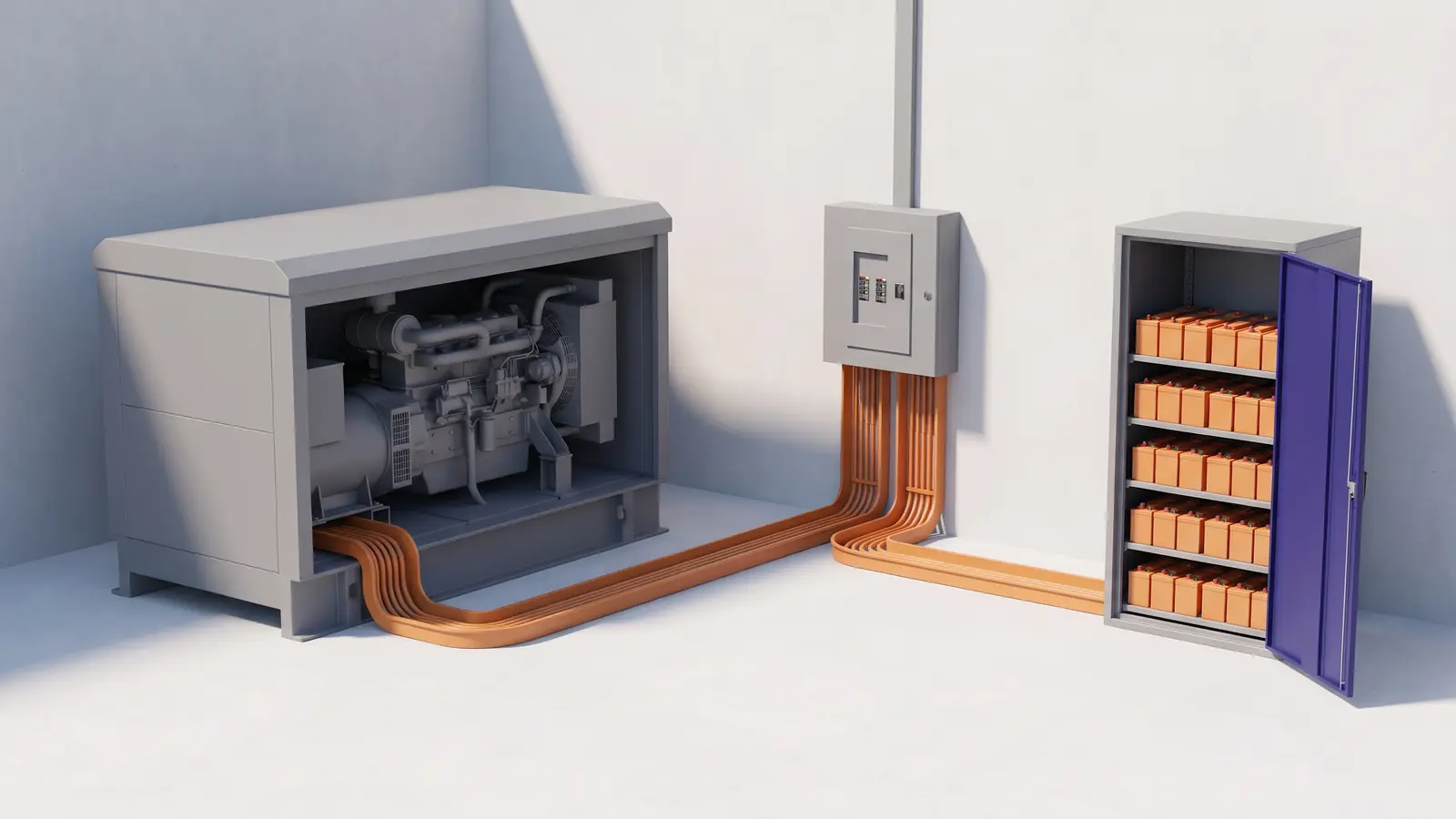
We make the Vidyut 240. It is the battery cabinet of a battery energy storage system, for 240V DC telecom plants, data centres, factories, schools and hospitals.
| Spec (our catalogue) | Vidyut 240 |
|---|---|
| Voltage and capacity | 240V 200Ah LFP, 48 kWh |
| Usable at 80% DoD | 38.4 kWh (our calculation) |
| Parallel | Up to 4 cabinets, 192 kWh |
| Cycle life | 6,000 or 8,000 cycles at 80% DoD, by version |
| Continuous discharge | 100 A, which is 24 kW per cabinet at 240 V (our calculation) |
| Peak discharge | 200 A, which is 48 kW per cabinet at 240 V (our calculation) |
| Charge | 50 A, about 4 hours |
| Enclosure | IP67, −10 to 55 °C |
| Size and weight | 600 × 650 × 1100 mm, 440 kg |
| Warranty | 10 years |
| Build time | Made to order in 6 to 7 days |
| Installation | By a certified Halovolt partner in serviced cities |
| Price | Price on request |
In the BESS parts table above, the Vidyut 240 is the battery, BMS and enclosure. In our Rajkot project the solar EPC supplied the hybrid inverter. An inverter from us is optional and depends on your project, so tell us if you want one in your quote. Our catalogue lists no fire suppression system and no grid or fire certification for this cabinet, so we make no such claim here. Four cabinets in parallel stop at 192 kWh. Above that we quote a custom pack through our OEM team, up to about 1 MWh, and containerised systems from other suppliers are worth comparing at a few MWh. Smaller sites may be better served by our Surya rack packs, which we also make.
To get a price, send your load and hours through the Vidyut 240 quote form.
What we could not confirm
- An Indian C&I price benchmark. Our searches of CEA, BloombergNEF and the wider web found none, and the C&I figures above rest on vendor estimates alone.
- Payback. Vendor guides quote payback periods without data. We found no independent figure for Indian C&I systems.
- The CEA gazette text and its standards list. We relied on a news report, and the list of standards was still to come.
- Current demand charges and ToD rates by state. GERC's FY 2026-27 order and tariff schedule would not open for us, so the Gujarat detail above comes from a news report and we quote no demand charge. We read no other state's order.
- A national capital subsidy for C&I batteries. We found none, though our search was not exhaustive and state schemes change.
Sources
- IEEFA and JMK Research, Viability of standalone battery energy storage tariffs discovered in 2025, May 2026 (PDF)
- IEEFA and JMK Research, EnergyWatts monthly update on India's energy storage market, September 2026 (PDF)
- Ember, How cheap is battery storage?, 11 December 2025
- BloombergNEF, Lithium-ion battery pack prices fall to $108 per kilowatt-hour, 9 December 2025
- BloombergNEF, Lithium-ion battery pack prices rise for first time to an average of $151/kWh, 6 December 2022
- PTI in The Week, Battery energy storage cost falls to Rs 2.1 unit from Rs 10.18 in 2022-23: Power Min, 15 December 2025
- Energetica India, TNGECL and NVVN Kerala BESS tenders close at lower than expected tariffs, 2 February 2026
- Energetica India, CEA issues 2026 BESS safety rules, 14 April 2026
- Ministry of Power rules under the Electricity Act, compendium hosted by PIB, including Rule 8A of the Electricity (Rights of Consumers) Rules as amended in 2023 (PDF)
- PPAC, retail selling price of petrol and diesel in metro cities, posted 4 November 2026 (PDF)
- DeshGujarat, GERC unveils FY 2026-27 power tariff in Gujarat, 25 March 2026
- pv magazine, India offers $631.5 million to support 30 GWh of battery storage, 11 June 2025
- Mercom India, Solar plus storage cuts grid imports and diesel use at Maharashtra firm, 13 August 2026
- pv magazine India, What's stopping a faster rush to BESS adoption by the C&I segment (opinion, Rahul Das, Oorjan Cleantech), 13 July 2026
- pv magazine India, Battery energy storage systems as an alternative to diesel generators (Auroville Consulting study), 14 September 2022
- pv magazine India, IESA welcomes the new tax regime under GST 2.0, 8 September 2025
- Energetica India, Maharashtra clarifies renewable energy and storage policy targets, 18 September 2026
- CLN Energy, How much does a BESS cost in India? (vendor estimate), reviewed September 2026
- DC&T Global, BESS in India: a 2026 C&I buyer's guide (vendor estimate), 5 August 2026
- Zetwerk, BESS cost in India 2026 (vendor estimate), 23 September 2026 per the page's data
- Powermore, BESS cost per kWh in India: 2026 pricing guide (vendor estimate), 17 August 2026
- Halovolt, 96 kWh solar storage for a Rajkot anodizing plant (case study)
- Halovolt, Vidyut 240 product page (catalogue specs)
Frequently asked questions
What is the full form of BESS?
BESS stands for battery energy storage system. It means the battery together with its battery management system (BMS), a power converter (PCS or inverter), an energy management system (EMS), an enclosure and fire protection. Check what a quote includes, because some cover only the battery.
How much does a BESS cost for a business in India?
We found no public Indian benchmark for commercial and industrial systems. Vendor price tables published in 2026 cite no data. For 1 MWh, those with a size band work out to ₹1.2 crore to ₹3.2 crore (our calculation), about 2.7 times from lowest to highest, and one unbanded range runs higher. Compare real quotes on the same scope, including GST, the converter, fire protection and installation.
Are BESS tender prices the same as the cost of buying a system?
No. Indian tender prices such as ₹1.81 lakh per MW per month are monthly fees for a service over 12 to 20 years, for projects of hundreds of MWh, and many had viability gap funding. Installed cost per kWh is the price of buying and commissioning equipment. The two are not comparable.
How do I size a BESS for my factory or building?
Multiply the load that must stay on by the hours it must run to get usable kWh, then divide by 0.8 for rated kWh at 80% depth of discharge. A 50 kW load for 1.5 hours needs 75 kWh usable, or about 94 kWh rated. Add margin for losses, then check that the converter and battery current can carry your peak.
Which part of a BESS does Halovolt make?
Halovolt makes the Vidyut 240, the battery cabinet of a BESS: 240V 200Ah LFP, 48 kWh, with up to four in parallel for 192 kWh. It has a 10-year warranty, comes in 6,000-cycle and 8,000-cycle versions and is made to order in 6 to 7 days. Its price is on request. In our Rajkot project the solar EPC supplied the inverter, so check what your quote includes.