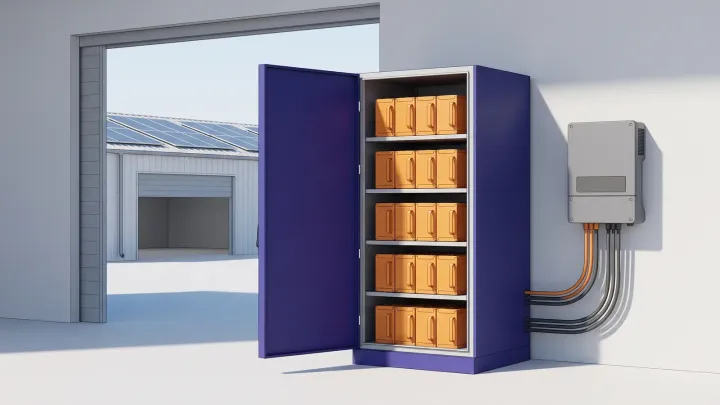

On 4 November 2026, makers' own sites listed a 12V 150Ah tubular solar battery at ₹17,999 to ₹20,342, about ₹10,000 to ₹11,300 per kWh of rated energy, and a lithium solar battery of about 5 kWh at ₹67,700 to ₹1,15,000, or ₹13,652 to ₹22,461 per kWh (our calculation). Tubular costs less on the day you buy it. The lowest lithium price (Surya 48) and the lowest lithium per-kWh figure (Surya 51) are our own packs, and the lowest from another maker was UTL's 48V pack at ₹72,100, or ₹15,021 per kWh.
Key Takeaways
- About ₹70,000 buys more stored energy in tubular: four Luminous 150Ah batteries store 7.2 kWh rated (240 kg), against 4.8 kWh in a UTL 48V pack or 5.12 kWh in our Surya 51 (43 kg).
- A solar battery can cycle almost every day, so the cycle rating changes the cost. Over rated cycles, we calculate about ₹2.84 per kWh delivered for our Surya 51, ₹5.54 to ₹7.57 for other makers' lithium and ₹8.12 for a Luminous 200Ah tubular. Makers rate cycles under their own conditions, so this is a guide.
- GST is 18% on lead-acid and lithium solar batteries bought on their own. A battery sold inside a complete solar system may be taxed differently, and we could not confirm how.
- PM Surya Ghar's June 2024 guidelines let a rooftop system include a battery, but they work out the subsidy only on solar module capacity.
- Ember modelled a 3 kW home solar system in October 2026, and adding a 5 kWh battery stretched payback from 3.3 years to around 9. Buy a battery for backup and evening use, and do not count on it for a quicker payback.
Tubular solar battery price list (4 November 2026)
We read these prices from Luminous's product pages and Exide's current solar price list. All are 12V batteries, so rated energy is 12 V × Ah. Every price here includes GST: Luminous says "Inclusive of all taxes" and Exide's list says "inclusive of GST". Usable energy is 80% of rated, because Luminous rates its cycles at 80% depth of discharge (DoD). Both ₹ per kWh columns are our calculation. Prices change, so check the maker's page on the day you buy.
| Battery (as listed) | Rated energy | Price | Warranty | ₹ per rated kWh | ₹ per usable kWh |
|---|---|---|---|---|---|
| Luminous LPTT 12150H, 150Ah @C10 | 1.8 kWh | ₹17,999 selling (MRP ₹21,200) | 72 months | ₹9,999 | ₹12,499 |
| Luminous LPTT 12200H, 200Ah @C10 | 2.4 kWh | ₹23,399 selling (MRP ₹27,200) | 72 months | ₹9,750 | ₹12,187 |
| Exide Solatubular 6LMS150L, 150Ah | 1.8 kWh | ₹20,342 list | 60 months | ₹11,301 | ₹14,126 |
| Exide Solatubular 6LMS200L, 200Ah | 2.4 kWh | ₹26,022 list | 60 months | ₹10,843 | ₹13,553 |
| Exide Solatubular 6LMS150, 150Ah | 1.8 kWh | ₹18,428 list | 36 months | ₹10,238 | ₹12,797 |
| Exide Solatubular 6LMS200, 200Ah | 2.4 kWh | ₹23,957 list | 36 months | ₹9,982 | ₹12,478 |
Exide's figure is its MRCP in price list EIL/SOLAR/MRCP/26-27/01, effective 1 July 2026. That list replaces earlier ones, and search results can still show a September 2025 version. We read MRCP as a retail ceiling, so a dealer may charge less. We did not collect dealer quotes.
A marketplace listing shows how far a street price can fall. On IndiaMART, the seller Hemuda Power of Jaipur listed a Livguard LS 15060PTT 150Ah with a 60-month warranty at ₹11,900, about ₹6,611 per rated kWh (our calculation) (IndiaMART, marketplace price, observed 4 November 2026). It does not say whether GST is included. If it is not, 18% brings the price to ₹14,042 (our calculation). This is one seller's figure, and we did not find a price from Livguard itself.
Our battery backup calculator counts a tubular at half of its rated capacity. On that stricter basis, the Luminous 200Ah costs about ₹19,499 per usable kWh (our calculation). The table uses 80% so that tubular and lithium share one basis.
Lithium solar battery prices compared (4 November 2026)
These lithium batteries for a solar system were listed on makers' sites on 4 November 2026. All are LFP at 100Ah. We make the Surya packs in the last two rows, so read those as the publisher's own prices. Luminous, UTL and Halovolt state that their prices include tax, and the Loom rows are marked because its listings do not say. Usable energy is again 80% of rated, which is what our ratings use, though LFP cells allow 90% to 100%. Both ₹ per kWh columns are our calculation.
| Battery (as listed) | Rated energy | Price | Rated cycles | ₹ per rated kWh | ₹ per usable kWh |
|---|---|---|---|---|---|
| Luminous Helios 51.2V | 5.12 kWh | ₹92,999 (MRP ₹1,00,000) | Up to 3,000, DoD not stated | ₹18,164 | ₹22,705 |
| Loom Solar CAML 48V, rack | 5 kWh as listed | ₹99,000 (GST not stated) | Not stated | ₹19,800 | ₹24,750 |
| Loom Solar CAML 51.2V, rack | 5.12 kWh | ₹1,08,000 (GST not stated) | Not stated | ₹21,094 | ₹26,367 |
| Loom Solar CAML 51.2V, wall | 5.12 kWh | ₹1,15,000 (GST not stated) | Not stated | ₹22,461 | ₹28,076 |
| UTL 48V SM | 4.8 kWh (48 V × 100 Ah) | ₹72,100 (MRP ₹98,720) | Not stated | ₹15,021 | ₹18,776 |
| UTL 48V PM | 4.8 kWh | ₹74,500 (MRP ₹1,04,525) | Up to 3,500, DoD not stated | ₹15,521 | ₹19,401 |
| UTL 51.2V PM | 5.12 kWh | ₹79,970 (MRP ₹1,11,478) | Not stated | ₹15,619 | ₹19,524 |
| Halovolt Surya 48 (ours) | 4.8 kWh | ₹67,700 (MRP ₹87,000) | 6,000 at 80% DoD | ₹14,104 | ₹17,630 |
| Halovolt Surya 51 (ours) | 5.12 kWh | ₹69,900 (MRP ₹89,000) | 6,000 at 80% DoD | ₹13,652 | ₹17,065 |
UTL's page shows a different price in its specification table for some models: ₹77,157 for the 48V PM, and "Contact Us" for the 51.2V. We used the listing price. An older table on Loom's page is headed "Price All Inclusive". Loom lists its 48V pack as 5 kWh. At 48 V × 100 Ah it would be 4.8 kWh, or ₹20,625 per kWh (our calculation).
12V and 24V lithium batteries for smaller solar inverters (4 November 2026)
Both ₹ per kWh columns are our calculation.
| Battery | Rated energy | Price | ₹ per rated kWh | ₹ per usable kWh |
|---|---|---|---|---|
| Luminous Helios 12.8V 100Ah | 1.28 kWh | ₹29,000 | ₹22,656 | ₹28,320 |
| UTL 12.8V 100Ah | 1.28 kWh | ₹19,990 | ₹15,617 | ₹19,521 |
| Loom Solar CAML 12.8V 100Ah | 1.28 kWh | ₹34,500 | ₹26,953 | ₹33,691 |
| Luminous Helios 25.6V 100Ah | 2.56 kWh | ₹47,499 | ₹18,554 | ₹23,193 |
| Loom Solar CAML 25.6V 100Ah, wall | 2.56 kWh | ₹64,375 | ₹25,146 | ₹31,433 |
| Halovolt Shakti 12 (ours) | 1.28 kWh | ₹17,950 | ₹14,023 | ₹17,529 |
| Halovolt Shakti 12 Plus (ours) | 2.56 kWh | ₹34,400 | ₹13,438 | ₹16,797 |
| Halovolt Shakti 24 (ours) | 2.56 kWh | ₹35,500 | ₹13,867 | ₹17,334 |
| Halovolt Shakti 24 Plus (ours) | 5.12 kWh | ₹69,900 | ₹13,652 | ₹17,065 |
Luminous, UTL and Halovolt state that these prices include taxes, and Loom's listings do not say. The lowest figures in this table are also ours.
Tubular vs lithium solar battery: price today and cost per kWh delivered
Tubular has the lower price on the day. A 48V inverter needs four 12V tubular batteries in series, so here is what about ₹70,000 buys.
| Four Luminous LPTT 12150H | One UTL 48V SM | One Halovolt Surya 51 (ours) | |
|---|---|---|---|
| Price | ₹71,996 | ₹72,100 | ₹69,900 |
| Rated energy | 7.2 kWh | 4.8 kWh | 5.12 kWh |
| Usable at 80% | 5.76 kWh | 3.84 kWh | 4.1 kWh |
| Weight | 240 kg | Not stated | 43 kg |
| Rated cycles | Up to 1,500 | Not stated for this model | 6,000 |
| Warranty | 72 months | Not stated for this model | 5 years |
| Water top-up | Every 8 to 10 months | Not stated for this model | None |
The Luminous figures come from its LPTT 12150H page: 60 kg each, up to 1,500 cycles at 80% DoD and a top-up every 8 to 10 months. The Surya 51's 6,000 cycles are also at 80% DoD. UTL's page gives no weight, cycles, warranty or top-up interval for the SM model. For its lithium range it says up to 3,500 cycles with no DoD stated, a "minimum of 5 years" warranty and "zero maintenance". The four-battery sums, UTL's 4.8 kWh (48 V × 100 Ah) and the usable figures are our calculation.
The tubular bank stores about 40% more rated energy than the Surya 51 and 50% more than the UTL pack for about the same money (our calculation), and its warranty runs longer than the Surya 51's. We did not read Luminous's full warranty terms, so check what its 72 months cover.
Solar use can cycle a battery every day. Ember modelled a 5 kWh battery on a 3 kW home system shifting 1,600 to 1,800 units a year to the evening (Ember, 22 October 2026). That averages about 4.4 to 4.9 units a day (our calculation), more than the 4 kWh a 5 kWh battery gives at the 80% we use in these tables. So Ember's case implies discharge deeper than 80% or more than one cycle on some days, and we did not read its detailed assumptions.
The table below spreads each price over the maker's rated cycles. The figures are our calculation: price ÷ (rated cycles × usable kWh).
| Battery | Price used | Rated cycles | kWh over rated cycles | ₹ per kWh delivered | Years at one cycle a day |
|---|---|---|---|---|---|
| Halovolt Surya 51 (ours) | ₹69,900 | 6,000 at 80% DoD | 24,576 | ₹2.84 | 16.4 |
| Halovolt Surya 48 (ours) | ₹67,700 | 6,000 at 80% DoD | 23,040 | ₹2.94 | 16.4 |
| UTL 48V PM | ₹74,500 | Up to 3,500, DoD not stated | 13,440 | ₹5.54 | 9.6 |
| Luminous Helios 51.2V | ₹92,999 | Up to 3,000, DoD not stated | 12,288 | ₹7.57 | 8.2 |
| Luminous LPTT 12200H | ₹23,399 | Up to 1,500 at 80% DoD | 2,880 | ₹8.12 | 4.1 |
| Luminous LPTT 12150H | ₹17,999 | Up to 1,500 at 80% DoD | 2,160 | ₹8.33 | 4.1 |
Where a maker gives no DoD we assumed 80%, and the true figure could differ either way. Our own figures use our own rating, which ends at 80% of capacity at 25 °C. Makers test under their own conditions, and the sum leaves out heat, calendar ageing, inverter losses and the cost of money. A battery may age out before it reaches its rated cycles, so the years column is an upper limit, and our Surya warranty runs 5 years, well short of 16.4.
Tubular makes the most sense when the budget is tight, the floor can take the weight and someone will top up the water. It also suits a battery that mostly waits for power cuts, since the cycle gap counts for little if you rarely use the cycles. For the full comparison, read lithium vs tubular inverter battery.
Which battery suits a solar inverter: 12V, 24V or 48V?
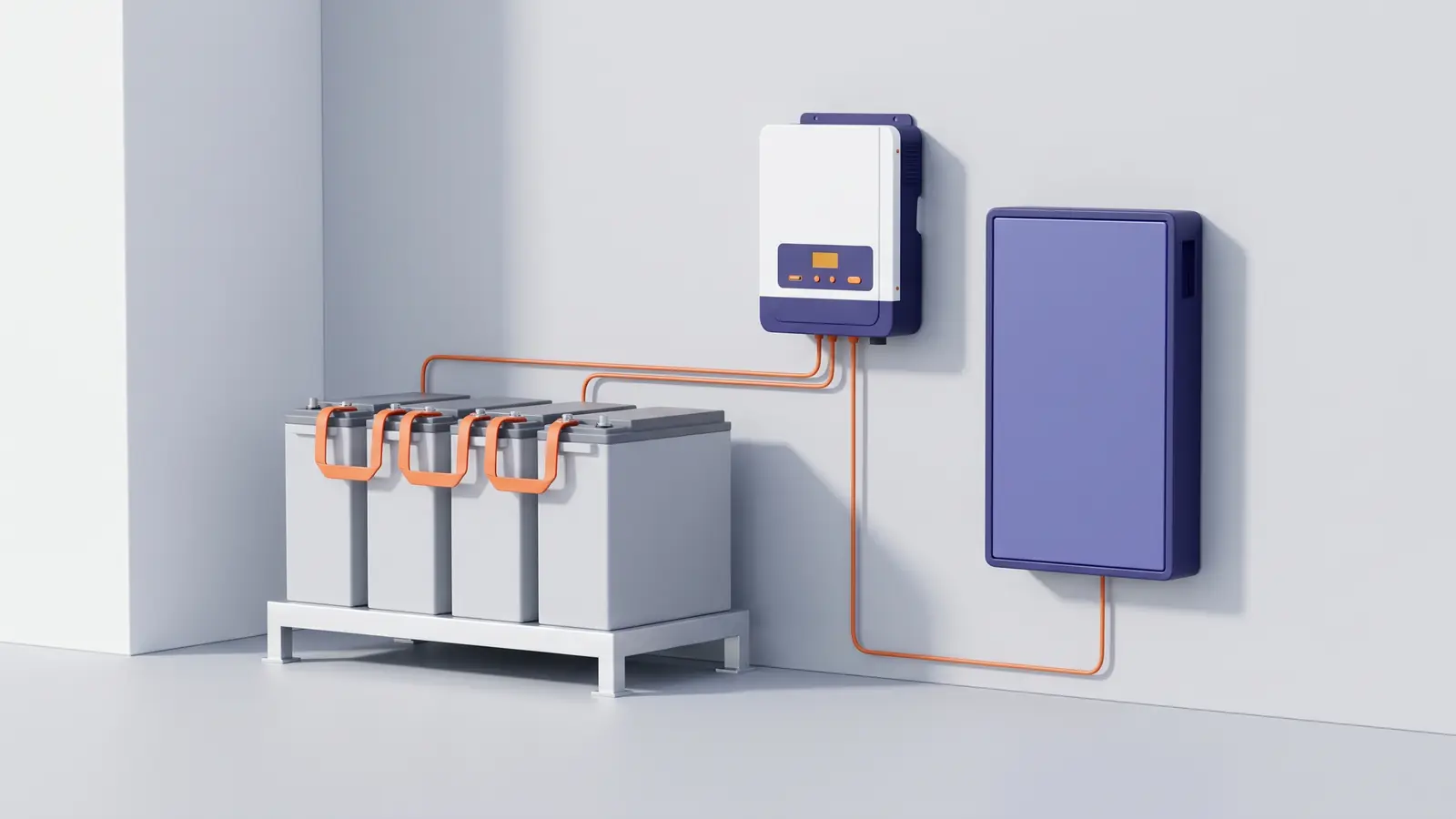
The right battery for a solar inverter starts with the inverter's battery voltage, which is on its spec sheet. A 12V or 24V solar inverter takes a 12V or 24V battery, and a 48V hybrid takes four 12V tubulars in series or one 48V or 51.2V lithium pack.
Then check two things before you pay:
- Charge voltage. A 15-cell pack such as the Surya 48 charges at 54 V, and a 16-cell pack such as the Surya 51 at 57.6 V. Pick the one your inverter or PCU can be set to. Our 48V lithium battery price guide explains the difference.
- Communication. For the inverter to read a lithium battery's state of charge over CAN or RS485, the two need a shared protocol, and a matching socket does not prove that. Send the inverter model to the seller first.
How many hours of backup does a home solar battery give?
Backup hours = voltage × Ah × 0.8 ÷ load in watts. For a Surya 51 at 1,000 W, that is 51.2 × 100 × 0.8 ÷ 1,000, or about 4.1 hours.
| Battery bank | Usable energy | 500 W | 1 kW | 2 kW |
|---|---|---|---|---|
| Four 12V 150Ah tubular at 80% | 5.76 kWh | 11.5 hours | 5.8 hours | 2.9 hours |
| Four 12V 150Ah tubular at half capacity | 3.6 kWh | 7.2 hours | 3.6 hours | 1.8 hours |
| Surya 48 (ours) | 3.84 kWh | 7.7 hours | 3.8 hours | 1.9 hours |
| Surya 51 (ours) | 4.1 kWh | 8.2 hours | 4.1 hours | 2 hours |
| Two Surya 51 in parallel (ours) | 8.2 kWh | 16.4 hours | 8.2 hours | 4.1 hours |
On a smaller system, a 12V 200Ah tubular at 400 W gives 12 × 200 × 0.8 ÷ 400, or 4.8 hours, and a Shakti 12 Plus gives about 5 hours. Inverter losses take a little off all these figures. To size from your own appliances, use the battery backup calculator.
A solar battery also has to refill, so ask your installer whether the panels can charge it on top of the home's daytime use.
Our Surya and Shakti solar batteries
We make the Surya and Shakti batteries, all LFP. Today's live prices, including GST, are ₹69,900 for the Surya 51 and ₹67,700 for the Surya 48. The Shakti range starts at ₹17,950 for the Shakti 12 and suits smaller 12V and 24V solar inverters. The full list is on our lithium solar batteries page.
Each Surya pack comes with a wall bracket and rack ears and has a 5-year replacement warranty. Up to 16 can run in parallel. A certified Halovolt partner installs them at no extra cost in serviced cities, and delivery is free on every online order. We have tested Surya packs with inverters from all major brands. Send us your model and we will confirm the protocol before you order.
For factory-scale storage, a Rajkot anodizing plant runs two Vidyut 240 cabinets, 96 kWh in all, with 150 kWp of solar (case study). The Vidyut 240 is price on request.
GST on solar batteries: 18% when bought separately
GST on a lead-acid or lithium-ion solar battery bought on its own is 18%. Notification 9/2025-Integrated Tax (Rate) lists heading 8507, "Electric accumulators", at S. No. 480 of its 18% schedule, with no split by chemistry (CBIC copy, as corrected on 18 September 2025). Tata Green Batteries, a battery maker, reports lead-acid solar batteries moving from 28% to 18% from 22 September 2025, with lithium-ion packs unchanged at 18% (Tata Green Batteries).
One source disagrees in part. Tally's solar GST guide lists a solar or storage battery under HSN 8507 at 5% in a table, then says batteries sold separately typically attract 18% and complete solar power generating systems are taxed at 5% (Tally, 5 May 2026). The notification's 5% schedule names solar power generators and solar power-based devices, and it does not name batteries there. So a battery billed inside a complete system may be treated differently. Ask the installer how the invoice splits the tax, and ask your accountant if you plan to claim input credit.
To see the GST inside a tax-inclusive price, multiply by 18 and divide by 118. For a ₹69,900 battery, that is ₹10,663 of GST on ₹59,237 before tax (our calculation). If Loom's ₹1,08,000 turned out to exclude it, the bill would be ₹1,27,440 (our calculation).
Solar battery cost against the whole solar system
In Ember's model, a 3 kW rooftop system for a home using about 350 units a month costs ₹1,65,000, or ₹87,000 after the ₹78,000 subsidy, with a 3.3-year payback. Adding a 5 kWh battery raises the overall capital cost to ₹2,27,000 and stretches payback to around 9 years (Ember).
Ember's report text does not give the battery's own price, does not say whether ₹2,27,000 is before or after the subsidy, and does not say whether it includes a hybrid inverter. As a rough scale from the listings above, a lithium pack of about 5 kWh at ₹67,700 (our Surya 48) to ₹1,15,000 is about 41% to 70% of that ₹1,65,000 system (our calculation), before any hybrid inverter or installation cost, which we did not price.
Ember also says that under current metering, the consumer "receives no incremental financial benefit" from the battery (Ember). That applies to its modelled case, and your tariff and state rules may differ. A battery's clearest value is power during cuts and solar for the evening.
PM Surya Ghar subsidy: does it cover the battery?
The subsidy does not pay for the battery itself, as the guidelines read. Clause 5(l) of the scheme's June 2024 guidelines says a rooftop installation may include battery storage, "however, the CFA calculation shall be based on the CFA structure under the scheme as per capacity of solar modules" (PM Surya Ghar guidelines, copy hosted by JBVNL). A consumer manual from the Chennai non-profit CAG reads it the same way (CAG).
- Subsidy amount. ₹30,000 per kW for the first 2 kW and ₹18,000 for the third kW, up to ₹78,000, with nothing extra beyond 3 kW. Special category states and UTs get ₹33,000 and ₹19,800 (guidelines, clause 5(h)). Ember restated the general rates in October 2026.
- Batteries and hybrid inverters. MNRE clarified in September 2024 that residential systems with battery storage remain eligible, and hybrid inverters can be installed under state regulators' rules (Mercom India; Energetica India).
- Non-exporting and off-grid systems. Clause 5(o) of the guidelines makes battery hybrid systems that are grid-connected but not feeding the grid eligible, subject to the state regulator's approval. Off-grid installations are not eligible.
- A battery subsidy is a proposal so far. Ember recommends one, and says a 50% subsidy on battery cost would cut payback to 6.3 years (Ember). Mercom reported in September 2026 that the industry is calling for storage incentives in the next phase (Mercom India). The guidelines run the scheme to FY 2026-27, so check for changes before you sign.
What we could not confirm
- GST notification text. We read the battery entry in the Integrated Tax version, in an ICAI copy hosted on CBIC's site, and did not open the Central Tax version. Notification 01/2026 amended the Central Tax version from 1 May 2026, and the report we read mentions other goods and no batteries (TaxGuru).
- Tax on a battery inside a full solar system. Sources conflict and we found no official answer.
- State subsidies. We did not check whether any state subsidises batteries.
- Current PM Surya Ghar text. We read the June 2024 guidelines and later reports, and did not find an official page that restates the battery clause for 2026.
- Other makers. We could not open Livguard's solar pages, and our searches found no maker-listed solar price for Livguard, Eastman or Microtek. We did not check Amazon or Flipkart.
- Exide cycle ratings. We found no current cycle rating for the Solatubular range, so it is left out of the per-kWh-delivered table.
Sources
- Luminous, solar battery LPTT 12150H, read 4 November 2026
- Luminous, solar battery LPTT 12200H, read 4 November 2026
- Luminous, Helios 51.2V 100Ah, read 4 November 2026
- Luminous, lithium-ion batteries (Helios range), read 4 November 2026
- Exide Industries, solar batteries price list EIL/SOLAR/MRCP/26-27/01, effective 1 July 2026, read 4 November 2026 (PDF)
- Loom Solar, lithium battery collection, read 4 November 2026
- UTL Solar, lithium battery, read 4 November 2026
- IndiaMART, Hemuda Power listing for Livguard LS 15060PTT (marketplace price observation), 4 November 2026
- Halovolt, home solar storage catalogue, prices read 4 November 2026
- Ember, "Plugging storage into India's rooftop solar revolution", 22 October 2026 (PDF)
- Tata Green Batteries, "Battery prices slashed: with great power comes great savings" (undated, read 4 November 2026)
- Tally Solutions, solar HSN code and GST rate guide, 5 May 2026
- CBIC, Notification 9/2025-Integrated Tax (Rate), 17 September 2025, ICAI copy as corrected on 18 September 2025, read 4 November 2026 (PDF)
- TaxGuru, CBIC revises GST rate notification under Finance Act 2026 (Notification 01/2026-Central Tax (Rate), 30 April 2026), read 4 November 2026
- MNRE, PM Surya Ghar guidelines for CFA to residential consumers, June 2024, copy hosted by JBVNL (PDF)
- CAG, PM Surya Ghar Scheme: a consumer manual (PDF)
- Mercom India, residential rooftop solar projects with battery storage eligible for CFA, 23 September 2024
- Energetica India, residential rooftop solar systems with battery storage and hybrid inverters eligible for CFA, 23 September 2024
- Mercom India, solar-plus-storage under PM Surya Ghar 2.0 may hinge on subsidy levels, 8 September 2026 (headline and opening read; the rest needs sign-in)
Frequently asked questions
What is the price of a solar battery in India?
On 4 November 2026, makers' own sites and price lists showed 12V 150Ah tubular solar batteries at ₹17,999 (Luminous selling price) to ₹20,342 (Exide list price), and 200Ah models at ₹23,399 to ₹26,022. Lithium packs of about 5 kWh listed at ₹67,700 to ₹1,15,000. The ₹67,700 is Halovolt's own Surya 48, and Halovolt publishes this guide. Among other makers, the lowest was UTL at ₹72,100.
Is a tubular or a lithium solar battery cheaper?
A tubular battery is cheaper to buy: about ₹9,750 to ₹11,300 per rated kWh across 150Ah and 200Ah models, against ₹13,652 to ₹22,461 for 48V and 51.2V lithium packs on 4 November 2026 (our calculation; the low lithium figure is Halovolt's own Surya 51). Spread over each maker's rated cycles, the order can reverse: about ₹2.84 per kWh delivered for our Surya 51, ₹5.54 to ₹7.57 for other makers' lithium and ₹8.12 for a Luminous 200Ah tubular. Makers rate cycles under their own conditions, so treat this as a rough guide.
Does the PM Surya Ghar subsidy cover a solar battery?
As the scheme's June 2024 guidelines read, the subsidy is not paid on the battery. They let a rooftop system include battery storage but calculate the subsidy on the capacity of the solar modules, up to ₹78,000 for most households. Off-grid systems are not eligible. Ember recommended a battery subsidy in October 2026, which remained a proposal in the sources we read. We did not check state schemes or find an official 2026 restatement of this clause.
What is the GST on a solar battery in India?
A lead-acid or lithium-ion solar battery bought on its own pays 18% GST. Notification 9/2025-Integrated Tax (Rate) lists heading 8507, electric accumulators, in its 18% schedule, and Tata Green Batteries says lead-acid solar batteries moved from 28% to 18% from 22 September 2025. A battery billed inside a complete solar system may be taxed differently, and sources conflict on this, so ask your installer or accountant.
How many hours will a 5 kWh solar battery run a home?
Use voltage × Ah × 0.8 ÷ load in watts. A 51.2V 100Ah battery stores 5.12 kWh, so it runs a 1,000 W load for about 4.1 hours and a 500 W load for about 8.2 hours. Two in parallel double those figures. Inverter losses take a little off, and the panels must be able to refill the battery.