
On 1 November 2026, three makers' own websites (Luminous, Loom Solar and Halovolt, which publishes this guide) listed 48V and 51.2V 100Ah lithium (LFP) batteries at ₹67,700 to ₹1,15,000. The ₹67,700 low end is our own Surya 48; Luminous and Loom Solar listed theirs at ₹92,999 to ₹1,15,000. Each pack stores about 5 kWh, so before you compare quotes, check whether each price includes 18% GST and whether the pack holds 4.8 kWh or 5.12 kWh.
Key Takeaways
- "48V 100Ah" can mean a 15-cell pack (48 V, 4.8 kWh) or a 16-cell pack (51.2 V, 5.12 kWh). Divide the price by the kWh to compare them fairly.
- GST on lithium-ion batteries is 18%. Some makers' pages say their price includes it and some don't say, so ask before you compare.
- A 15-cell pack charges at 54.0 V and a 16-cell pack at 57.6 V. Pick the one your inverter, PCU or rectifier can be set to charge.
- For the inverter to read the battery's state of charge, the two must share a communication protocol as well as a CAN or RS485 socket. Check the inverter maker's approved-battery list, or send the model to the battery seller.
48V 100Ah lithium battery price list (1 November 2026)
These prices were listed on each maker's own website on 1 November 2026. Every pack here is 100Ah with LFP cells. The ₹ per kWh column is our own division of the listed price by the listed energy. We make the Surya packs in the last two rows, so read those as the publisher's own prices.
| Battery (as listed) | Maker's site | Voltage | Energy | Listed price | GST in price? | ₹ per kWh |
|---|---|---|---|---|---|---|
| Luminous Helios 51.2V 100Ah | luminousindia.com | 51.2 V | 5.12 kWh | ₹92,999 | Yes, "inclusive of all taxes" | ₹18,164 |
| Loom Solar CAML 48V 100Ah, rack | loomsolar.com | 48 V | 5 kWh (as listed) | ₹99,000 | Not stated | ₹19,800 |
| Loom Solar CAML 51.2V 100Ah, rack | loomsolar.com | 51.2 V | 5.12 kWh | ₹1,08,000 | Not stated | ₹21,094 |
| Loom Solar CAML 51.2V 100Ah, wall mount | loomsolar.com | 51.2 V | 5.12 kWh | ₹1,15,000 | Not stated | ₹22,461 |
| Halovolt Surya 48, wall or rack | Surya 48 product page | 48 V | 4.8 kWh | ₹67,700 | Yes | ₹14,104 |
| Halovolt Surya 51, wall or rack | Surya 51 product page | 51.2 V | 5.12 kWh | ₹69,900 | Yes | ₹13,652 |
Loom lists its 48V pack as 5 kWh. At 48 V × 100 Ah it would be 4.8 kWh, which gives ₹20,625 per kWh.
A marketplace listing gives one more reference point. Moglix listed a UTL 51.2V 100Ah battery at ₹77,999 including taxes, about ₹15,234 per kWh (Moglix, observed 1 November 2026). Marketplace prices depend on the seller and change often.
Prices move, so check the maker's page on the day you buy. Current prices and specs for our packs are on the 48V lithium battery page.
Price per kWh: comparing 4.8 kWh and 5.12 kWh packs
Price per kWh puts a 48V pack and a 51.2V pack on the same scale. At 100Ah, the 51.2V pack stores 0.32 kWh more (about 7% more), so two packs with the same price are not the same value. Divide the price by the energy and the difference shows.
Per kWh is a starting point. It leaves out cycle life, warranty terms and whether GST is in the price.
48V vs 51.2V lithium battery: 15 or 16 cells
The difference between a 48V and a 51.2V lithium battery is the number of cells in series. LFP cells are 3.2 V nominal and 3.6 V at the end of charge, per TEC's lithium-ion guideline (TEC standards list). Fifteen or sixteen of them give two different packs.
| 15 cells (15S) | 16 cells (16S) | |
|---|---|---|
| Nominal voltage | 48.0 V | 51.2 V |
| Full charge at 3.6 V per cell | 54.0 V | 57.6 V |
| Energy at 100 Ah | 4.8 kWh | 5.12 kWh |
| Suits | Rectifiers, PCUs and inverters that cannot be set above 54 V | Inverters with a lithium setting that charges to 57.6 V |
Sellers call both "48V". Loom Solar lists a "48 V 100 Ah, 5 kWh" rack pack next to a "51.2 V 100 Ah, 5.12 kWh" one (Loom Solar). Luminous gives the Helios 51.2V an operating range of 44.8–57.6 V (Luminous). That equals 16 × 2.8 V to 16 × 3.6 V, which fits a 16-cell pack, though Luminous does not state the cell count.
Some hybrid solar inverters accept either pack. Deye's 48V SUN-3–6K-SG04LP1-EU models list a battery voltage range of 40–60 V and accept "Lead-acid or Lithium-ion" (Deye). Both 54.0 V and 57.6 V fall inside that range. The question to answer is what charge voltage your own equipment can be set to.
Telecom plants are stricter. A -48V DC plant works within a 40.5–57 V window at the equipment input. A 15-cell pack's low end sits on the 40.5 V floor, and a 16-cell pack's charge has to be held at 56.8 V or lower. TEC 66160:2024, the hybrid (AC+DC) UPS GR, sets a charge of 54.0 V or as the purchaser specifies, and 54.0 V matches a 15-cell pack. Our lithium battery guide for telecom towers covers the window, sizing and TEC rules in full.
Some e-rickshaws are also sold as "48V", but they need a traction battery made for the vehicle, and AIS-156 is the Indian safety standard for EV batteries. A rack battery is a different product. See our EV batteries and the e-rickshaw lithium battery price guide.
GST on lithium batteries: 18%
GST on lithium-ion batteries in India is 18%. Under GST 2.0, every battery under heading 8507 moved to a uniform 18%, and lithium-ion was already at that rate (pv magazine India, September 2025). The rate was cut from 28% to 18% in 2018 (Mercom India, July 2018). In 2023 the GST Council's fitment committee kept it at 18% and turned down a cut to 5% (Outlook Business, October 2023).
Here is what 18% does to the prices above:
- GST included: a ₹67,700 price is about ₹57,373 before tax plus about ₹10,327 of GST (₹67,700 ÷ 1.18).
- GST not stated: if a ₹99,000 price turns out to exclude GST, 18% adds ₹17,820, for ₹1,16,820. Its ₹ per kWh rises from ₹19,800 to ₹23,364.
- GST shown separately: the Moglix UTL listing splits ₹77,999 into ₹66,100 plus ₹11,899 of GST, which is 18%.
What sets the price of a 48V lithium battery
Two packs with the same voltage and kWh can still differ on cycle life, enclosure, current and warranty. The Luminous Helios and our Surya 51 are both 51.2V 100Ah packs with specs listed on their makers' sites. We did not record Loom Solar's specs, so ask for its datasheet.
| Spec (as listed by the maker) | Luminous Helios 51.2V 100Ah | Halovolt Surya 51 (our product) |
|---|---|---|
| Rated cycles | Up to 3,000 (DoD not stated) | 6,000 at 80% depth of discharge |
| IP rating | IP20, indoor | IP54 |
| Charge current | 50 A | Not listed |
| Discharge current | 100 A | Not listed separately (100 A BMS, 200 A peak) |
| Warranty | 60 months | 5 years |
The two cycle figures cannot be compared directly, because one states a depth of discharge (DoD) and the other does not.
Ask these questions about any quote:
- Cycle life at a stated DoD. How many cycles, at what DoD and temperature, and how much capacity is left at the end?
- IP rating. Where will the pack sit? Under IEC 60529, IP20 offers no protection against water, so the pack needs a dry indoor spot. IP54 adds protection against dust and splashing water.
- Charge current. What is the maximum charge current? A higher figure refills the pack faster from solar or the grid, if the inverter can supply that current.
- Warranty terms. What counts as the end of life, and is a failed pack replaced or repaired?
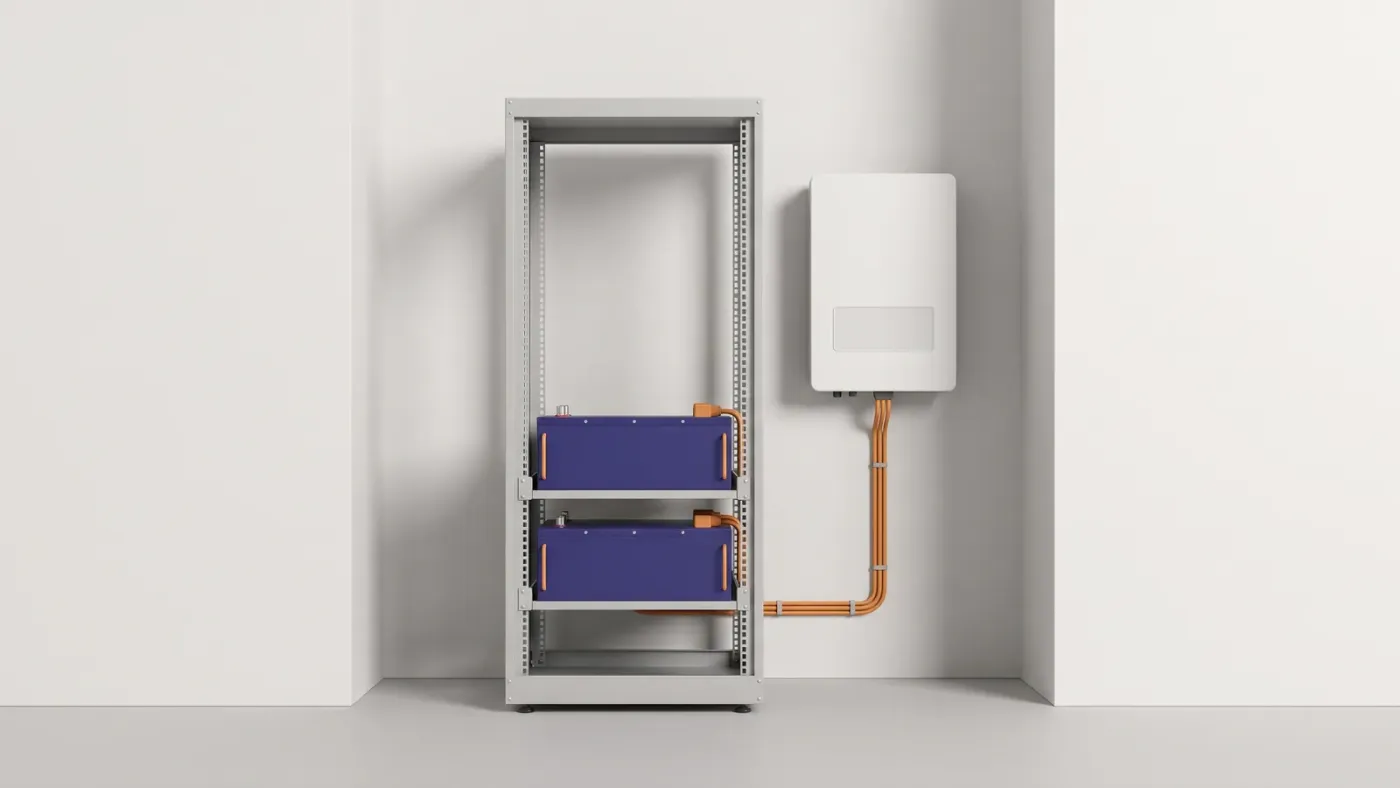
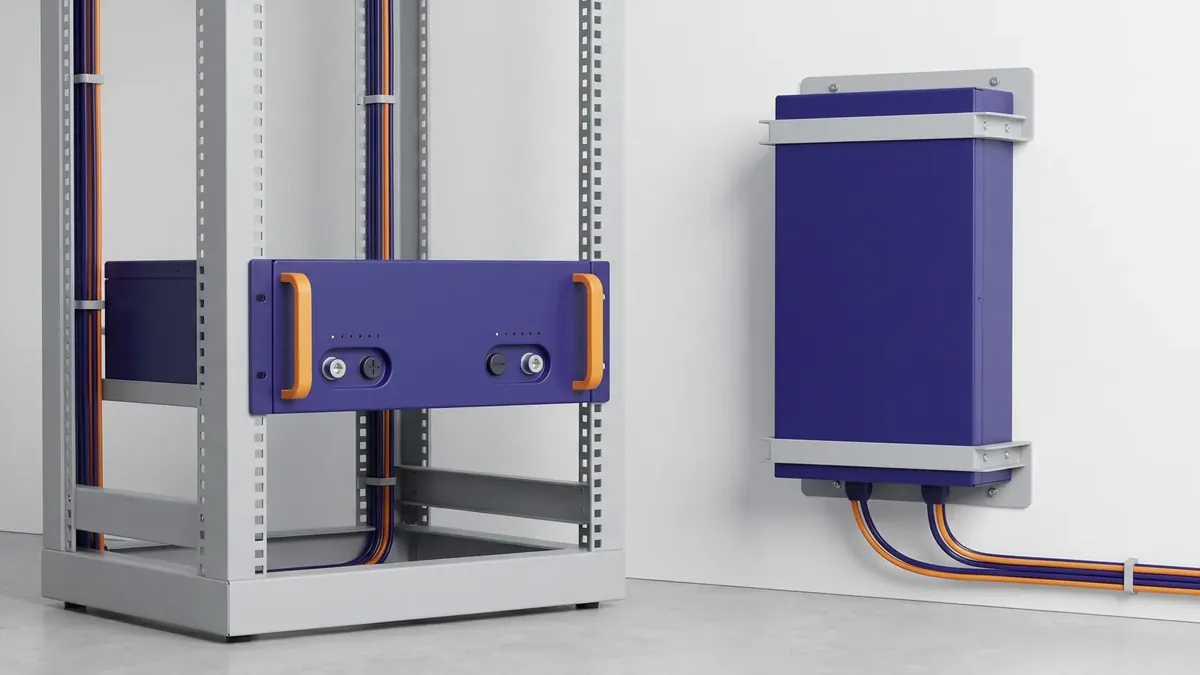
- Rack or wall. Does the price include a rack kit, a wall bracket or both? Loom's 51.2V wall-mount pack is listed ₹7,000 above its rack version.
- Parallel limit. How many packs of the same model can run in parallel? That decides how far the system can grow.
- Installation. Is installation in the price, and who does it?
Specs and warranty for our Surya packs are on the rack and telecom batteries page.
How the cells, BMS and enclosure come together in a pack is on our technology page.
48V lithium battery inverter compatibility checklist
When the data link works, a hybrid inverter reads the battery's state of charge directly. That needs the right voltage and a shared protocol. Work through these before you pay.
- Read the battery settings in the inverter manual. Note the battery types it accepts, its voltage range and the highest charge voltage it can be set to. Deye's page, for example, lists "Lead-acid or Lithium-ion", a 40–60 V range and Li-ion charging that is "self-adaption to BMS".
- Match the port and the protocol. CAN and RS485 are the common ports. Deye lists WIFI, RS485 and CAN on its inverter but does not say which one the BMS link uses. A matching socket does not mean the two speak the same protocol, so ask.
- Check the inverter maker's approved-battery list. Deye publishes lists for its low-voltage inverters; the newest we found is dated 19 October 2026 (Deye, DY-LV48-0132). If your battery is not listed, ask the inverter maker or installer how that affects your inverter warranty.
- Send the inverter model to the battery seller. Ask them to confirm the communication protocol before you order. For our Surya packs, send us your inverter model and we will confirm it.
How many hours of backup a 48V 100Ah battery gives
Backup hours equal usable energy divided by load. Our figures take usable energy as about 80% of rated energy, so a 4.8 kWh pack gives about 3.84 kWh and a 5.12 kWh pack about 4.1 kWh.
| Load | 48V 100Ah (4.8 kWh) | 51.2V 100Ah (5.12 kWh) |
|---|---|---|
| 500 W | about 7.7 hours | about 8 hours |
| 1 kW | about 3.8 hours | about 4 hours |
| 2 kW | about 1.9 hours | about 2 hours |
Two packs in parallel double these figures, so a home drawing 1 kW through the evening gets about 8 hours from two 51.2V packs. Your inverter's own losses take a little off, so treat the table as an estimate. For a figure from your appliance list, use the battery backup calculator.
48V lithium battery vs lead-acid: the cost on the day you buy
A 48V lead-acid bank, usually four 12V batteries in series, costs less to buy. A fair comparison divides each price by the years of service you expect and by the energy you can actually use. Ask a lead-acid seller what depth of discharge and cycle count their rated life assumes, and compare it with the lithium figures above. Our lithium vs tubular inverter battery guide works through that comparison. For 12V and 24V home inverter batteries, see the lithium inverter battery price guide.
Sources
- Luminous India, Helios 51.2V 100Ah lithium battery product page, observed 1 November 2026
- Loom Solar, lithium battery collection (CAML 48V and 51.2V 100Ah), observed 1 November 2026
- Moglix, UTL 51.2V 100Ah lithium solar battery listing (marketplace price observation), observed 1 November 2026
- Halovolt, 48V lithium battery price list (rack and telecom batteries), 1 November 2026
- Deye, SUN-3–6K-SG04LP1-EU hybrid inverter product page, observed 1 November 2026
- Deye, approved battery list DY-LV48-0132, 19 October 2026 (PDF)
- TEC, standards and specifications list (lithium-ion guideline TEC/GL/FA/LIB-801/01/JUL-20 and TEC 66160:2024)
- pv magazine India, IESA welcomes the new tax regime under GST 2.0, 8 September 2025
- Mercom India, GST on lithium-ion batteries reduced from 28% to 18%, 23 July 2018
- Outlook Business, no reduction in GST for EV batteries as fitment committee rejects proposal, 4 October 2023
- BloombergNEF, lithium-ion battery pack prices fall to $108 per kilowatt-hour, 9 December 2025
Frequently asked questions
How much does a 48V lithium battery cost per kWh in India?
On 1 November 2026, three makers' own websites listed 48V and 51.2V 100Ah LFP packs at about ₹13,700 to ₹22,500 per kWh. The low end is Halovolt, which publishes this guide: our Surya 48 (₹67,700) and Surya 51 (₹69,900) worked out to ₹14,104 and ₹13,652 per kWh. Luminous and Loom Solar listed theirs at ₹92,999 to ₹1,15,000, or about ₹18,200 to ₹22,500 per kWh. Loom's page did not say whether GST was included.
Can a business claim GST input tax credit on a lithium battery?
That depends on your GST registration and how the business uses the battery, so check with your accountant. To keep the option open, ask the seller for a GST invoice in your company's name that shows your GSTIN. At Halovolt, you add your GSTIN at checkout and the invoice is issued in your company's name.
Can I connect two 48V lithium batteries together?
Yes, in parallel, if they are the same model and the maker allows it. Parallel packs keep the voltage and add the energy, so two 5.12 kWh packs store about 10 kWh. Check the maker's limit on how many packs can run in parallel.
Will lithium battery prices in India come down?
Global prices are falling, but there is no India figure to go on. BloombergNEF's December 2025 survey put the average lithium-ion pack price at $108 per kWh, down 8% in a year, and stationary storage packs at $70 per kWh, down 45% from 2024. BNEF expects prices to fall again in 2026 (BloombergNEF, December 2025). These are global survey averages in US dollars, not Indian retail prices, and they leave out GST, so they don't predict what a shop in India will charge.