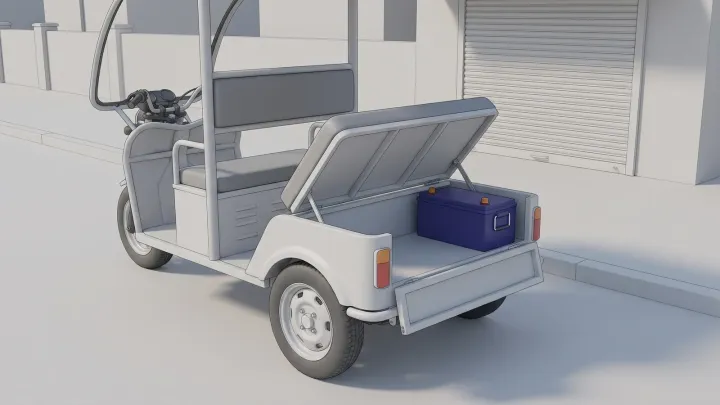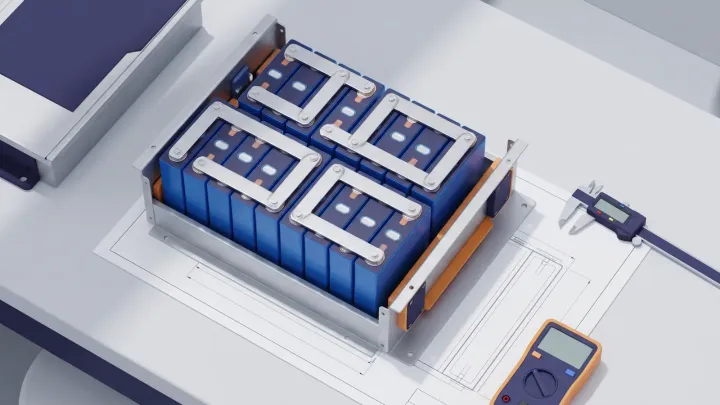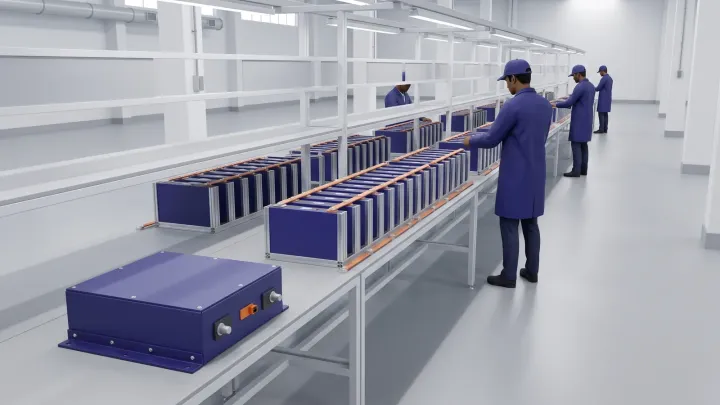

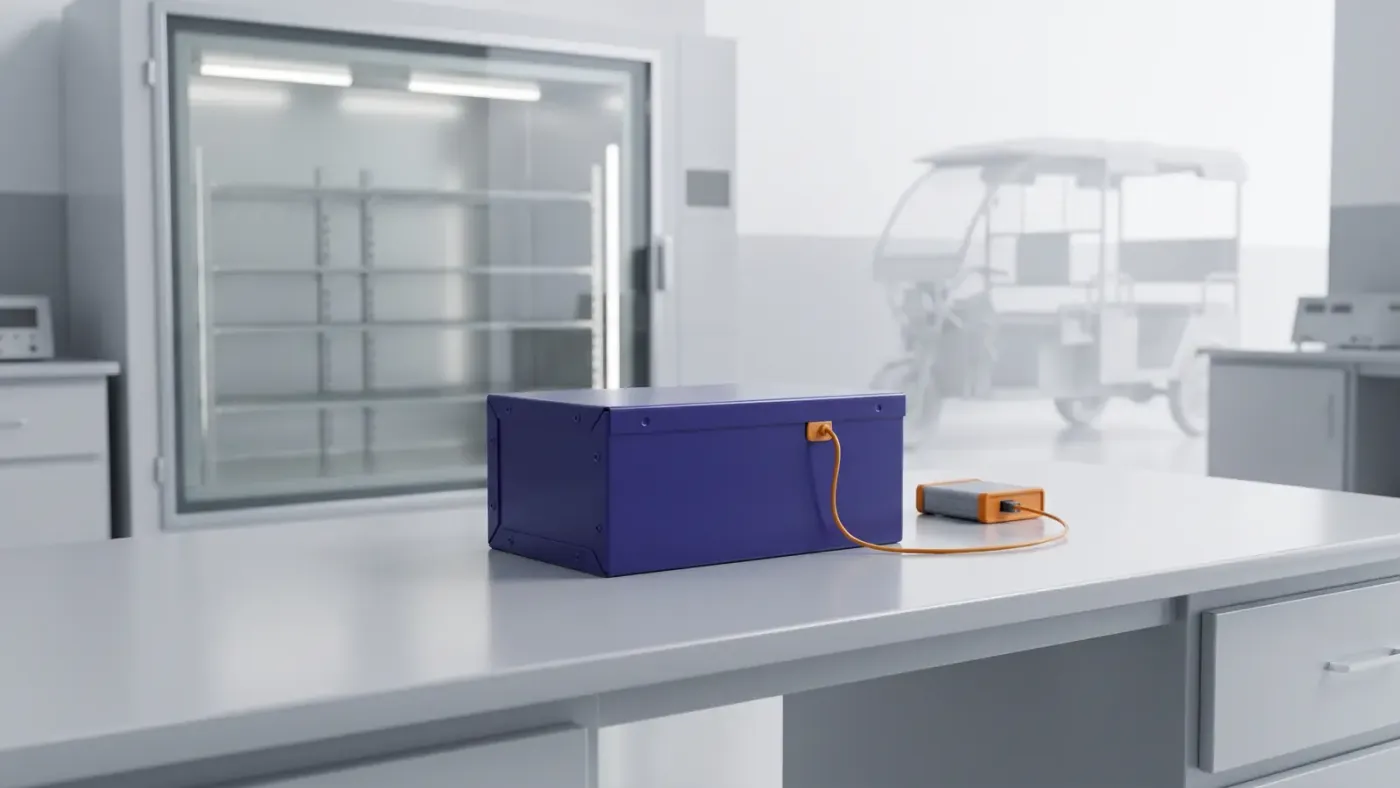
AIS-156 is India's safety standard for electric L-category vehicles (two-wheelers, three-wheelers and quadricycles) and their traction battery packs. Amendment 3 added battery requirements in two phases, Phase 1 from 1 December 2022 and Phase 2 from 31 March 2023. A test agency verifies a pack against them at type approval and for conformity of production (CoP).
Key Takeaways
- Phase 2 (also written Phase II) brought in the thermal propagation test, the IP X7 water test and cell certification to IS 16893 Parts 2 and 3.
- Amendment 3 names IS 16893 for cells and does not mention IEC 62660. BIS lists the 2018 parts of IS 16893 as identical to IEC 62660 editions.
- The Ministry of Road Transport and Highways (MoRTH) notifies the standard. Test agencies notified under Rule 126 of the Central Motor Vehicles Rules (CMVR) do the testing.
- Ask for the certificate that names your exact pack, CoP evidence, the cell certificates and the traceability record for your serial number.
What is AIS-156?
AIS-156 is titled "Specific Requirements for L Category Electric Power Train Vehicles". ARAI (the Automotive Research Association of India) publishes it on behalf of the Automotive Industry Standards Committee, set up under MoRTH. The cover of the standard is dated September 2020, and the copy we read includes Amendment 1 of July 2021.
It has two parts:
- Part I covers the electrical safety of the vehicle.
- Part II covers the REESS (rechargeable electrical energy storage system), which is the traction battery. It excludes batteries used mainly for starting an engine, lighting or other auxiliaries.
The government describes the L category as "a motor vehicle less than four wheels and quadricycle" (Lok Sabha answer, 28 March 2023).
The contents of Part II list these battery tests: vibration, thermal shock and cycling, a mechanical drop test for removable packs, mechanical shock, fire resistance, external short circuit, overcharge, over-discharge and over-temperature. Amendment 3 added its requirements on top of these.
AIS-156, AIS-038 and UN R136 compared
| AIS-156 | AIS-038 (Rev 2) | UN R136 | |
|---|---|---|---|
| Vehicles | L category | M (passenger) and N (goods) vehicles with at least four wheels | L category with a maximum design speed above 6 km/h |
| Issued through | MoRTH and ARAI | MoRTH and ARAI | United Nations regulation |
| Link to AIS-156 | Amended alongside it in 2022, with the same phase dates | AIS-156 says "considerable assistance has been taken from UN R 136" |
UN R136 is the international source that AIS-156 drew on. ARAI's guide to battery standards says AIS-038 Rev 2 drew on GTR 20 and ECE R100 Rev 3. We did not compare these documents clause by clause, so do not treat a report under one as a substitute for another.
AIS-156 Amendment 3 and the two phases
MoRTH set up a team of experts from DRDO, IISc Bengaluru, NSTL Visakhapatnam and IIT Madras (the answer writes "IIT Chennai") to revise the battery safety requirements. The Lok Sabha answer records this, and a practitioner's article on EVreporter links the review to EV fire incidents in 2022.
- 29 August 2022: MoRTH issued the amendments (The Tribune). This was Amendment 2, effective from 1 October 2022.
- 27 September 2022: MoRTH announced that Amendment 3 would apply in two phases, so that vehicle makers could be better equipped to comply (MoRTH press note; date from The Tribune).
- 28 September 2022: S.O. 4567(E) brought in the amendments, according to the Lok Sabha answer. We did not read the S.O. itself.
- 1 December 2022: Phase 1 clauses took effect (MoRTH press note).
- 31 March 2023: Phase 2 clauses took effect (MoRTH press note).
- 20 December 2023: Amendment 4 defined swappable battery packs and swapping stations, and said which charger is used to verify clause 6.1.3 for a swappable pack. The Amendment 3 clauses below read the same in its file (our word-by-word comparison).
Phase 1 and Phase 2 are two start dates for clauses of one amendment. Amendment 3 also removed Amendment 2's RFID tag requirement and cut cell cycling from five cycles to one (EVreporter, and both texts in the Amendment 4 file), so older summaries that mention those items describe the earlier version.
AIS-156 Phase 1 and Phase 2 requirements
This table comes from the phase list in the press note and the clauses in Amendment 3 to AIS-156. "8K" means Annexure 8K of the amendment.
| Requirement | Clause | Phase |
|---|---|---|
| BMS is a microprocessor or microcontroller circuit | 6.1.2.1 | 1 |
| BMS verified for over-charge, over-discharge, over-temperature, overcurrent and short circuit protection | 6.1.2.3 | 1 |
| Charger has voltage cut-off, soft start, pre-charge function, input supply variation protection (230 VAC ±10%) and communication with the BMS | 6.1.3 except (e) | 1 |
| Cells get at least one charge-discharge cycle at C/3, with the data kept by the pack maker | 8K clause 3 | 1 |
| Enough cell-to-cell spacing for heat transfer and for isolating cells in thermal runaway | 8K clause 7 | 1 |
| Additional safety fuse or circuit breaker | 8K clause 8 | 1 |
| Traceability document for each pack | 8K clause 9 | 1 |
| Cell protection during regenerative braking considered in the design | 8K clause 10 | 1 |
| IP X7 water ingress test at 100% state of charge | 6.1.1 | 2 |
| BMS meets EMC (electrical interference) requirements of AIS 004 Part 3 | 6.1.2.2 | 2 |
| Charger has earth leakage detection, Class 1 of IS 12640 Part I:2016 | 6.1.3 (e) | 2 |
| Thermal propagation test and audio-visual warning | 6.11, Annex 8J | 2 |
| Cell manufacturing date visible, with the date printed on the pack | 8K clause 1 | 2 |
| Cells certified to IS 16893 Parts 2 and 3 | 8K clause 2 | 2 |
| Pressure release vent | 8K clause 4 | 2 |
| At least four temperature sensors, with an alarm at 60 °C | 8K clause 5 | 2 |
| Active paralleling circuits, or an allowed alternative, for parallel strings | 8K clause 6 | 2 |
| BMS logs critical data, with at least the latest month kept | 8K clause 11 | 2 |
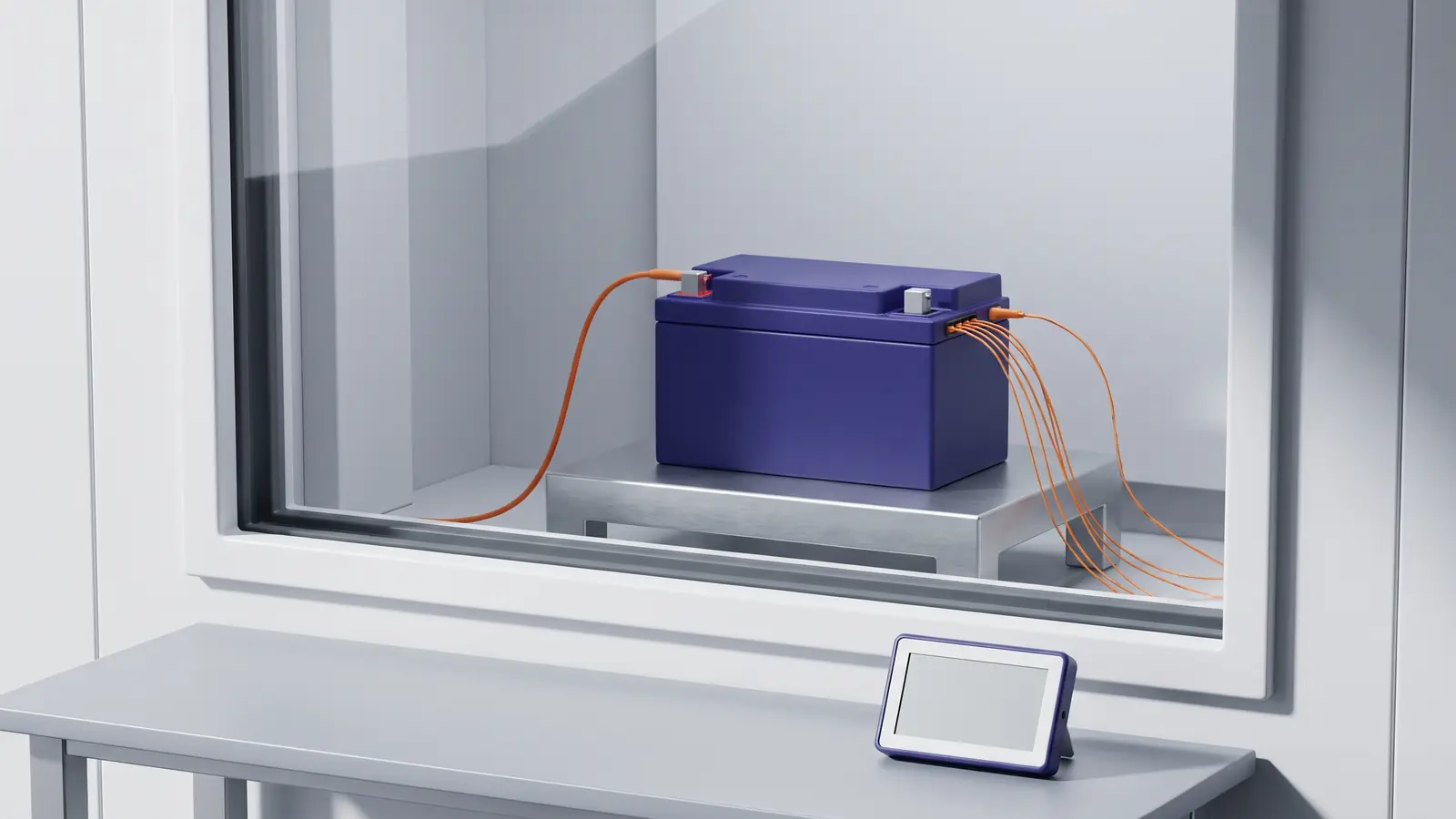
AIS-156 battery requirements in plain English
This section comes from the Amendment 3 text unless another source is named.
IP rating: the IP X7 water test
Clause 6.1.1 says a pack at 100% state of charge "shall be tested for water ingress protection IP X7 as per IEC 60529", and that there shall be no fire or explosion during the test. IP67 shares the water digit 7, but ask for the report of this test at 100% charge, because the clause also sets the no-fire, no-explosion condition.
Thermal propagation test
The test starts a thermal runaway in one cell, usually with a heater, and checks that the event does not lead to fire or explosion of the pack. Single-cell overcharging is allowed if heating is not technically feasible.
- Conditions: 25 ± 2 °C and at least 95% state of charge, on the complete pack or on a subsystem shown to represent it.
- Cell choice: the cell whose heat most easily reaches its neighbours, such as one near the centre of the casing.
- Pass result: no external fire or explosion. The pack also meets the requirement for the heating method if no thermal runaway occurs.
- Warning: the pack must give an audio-visual warning of a thermal event or gases at least 5 minutes before thermal propagation such as fire or explosion.
- Paperwork: the maker submits a risk reduction analysis, a system diagram and a functional diagram.
BMS and temperature sensors
The four sensors must be placed to read the true cell temperature. If the temperature crosses 60 °C an audio-visual alarm must come on, and if the vehicle is in use the BMS must gradually cut power to the motor. Logged data may be stored in the pack or on a remote server.
Clause 6 of Annexure 8K is often summarised as a mandate for active parallel circuits. The text also accepts other circulating-current mitigation techniques, and fuses or bond wires as an alternative.
Cell requirements: IS 16893 and IEC 62660
Cells must be certified to IS 16893 Part 2 and Part 3 "by NABL accredited lab or by test agency notified under CMV Rule 126". IS 16893 covers lithium-ion cells for electric road vehicles. Part 2 deals with reliability and abuse testing and Part 3 with safety requirements (Rajya Sabha answer, 12 December 2025).
Amendment 3 does not mention IEC 62660. The two are closely related, though: BIS lists IS 16893 (Part 2):2018 as identical to IEC 62660-2:2010 and IS 16893 (Part 3):2018 as identical to IEC 62660-3:2016. So if you are shown only an IEC 62660 report, ask how it satisfies the IS 16893 clause.
BIS now also lists first revisions, Part 2:2026 and Part 3:2026. Amendment 3 names no edition, and we could not confirm which edition a new approval must use.
IS 16046, the standard behind the BIS registration covered in our lithium battery manufacturers guide, is a separate standard for portable cells and batteries. It does not appear in the Amendment 3 text.
Traceability
Each pack needs a traceability document with details of the cells, BMS and charger, their serial or batch numbers and charge-discharge data. The pack maker keeps it. Cells must show the month and year of manufacture. If the date on a cell is in code, the pack maker prints the date on the pack and keeps a record of the cell dates.
Who tests AIS-156 battery packs?
MoRTH notifies the standard and updates it (Rajya Sabha answer). Prototypes and components are tested by test agencies notified under Rule 126 of the CMVR (Lok Sabha answer). G.S.R. 888(E) of 19 December 2022 set out the type approval and CoP procedure for traction battery components, according to the same answer. Annexure 8K says the test agency verifies its requirements "at the time of type approval and CoP of REESS".
The base standard lets a pack maker or its accredited representative apply for approval of a pack type. Any later change to that type must be notified to the agency that approved it, and the agency may ask for further testing.
Rule 126 names ARAI and ICAT among the agencies that test prototypes and grant certificates of compliance, and a 2017 notification added GARC:
- ARAI, Pune. ARAI is the secretariat of the standards committee. Autocar Professional reported ARAI certification of Amara Raja's three-wheeler packs under Phase 2 in March 2023.
- ICAT, Manesar. ICAT lists AIS 156 among the battery standards it covers. Autocar Professional reported an ICAT authorisation under Phase II for a 200Ah pack in May 2023.
- GARC, Chennai. G.S.R. 247(E) of 2017 added GARC to Rule 126. Autocar Professional reported in September 2026 that its upgrades include AIS-156 battery test facilities. We could not confirm that this testing is running yet.
Rule 126 names other agencies too. The copy we read is a consolidated one uploaded in 2023, and it does not show the 2017 GARC insertion, so it is not fully current. Check that the agency on a certificate is notified.
Does AIS-156 apply to e-rickshaws and replacement batteries?
Our Gati batteries for e-rickshaws are certified to AIS-156 Phase II like the rest of the Gati range, and we share the certificates with buyers on request. What the rules require of an e-rickshaw or e-cart is a separate question, and we could not confirm how AIS-156 applies to them by law. The CMVR copy we read defines them separately, in Rules 2(cb) and 2(cc), as three-wheeled battery vehicles. That copy was uploaded in July 2023, but its text may be older, because it lacks the 2017 GARC change, so it cannot settle the question. KNN India reported in July 2025 on a draft notification requiring lithium-ion batteries in e-rickshaws and e-carts made after April 2027. That report does not mention AIS-156, and we found no final notification as of 4 November 2026. Ask the vehicle maker or a test agency which approval covers your model. Our e-rickshaw lithium battery price guide covers the buying side.
Replacement packs are also unclear in the rules. We confirm that a Gati pack fits your vehicle before you order, but the vehicle's approval is a question for its maker. Amendment 3 ties verification to type approval and CoP, and we found nothing in it or elsewhere that sets out how it applies to a pack bought for a vehicle already on the road. If the vehicle's approval names its battery, ask the vehicle maker before you change it. A test agency can also advise. Our electric scooter battery price guide covers replacement packs for branded scooters.
What to ask to see before you buy an AIS-156 battery
These are our suggestions, based on the clauses above.
- The certificate for your exact pack. It should name the model, voltage and capacity, the test agency, and the amendment and phase it covers.
- CoP evidence. Approval rests on a sample of the pack type, so ask how the maker shows that production packs still match it.
- Changes since approval. If the cells or BMS have changed, ask whether the agency was told and what it decided.
- Cell certificates. Ask for IS 16893 Part 2 and Part 3 certificates for the cell model in your pack, and who issued them.
- Traceability record. Ask for the record linked to your pack's serial or batch number, and check the manufacturing date printed on the pack.
- Thermal warning and data log. Ask what the warning looks and sounds like on your vehicle, and how you or the service team can read the logged data.
- The charger. Amendment 3 includes charger requirements, so ask whether the certificate or report covers the charger you will use.
- The vehicle maker's view. For a vehicle you already own, ask whether the pack fits within the vehicle's approval.
We found no public register for checking a battery's AIS-156 certificate. If a document looks doubtful, contact the agency named on it.
The clauses we read deal with safety. They do not set cycle life, range or warranty, so compare those separately and get them in writing.
Halovolt Gati batteries and AIS-156
We make the Gati range, so read this section as a maker's statement. Every Gati battery in our shop is certified to AIS-156 Phase II, and we share the certificates with buyers on request. We don't publish them on the site. The certificates cover our standard Gati options, so ask us first if you need a different vehicle class or charger. Other makers have also reported AIS-156 certificates, as the articles above show, so ask each one for the same documents.
The Gati range covers e-rickshaws with the Gati 105 and Gati 132, and L5 e-autos with the Gati Auto 210. The Gati Cargo 132 is for cargo three-wheelers and L5 cargo vehicles. Gati batteries are Price on request, so ask us for a quote. Our shop has no scooter battery.
Vehicle makers who need a pack built to a chassis can talk to our OEM team. A changed design has to be handled against the approval rules above, so settle the certification plan for your pack at the start. For one Ahmedabad dealer we built custom LFP packs for cargo e-rickshaws; that case study covers the design work and does not report AIS-156 test data.
What we could not confirm about AIS-156
- Amendment 4's source. MoRTH's current site and ARAI's download server did not serve us this file. We read a copy archived from a test lab's website, with ARAI's printing block and the date 20 December 2023. We could not confirm whether any later amendment exists.
- MoRTH's own files. For the same reason, we read archived copies of Amendment 3, the press note and the base standard.
- IS 16893 and test methods. We read BIS's listings for IS 16893, and we did not read the standard itself or IEC 60529.
- IS 18590:2024. BIS published this standard for L-category vehicles in 2024 (Autocar Professional). We could not confirm how it relates to AIS-156.
This guide explains the standard for buyers and is not legal or compliance advice. Vehicle makers should work from the current text with their test agency.
Sources
- MoRTH, Amendment 3 to AIS-156 (09/2022), archived copy of 11 November 2023, read 4 November 2026
- AIS-156 Amendment No. 4 (12/2023) with Amendments 1 to 3, dated 20 December 2023, archived copy of 18 May 2026 from a test lab's site, read 4 November 2026
- MoRTH, press note on amendments to EV battery testing standards, archived copy of 1 May 2023, read 4 November 2026
- ARAI, AIS-156 with Amendment 1, cover dated September 2020, archived copy read 4 November 2026
- Ministry of Heavy Industries, Lok Sabha unstarred question 4431, 28 March 2023
- Ministry of Heavy Industries, Rajya Sabha unstarred question 1528, 12 December 2025
- MoRTH, G.S.R. 247(E), 15 March 2017, copy on the Chhattisgarh transport site
- Central Motor Vehicles Rules, 1989, consolidated copy on Supreme Court Observer, uploaded July 2023, read 4 November 2026
- United Nations Regulation No. 136, copy on Japan's MLIT site, read 4 November 2026
- BIS, IS 16893 (Part 2):2018 listing, read 4 November 2026
- BIS, IS 16893 (Part 3):2018 listing, read 4 November 2026
- BIS, IS 16893 (Part 2):2026 listing, read 4 November 2026
- BIS, IS 16893 (Part 3):2026 listing, read 4 November 2026
- ICAT, battery testing capabilities page, read 4 November 2026
- EVreporter, guide to battery safety standards in India, compiled by ARAI, 13 December 2021, updated 28 September 2022
- EVreporter, AIS-156 additional safety requirements: a practitioner's perspective, 9 September 2022, updated 28 September 2022
- The Tribune, government defers rollout of EV battery safety norms, 27 September 2022
- Autocar Professional, Amara Raja Batteries' EV battery receives safety certificate, 28 March 2023
- Autocar Professional, Godawari Electric Motors receives ICAT certification for its Li-ion battery, 16 May 2023
- Autocar Professional, Bureau of Indian Standards introduces two new safety norms for EVs, 24 June 2024
- Autocar Professional, GARC upgrades automotive testing infrastructure under PM E-DRIVE, 28 September 2026
- KNN India, government to enforce mandatory audits for e-rickshaw and e-cart manufacturers, 31 July 2025
Frequently asked questions
What is AIS-156?
AIS-156 is the Indian safety standard for electric L-category vehicles, which are two-wheelers, three-wheelers and quadricycles. Part I covers the vehicle's electrical safety and Part II covers the traction battery, called the REESS. It drew on UN Regulation 136. AIS-038 (Rev 2) is the matching standard for M and N category vehicles with at least four wheels.
What is the difference between AIS-156 Phase 1 and Phase 2?
They are two start dates for clauses of Amendment 3. Phase 1, from 1 December 2022, covers items such as the microprocessor BMS, the extra fuse, cell spacing and traceability. Phase 2, from 31 March 2023, covers the IP X7 water test, the thermal propagation test, BMS EMC testing, four temperature sensors, data logging and cell certification to IS 16893 Parts 2 and 3.
Does AIS-156 require cells to meet IS 16893 or IEC 62660?
Amendment 3 requires cells to be certified to IS 16893 Part 2 and Part 3, by an NABL-accredited lab or a test agency notified under CMV Rule 126. It does not mention IEC 62660, though BIS lists the 2018 parts of IS 16893 as identical to IEC 62660-2:2010 and IEC 62660-3:2016. BIS also lists 2026 revisions, and we could not confirm which edition applies to a new approval.
Who approves AIS-156 batteries in India?
MoRTH notifies the standard, and test agencies notified under Rule 126 of the Central Motor Vehicles Rules do the testing. They verify a pack at type approval and for conformity of production. Published reports show ARAI and ICAT issuing AIS-156 Phase 2 certification. GARC was added to Rule 126 in 2017, but we could not confirm that its AIS-156 battery testing is running yet.
What should I ask for when a seller says a battery is AIS-156 certified?
Ask for the certificate that names your exact pack model, the test agency, and the amendment and phase it covers. Also ask for conformity of production evidence, IS 16893 cell certificates and the traceability record for your pack's serial number. For a vehicle you already own, ask the vehicle maker whether the pack fits within the vehicle's approval.