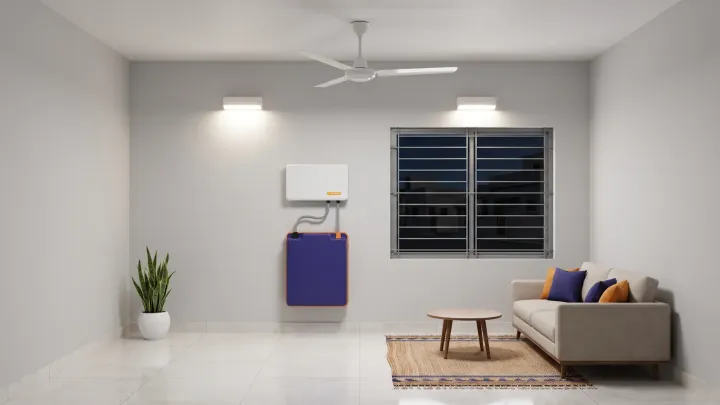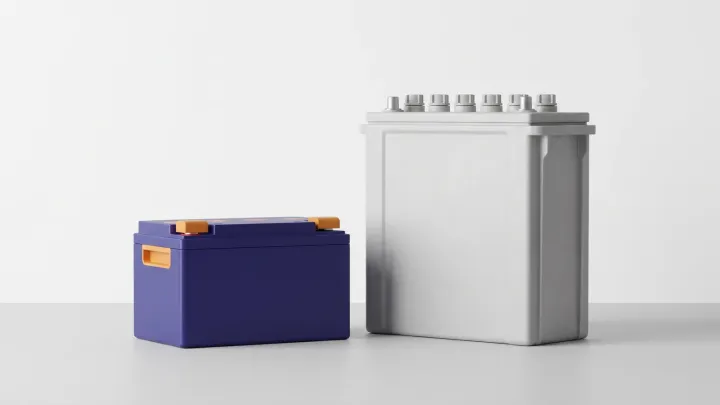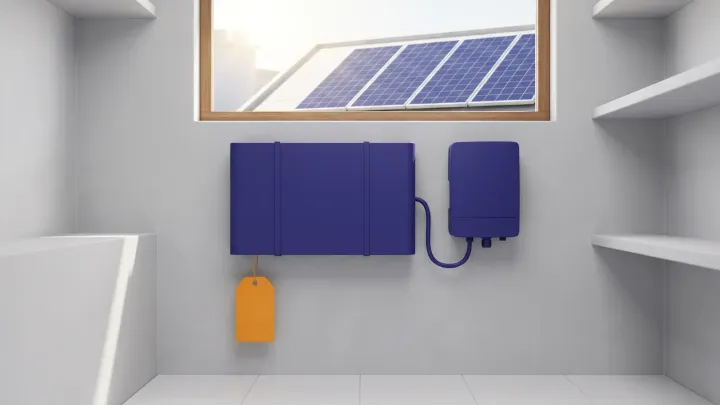
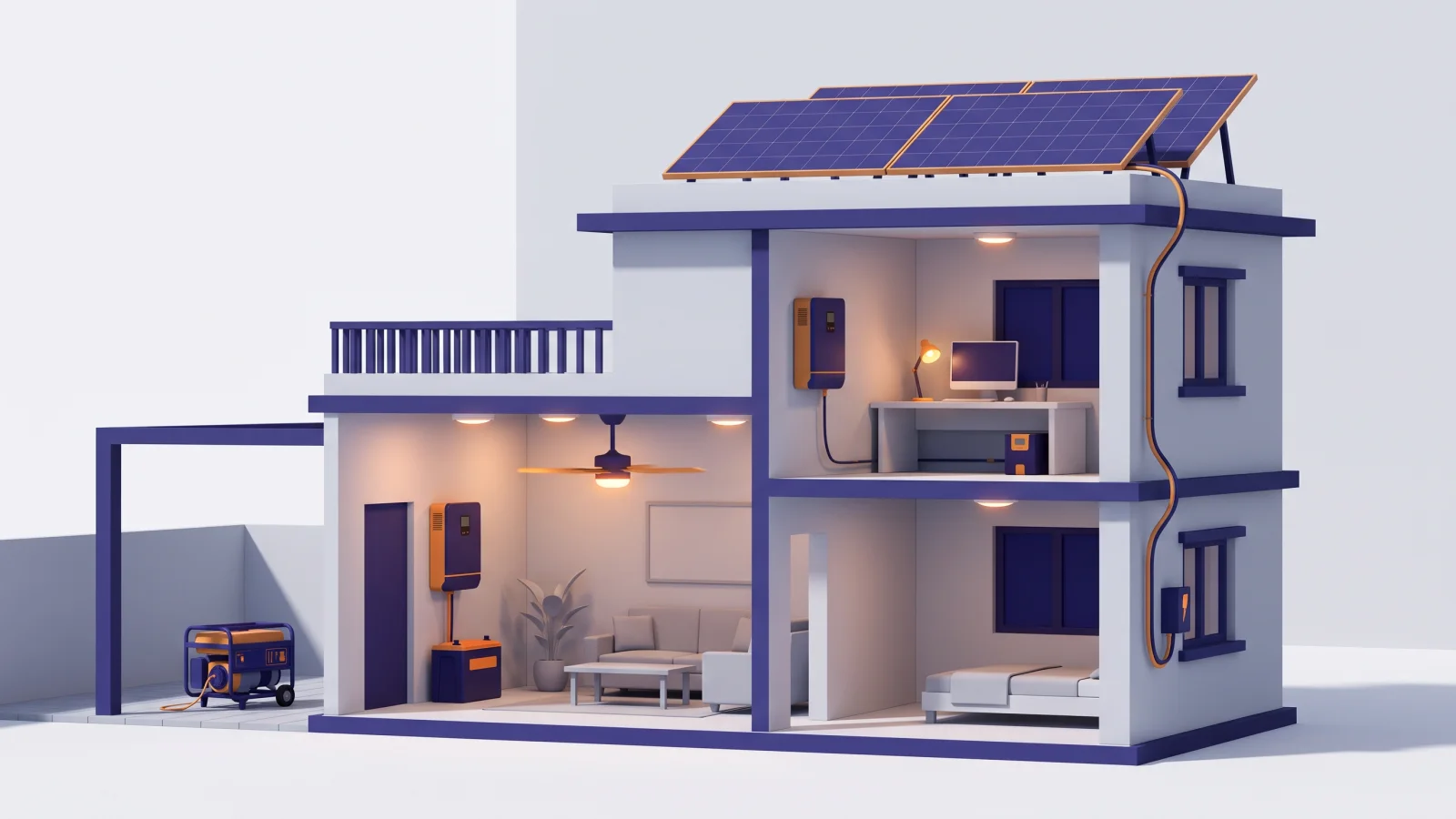
For fans, lights, a TV and a Wi-Fi router through a cut of a few hours, an inverter with a battery is a common choice for power backup for home: it switches over by itself and burns no fuel, so it can sit indoors. A computer UPS protects a desktop PC for minutes, a generator suits heavy loads and outages that last a day, and solar with a battery recharges from the roof. Choose by how long your cuts last and how many watts must keep running.
Key Takeaways
- Work out any battery option's backup from its kWh and your load in watts. The worked examples below put lithium, tubular and solar batteries on one basis.
- A UPS is the fastest to switch, and a generator is the only option here that runs an air conditioner all evening without a very large battery.
- CEA rules make a grid-connected rooftop system stop feeding the grid within two seconds of a power cut, so a standard grid-tie inverter shuts down. Solar backs up a home only with a battery and a hybrid inverter.
- We make the lithium batteries and inverters named in this guide. We sell no generator, UPS, solar panels or solar inverter.
Power backup for home options compared
The prices are dated observations from the sources named in each row, so check them on the day you buy.
| Option | What it keeps running | How long | Switch-over | Price seen | Upkeep and drawbacks |
|---|---|---|---|---|---|
| Inverter + tubular battery | Fans, lights, TV, router; a fridge on 24V sets | Hours, set by the battery | Automatic, in milliseconds | Luminous Zelio+ 1100 + 150Ah tubular, ₹22,598 (1 Nov 2026) | Water top-ups, a ventilated spot, 52.5 kg for a Luminous 150Ah |
| Inverter + lithium battery | Same loads | Hours, set by the battery | Automatic; 20 ms on our Prakash | Prakash 1100 + Shakti 12, ₹28,450 (16 Nov 2026) | Costs more to buy; no water or fumes |
| Inverter with a built-in lithium battery | A small flat's loads, up to 880 W on the Urja | About 4 hours at 250 W (Urja) | 20 ms (Urja) | Urja, ₹28,800 (16 Nov 2026) | Battery size is fixed at 1.28 kWh |
| Computer UPS | A desktop PC, monitor and router | About 10 to 15 minutes (Schneider Electric) | About 10 ms (Schneider Electric) | APC Back-UPS 600VA, ₹4,750 (Schneider eShop, 16 Nov 2026) | Too small for fans and lights |
| Online UPS | Equipment that must never blink | Set by its battery bank | Zero transfer time (Vertiv) | APC Easy UPS On-Line 3kVA, ₹47,613 (Schneider eShop, 16 Nov 2026) | Costs more; we could not confirm whether that price includes batteries |
| Petrol or diesel generator | Heavy loads such as an air conditioner or pump, by size | As long as there is fuel | Manual: start it and switch over (both listed models are recoil start) | 1600 VA petrol inverter generator ₹47,933; 2 kW petrol generator ₹27,499 (Moglix, 16 Nov 2026) | Fuel every hour, noise, exhaust; must run outdoors |
| Solar panels + battery | The same loads as an inverter, charged by the sun | Set by the battery, refilled by day | Set by the hybrid inverter; read its spec sheet | Surya 51 battery alone, ₹69,900 (16 Nov 2026); panels and hybrid inverter extra | Highest cost; the subsidy is worked out on panel capacity only |
The Luminous price is for the Zelio+ 1100 and the RC 18000 Pro bought separately (₹8,199 + ₹14,399), read on Luminous's own pages on 1 November 2026, and the 52.5 kg weight is from the RC 18000 Pro page. The Schneider eShop's ₹4,750 line shows no tax note; its online UPS line says "Inclusive of all Taxes". The two generator prices are marketplace listings on Moglix, for the Himalayan Power UL-20i and the Vinspire LX2500, both including GST.
Inverter with a battery: home battery backup for everyday cuts
An inverter sits between the mains and the circuits you wire to it. When the mains fails it switches those circuits to the battery, and when power returns it recharges the battery. It needs no one at home to start it, makes no exhaust and can sit indoors (a tubular battery still needs a ventilated spot).
Switch-over speed varies by model. Schneider Electric, which makes UPSs, puts a typical inverter at almost 500 milliseconds (Schneider Electric, updated April 2025). Read the figure on the spec sheet of any model you consider. A laptop runs on its own battery through the switch. A desktop PC may restart, which is why our shop and office inverter guide suggests a small UPS for it.
Tubular or lithium battery
A tubular lead-acid battery costs less on the day you buy it, and on a tight budget or with rare cuts it is a sound choice. It needs distilled-water top-ups and a ventilated spot; our lithium vs tubular inverter battery guide gives Luminous's check intervals.
A lithium (LFP) battery has no water to top up and no gas to vent, so it can sit next to the inverter. Our Shakti batteries are rated for 4,000 cycles at 80% depth of discharge, and the same guide compares cycle life, weight and cost per kWh by brand.
Inverter with a built-in lithium battery
Some makers put the inverter and a lithium battery in one box. Luminous sells the Li-ON 1250, and we make the Urja, an 1100 VA inverter with a 1.28 kWh LFP battery in one wall unit. One box saves floor space and wiring. The trade-off is a battery size fixed when you buy it; ask the maker whether an external battery can be added.
Computer UPS and online UPS for home
A UPS keeps a computer running through the moment the mains drops. Schneider Electric puts a UPS's changeover at "around 10 milliseconds" and its backup at "around 10 to 15 minutes only", and says a UPS is "mainly suitable for electronic devices and IT systems" (Schneider Electric). That is long enough to save your work and shut the PC down, and the table above gives the price of one APC unit from Schneider's India eShop.
An online (double-conversion) UPS runs the load from its battery all the time, so there is no switch at all; Vertiv, a UPS maker, gives it zero transfer time. It suits a home server, a network storage box or anything else that must never blink.
The shop and office guide linked above explains how to put a desktop on a small UPS alongside an inverter, and why a laser printer belongs on mains.
Generator for home: running costs and safety rules
A generator handles heavy loads and long outages better than the other options here. It runs for as long as it has fuel and can be refuelled during the cut, while a battery has to wait for the mains to recharge. A large enough set runs an air conditioner, which our calculator counts at 1,500 W for a 1.5 tonne unit. Matching that from a battery takes a large bank, as the worked examples below show.
The costs come every hour it runs. Fuel use depends on the set and its load, and we could not find a litres-per-hour figure on the makers' own sites we checked. Ask any dealer for litres per hour at 75% load and the tank size.
Before you buy one, check emissions, noise, exhaust and wiring:
- Emissions. New diesel gensets with engines up to 800 kW must meet the CPCB IV+ emission norms from 1 July 2023, according to generator maker Mahindra Powerol. Petrol sets fall under separate rules we could not confirm.
- Noise. Under the Environment (Protection) Rules, a new diesel genset up to 1000 kVA may not exceed 75 dB(A) at 1 metre from its enclosure, and must come with an acoustic enclosure fitted by the maker (Rules text on FAOLEX).
- Exhaust. The US Consumer Product Safety Commission says never to run a portable generator inside a home or garage, "even if doors and windows are open", and to keep it at least 20 feet (about 6 metres, our conversion) away with the exhaust facing away (CPSC).
- Wiring. We advise connecting a generator to house wiring only through a changeover switch fitted by a licensed electrician, and checking your housing society's rules.
Solar panels with a battery: backup that recharges by day
A rooftop solar system without a battery switches off in a power cut. The Central Electricity Authority's connectivity rules require a grid-connected system to "cease to energise the electricity system within two seconds" when the grid fails (CEA regulations, 2013, as amended). To keep your home running, the system needs a battery and a hybrid solar inverter, which charges the battery from the panels and runs the home from it.
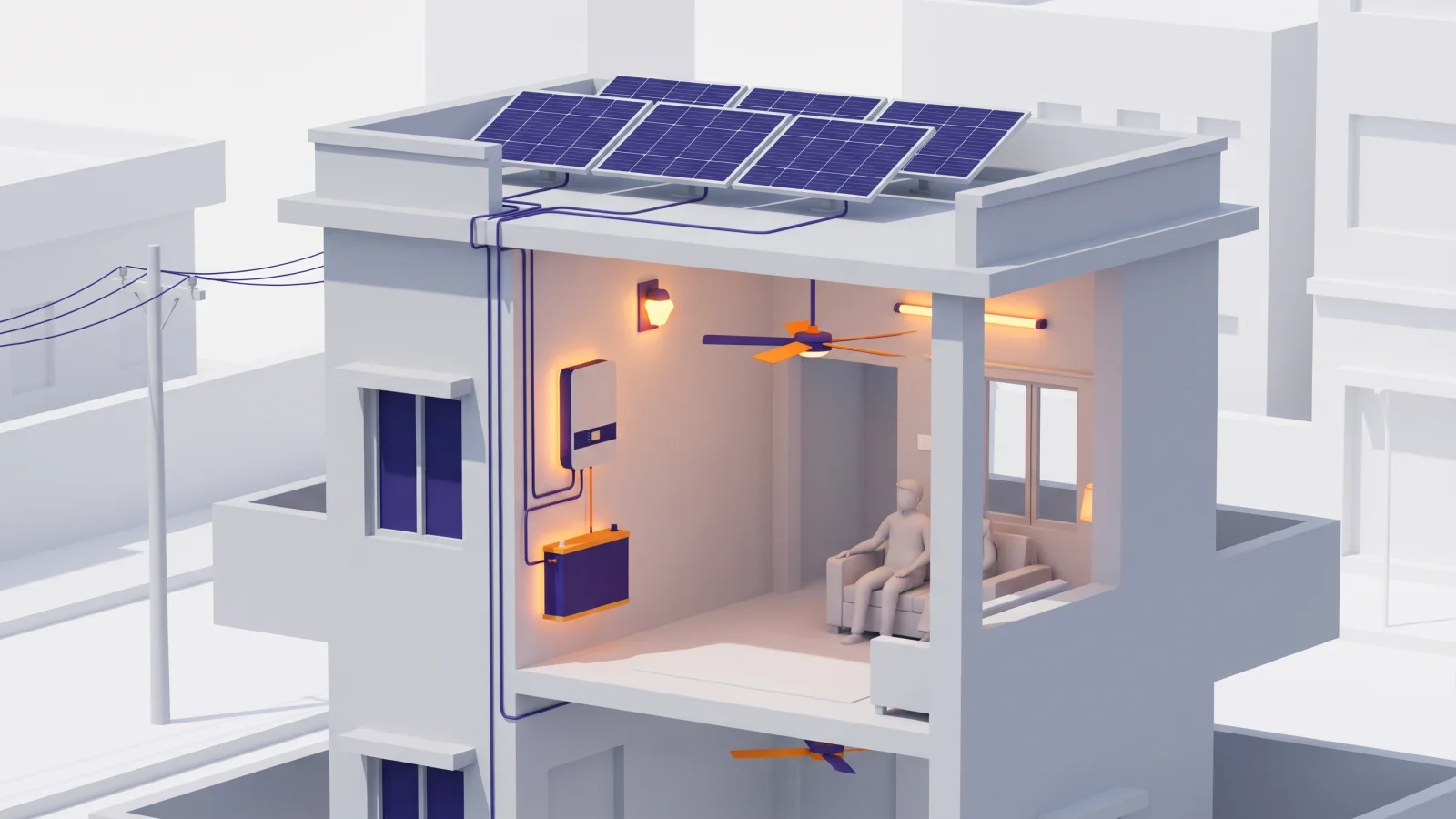
Solar with a battery costs the most of the options here. PM Surya Ghar lets a rooftop system include a battery, but its June 2024 guidelines work out the subsidy only on solar module capacity, and off-grid systems are not eligible (PM Surya Ghar guidelines, copy hosted by JBVNL). Our solar battery price guide sets out battery prices per kWh and what the subsidy does and does not cover.
We make solar batteries. We do not sell solar panels or hybrid solar inverters, so those come from your installer.
Which power backup suits your home: by outage length and load
Average figures hide when your cut comes and how long it lasts, so plan for the longest cut your street usually gets. Our best inverter and battery for home guide gives the national supply figures and five steps to size an inverter in VA.
- Short cuts, and a desktop PC is the worry: a computer UPS.
- Cuts of one to six hours, with fans, lights, a TV, a router and perhaps a fridge (up to about 800 W): an inverter with a battery. Lithium suits daily cuts; tubular costs less when cuts are rare.
- A small flat with no room for a battery trolley: an inverter with a built-in battery.
- An air conditioner, a 1 HP water pump (750 W in our calculator) or cuts that last most of a day: a generator, an inverter rated for the pump's start-up surge, or a large battery bank sized with the formula below.
- Daytime cuts, a sunny roof and a wish to use solar after dark: panels with a battery and a hybrid inverter.
The options also combine: an inverter for fans and lights, a small UPS for the PC and a generator for the air conditioner during long outages.
Home battery backup time: worked examples
Every battery backup for home uses one sum: backup hours = battery voltage × Ah × 0.8 ÷ load in watts. We count 80% of a lithium battery's rated energy as usable, the depth of discharge our cycle ratings use. Our battery backup calculator counts a tubular at half its rated capacity, because deep discharges wear lead-acid out quickly, so the tubular row shows both bases. None of these figures include inverter losses, so expect a little less in practice.
| Home and load | Battery | Sum | Backup (our calculation) |
|---|---|---|---|
| 1BHK: 2 fans, 4 LED lights, a small efficient TV, router, about 250 W | Urja's built-in 12.8V 100Ah | 12.8 × 100 × 0.8 ÷ 250 | about 4.1 hours |
| 2BHK: 3 fans, 6 LED lights, TV, router, about 400 W | Shakti 12 Plus, 12.8V 200Ah | 12.8 × 200 × 0.8 ÷ 400 | about 5.1 hours |
| Same 400 W | 12V 150Ah tubular, 80% basis | 12 × 150 × 0.8 ÷ 400 | about 3.6 hours |
| Same 400 W | 12V 150Ah tubular, calculator's 50% basis | 12 × 150 × 0.5 ÷ 400 | about 2.3 hours |
| Larger home with a fridge, about 800 W | Shakti 24 Plus, 25.6V 200Ah | 25.6 × 200 × 0.8 ÷ 800 | about 5.1 hours |
| Evening load on solar, 1 kW | Surya 51, 51.2V 100Ah | 51.2 × 100 × 0.8 ÷ 1,000 | about 4.1 hours |
| 1.5 tonne air conditioner, 1,500 W | Surya 51, 51.2V 100Ah | 51.2 × 100 × 0.8 ÷ 1,500 | about 2.7 hours |
Four hours of a 1,500 W air conditioner needs about 7,500 Wh of rated battery energy (1,500 × 4 ÷ 0.8, our calculation), roughly one and a half Surya 51 packs, plus an inverter that can start a compressor. A generator whose rated output covers the compressor's running load and start-up surge does the same job, refuelled as needed.
What we make for home power backup
We are Halovolt, a Rajkot maker of LFP and NMC lithium battery packs, and we publish this guide. Our home products are listed here so you can compare them with the options above. Prices include GST, and delivery is free on every online order.
- Urja, ₹28,800: an 1100 VA, 880 W pure sine wave inverter with a 12.8V 100Ah LFP battery in one 27 kg wall unit. Warranty is 5 years on the battery and 3 years on the inverter.
- Prakash 1100, ₹10,500, with a Shakti 12 (₹17,950) or Shakti 12 Plus (₹34,400): a 12V inverter and battery sold separately, for 1BHK and 2BHK loads. Shakti batteries also work with standard 12V and 24V home inverters; send us your inverter's model and our support team confirms the fit.
- Prakash 2200, ₹15,500, with a Shakti 24 Plus (₹69,900): a 24V system for larger homes, rated 2200 VA and 1760 W.
- Surya 51, ₹69,900: a 5.12 kWh solar battery for hybrid solar inverters, linked over CAN or RS485, with up to 16 packs in parallel and 6,000 cycles at 80% depth of discharge. A certified Halovolt partner installs it at no extra cost in serviced cities.
Shakti batteries carry a 5-year replacement warranty against manufacturing defects and capacity loss below 70% of rated capacity, and the Prakash inverters 3 years. The Shakti, Prakash and Urja are made for self-installation. Payment is by UPI or bank transfer through our sales team on WhatsApp.
To size your own backup, list your appliances in the battery backup calculator, then compare models and prices on our lithium inverter batteries and inverters page. For a rooftop system, see our home solar batteries.
Sources
- Schneider Electric India eShop, "Home UPS vs Inverter: What's the Difference?", 27 January 2023, updated 19 April 2025
- Schneider Electric India eShop, APC Back-UPS category page (APC Back-UPS 600VA and APC Easy UPS On-Line 3kVA prices), observed 16 November 2026
- Vertiv, "What are the different types of UPS systems?" (undated, read October 2026)
- Moglix, Himalayan Power Oasis UL-20i 1600 VA petrol inverter generator listing (marketplace price observation), 16 November 2026
- Moglix, Vinspire LX2500 2 kW petrol generator listing (marketplace price observation), 16 November 2026
- Mahindra Powerol, "Navigating CPCB IV+ norms" (undated, read 16 November 2026)
- Environment (Protection) Rules, 1986, as amended, noise limits for generator sets (FAOLEX copy, text as of 2004)
- US Consumer Product Safety Commission, "Protect Your Family from Carbon Monoxide Poisoning" (undated, read 16 November 2026)
- Central Electricity Authority, Technical Standards for Connectivity of the Distributed Generation Resources Regulations, 2013, with amendments (copy hosted by CBIP)
- MNRE, PM Surya Ghar guidelines for CFA to residential consumers, June 2024, copy hosted by JBVNL (PDF)
- Luminous, Zelio+ 1100 product page, read 1 November 2026
- Luminous, Red Charge RC 18000 Pro product page, read 1 November 2026
- Luminous, Li-ON 1250 product page, read 1 November 2026
Halovolt prices and specifications are from our live catalogue on 16 November 2026, including GST.
Frequently asked questions
Is an inverter or a generator better for home power backup?
An inverter with a battery suits regular cuts of a few hours with fans, lights, a TV and a router, and nobody has to be home to start it. A generator suits heavy loads such as an air conditioner or a water pump, and outages that last most of a day, because you can refuel it while the power is still off. It burns fuel every hour it runs and must stay outdoors, well away from doors and windows.
Can a home inverter run an air conditioner?
Only a large system can. A 1.5 tonne air conditioner draws about 1,500 W, so the inverter's watt rating must cover that load plus the compressor's start-up surge; ask the inverter maker before you try. Four hours of cooling also needs about 7.5 kWh of rated battery energy (1,500 × 4 ÷ 0.8), about one and a half times a 5.12 kWh battery. For long cuts with an air conditioner, a generator is often the simpler choice.
Is a UPS the same as an inverter?
No. Both switch a load to a battery when the mains fails, but a computer UPS switches in about 10 milliseconds and runs for minutes, while a home inverter switches more slowly and runs for hours from a larger battery. A UPS is meant for a desktop PC and networking gear; an inverter is meant for fans, lights and other household loads.
Does rooftop solar give backup during a power cut?
Only with a battery and a hybrid solar inverter. Indian grid rules make a grid-connected system stop feeding the grid within two seconds of a failure, so a standard grid-tie inverter without a battery shuts down. With a battery, the hybrid inverter runs the home from it and the panels recharge it during the day.
How much does power backup for a home cost in India?
In November 2026, an APC 600VA computer UPS cost ₹4,750, a Luminous 900 VA inverter with a 150Ah tubular battery about ₹22,600, and our 1100 VA Prakash inverter with a 1.28 kWh lithium battery ₹28,450. Two small petrol generators on a marketplace were listed at about ₹27,500 and ₹48,000, plus fuel. Lithium solar batteries of about 5 kWh were listed from ₹67,700 (our own) to ₹1,15,000 (GST not stated) on makers' sites on 4 November 2026, before panels and a hybrid inverter.