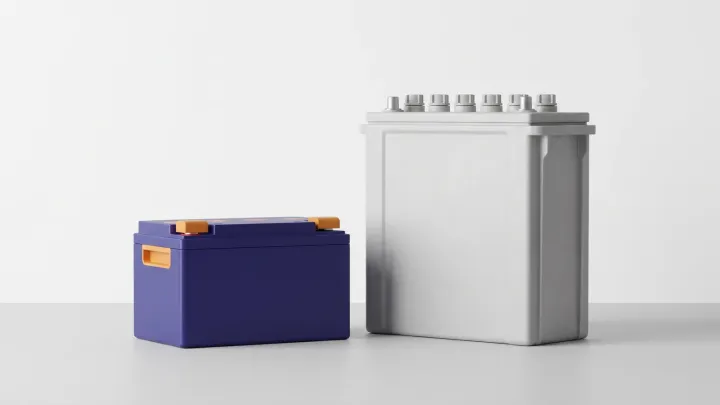
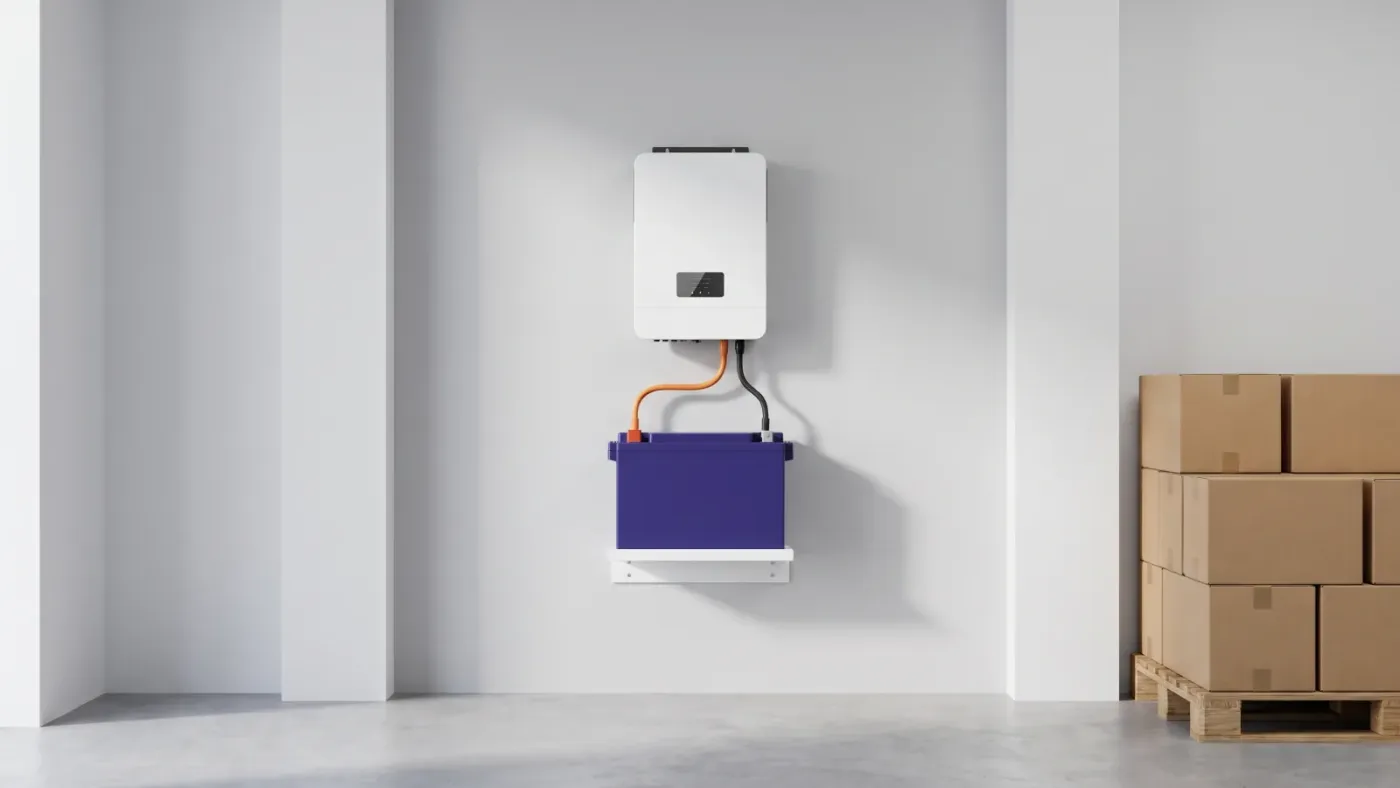
A 24V lithium battery for a home or shop inverter is usually an LFP pack of eight cells in series, rated at 25.6 V and charged to about 28.8 V. One of them takes the place of the two 12V tubular batteries a 24V inverter normally uses. Choose 100Ah when your load multiplied by the hours you need comes to about 2,000 watt-hours or less, such as 400 W for 5 hours. Choose 200Ah for up to about 4,000 watt-hours, such as 800 W for 5 hours. We make the two batteries this guide sizes, the Shakti 24 and Shakti 24 Plus, so we also say where a tubular pair may suit you better and how other makers' prices compare.
Key Takeaways
- A label of 25.6 V and a meter reading above 24 V are both normal on a 24V lithium battery.
- Two 12V 150Ah tubulars hold 3.6 kWh on the label, more than a 24V 100Ah lithium battery's 2.56 kWh. Which gives more backup depends on how deeply you run the tubulars.
- The 24V Luminous inverter page we read lists only lead-acid battery types. Look for a lithium setting in your manual, or ask the battery seller to confirm your model.
- The inverter's charger sets the recharge time. A 25 A charger refills a 100Ah battery in about 4 hours and a 200Ah battery in about 8.
- A tubular pair costs less on the day: two 150Ah Luminous tubulars came to ₹30,598 on 16 November 2026.
What 24V means for a lithium battery
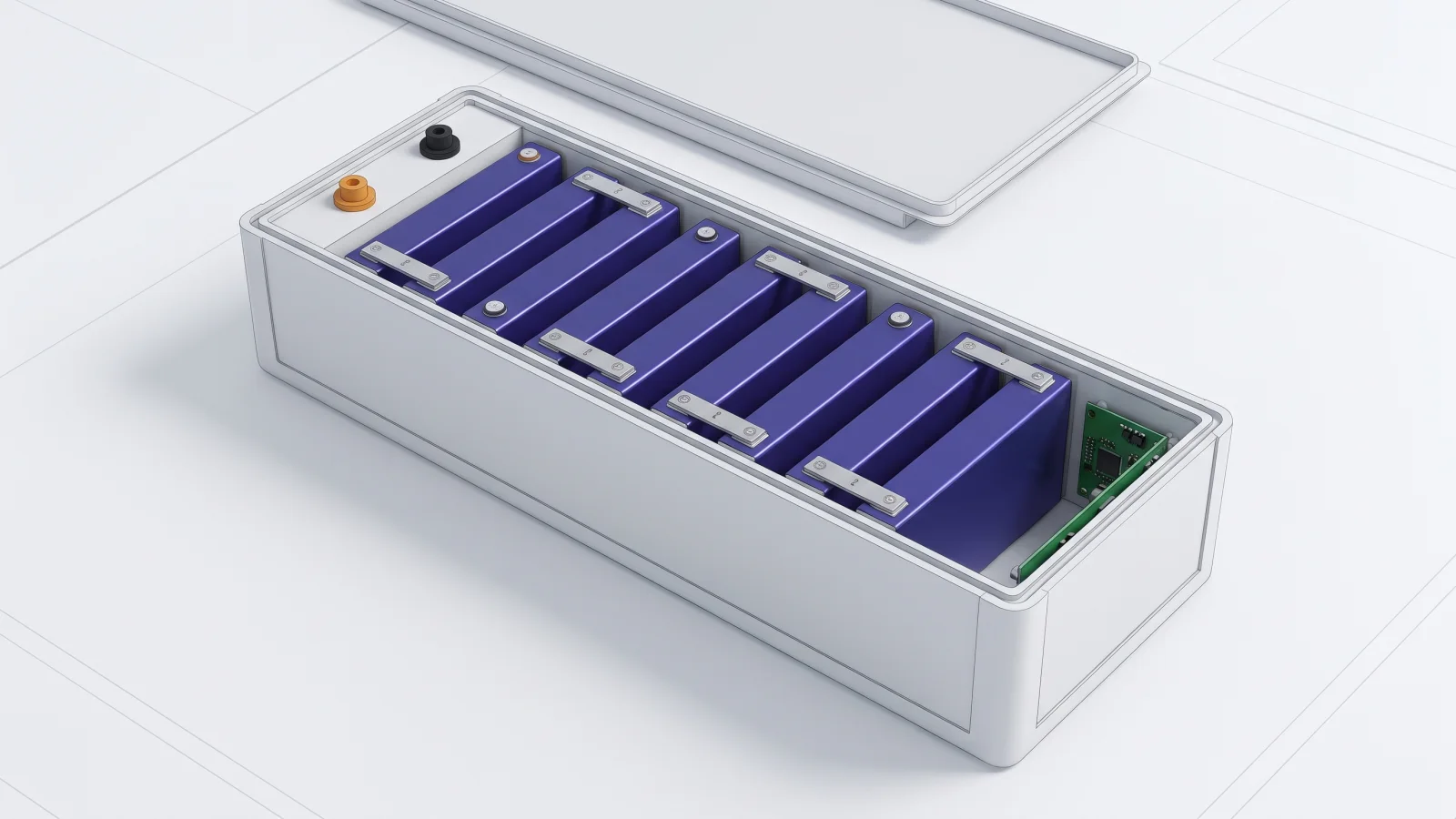
An LFP (lithium iron phosphate) cell is 3.2 V nominal. EVE Energy's datasheet for its LF105 cell charges it to a 3.65 V cut-off and discharges it to 2.5 V (EVE Energy LF105 specification, version F, 2019). Eight such cells in series give the 25.6 V printed on a 24V lithium battery.
| Voltage | One LFP cell | Eight cells in series (our calculation) |
|---|---|---|
| Nominal | 3.2 V | 25.6 V |
| Charge cut-off on the cell datasheet | 3.65 V | 29.2 V |
| Discharge cut-off on the cell datasheet | 2.5 V | 20.0 V |
| Shakti 24 charge voltage | 3.6 V (28.8 ÷ 8, our calculation) | 28.8 V |
A reading above 24 V on a 24V lithium battery is therefore normal: its working band runs from the cells' 20 V floor up to the 28.8 V charge voltage, with the 25.6 V label inside it. Luminous lists its Helios 25.6V 100Ah with a "20 - 28.8V Range" (Luminous Helios 25.6V), which equals eight cells between 2.5 V and 3.6 V, though Luminous does not state the cell count. In a Shakti battery, the BMS cuts off on overcharge, deep discharge, short circuit and high temperature, whichever inverter does the charging.
12V or 24V inverter: which homes and shops use 24V
Home inverters above about 1100 VA usually run on 24V. On Luminous's own pages, the Zelio+ 1100 is a 900 VA inverter on one 12V battery, and the Zelio+ 1700 is a 1.5 kVA inverter listed as "Voltage: 24V" with "Battery Supported: 2" (Zelio+ 1100, Zelio+ 1700). Our inverters split the same way: the Prakash 1100 runs on 12V and the Prakash 2200 (2200 VA, 1760 W) on 24V. The Shakti 24 is made for 24V inverters rated 1.5 to 2.5 kVA.
The higher voltage halves the current for the same power, so the cables and terminals run cooler. A 2.5 kVA inverter at the usual 0.8 power factor gives 2,000 W, or about 78 A at 25.6 V before inverter losses (our calculation). Losses and a part-discharged battery push the draw higher, so a 2.5 kVA inverter run near full load comes close to the 100 A continuous rating of both Shakti 24 models.
24V suits a 3BHK home with a fridge, at about 750 W, a shop of about 400 W that wants room for a display fridge later, and a small office of about 800 W with four laptops, lights, fans and a router. Our guides on choosing an inverter and battery for home and sizing an inverter for a shop or office work through those loads.
Replacing two 12V tubular batteries with one 24V lithium battery
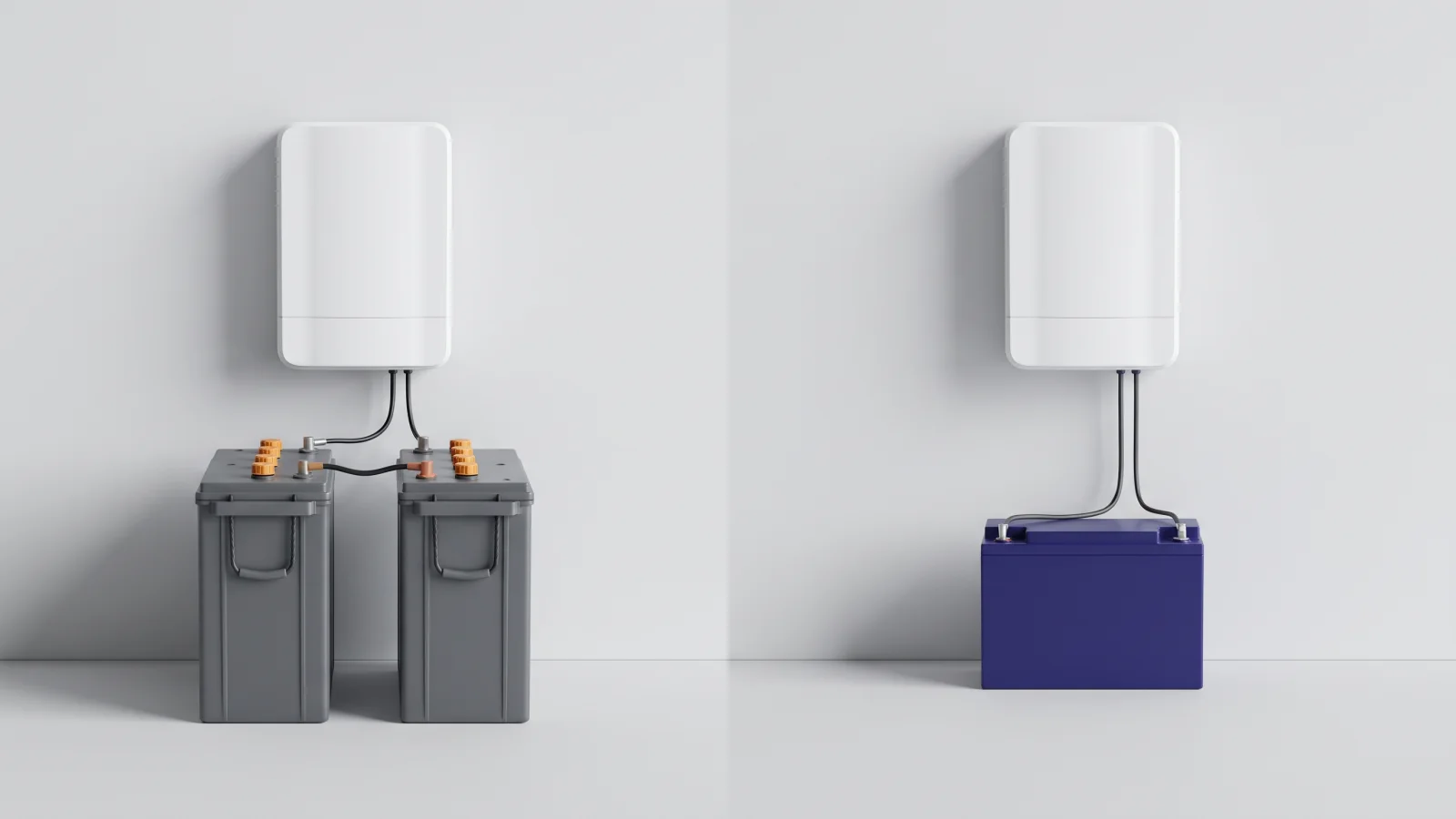
A 24V tubular setup is two 12V batteries in series, so one 24V lithium battery replaces the pair. Compare usable energy before you buy. The table counts a tubular two ways: at 80%, the same share we count for lithium, and at half, the figure our battery backup calculator uses because deep discharges wear a tubular out quickly.
| Battery | Rated energy | Usable at 80% | Usable at half capacity | Hours at 400 W (our calculation) |
|---|---|---|---|---|
| Two 12V 150Ah tubulars | 3.6 kWh | 2.88 kWh | 1.8 kWh | 7.2 (at 80%) or 4.5 (at half) |
| Two 12V 200Ah tubulars | 4.8 kWh | 3.84 kWh | 2.4 kWh | 9.6 (at 80%) or 6.0 (at half) |
| Shakti 24 (25.6V 100Ah) | 2.56 kWh | 2.05 kWh | Not used for lithium | 5.1 |
| Shakti 24 Plus (25.6V 200Ah) | 5.12 kWh | 4.10 kWh | Not used for lithium | 10.2 |
If you have been using about half of a 150Ah pair's rated energy, the Shakti 24 gives a little more backup. If you have been using 80% of it, only the Shakti 24 Plus gives as much or more. The Shakti 24 Plus covers a 200Ah pair on either basis. Tubular amp-hours are measured at different discharge rates by different makers, so treat the tubular rows as approximate.
What to check in your inverter manual
- The battery voltage. The spec sheet or rating label gives it, often with the number of batteries.
- A lithium battery setting. The Zelio+ 1700 page lists flat plate, tubular and VRLA (SMF) batteries and no lithium option. If your inverter has a lithium or Li-ion setting, select it. If it does not, send the model number to our support team and we will confirm the fit before you order.
- The charge voltages. Exide's Home Magic manual gives a boost charge of 28.8 V and a float of 27.4 V on its 24V models (Exide manual, as read on 1 November 2026). That boost equals the Shakti 24's charge voltage. The same manual says to use "only deep-cycle lead acid batteries", so ask the inverter maker or our support team before you switch. Our lithium vs tubular inverter battery guide compares these charge voltages with an LFP maker's guidance. Send us your manual's boost and float figures with the model number.
- The low-battery cut-off. Send the voltage at which the inverter shuts down as well, so we can check it against the battery's own cut-off.
Wiring one battery in place of two
In a tubular pair, a link cable joins the positive terminal of one battery to the negative of the other, and the inverter's leads go to the free terminals. One 24V lithium battery needs no link cable. Switch off the inverter and the mains, take out the old pair, then connect the inverter's positive lead to the battery's positive terminal and negative to negative. Shakti batteries are designed for self-installation in about 15 minutes. If the inverter feeds a separate backup circuit, or you are unsure of the wiring, use a licensed electrician. Hand the old tubulars to the dealer or a registered recycler; our lithium vs tubular inverter battery guide covers the battery waste rules.
100Ah or 200Ah: choosing from your load and outage hours
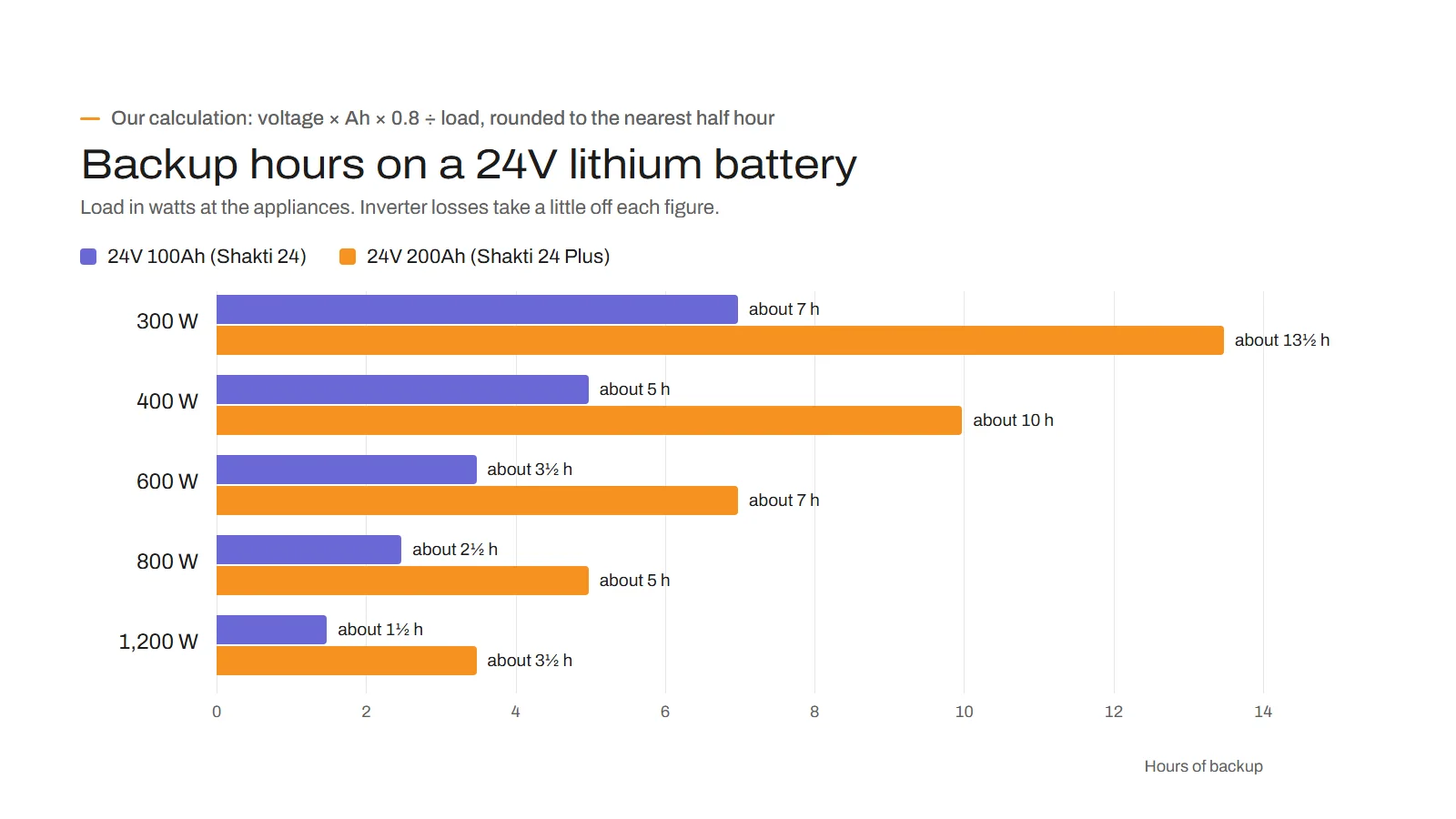
Backup time in hours is battery voltage × capacity in Ah × 0.8 ÷ load in watts. The 0.8 is the share of rated energy we count as usable, the same 80% depth of discharge our cycle ratings use. The table rounds to the nearest half hour (our calculation).
| Load | 24V 100Ah (Shakti 24) | 24V 200Ah (Shakti 24 Plus) |
|---|---|---|
| 300 W | about 7 hours | about 13.5 hours |
| 400 W | about 5 hours | about 10 hours |
| 600 W | about 3.5 hours | about 7 hours |
| 800 W | about 2.5 hours | about 5 hours |
| 1,200 W | about 1.5 hours | about 3.5 hours |
The formula has no separate allowance for inverter losses, so treat these as planning figures and expect a little less in use.
Multiply your load by your longest usual power cut:
- Up to about 2,000 Wh: 100Ah. A shop at 400 W through a 5-hour cut, or a 3BHK at 750 W for about 2.5 hours.
- About 2,000 to 4,000 Wh: 200Ah. An office at 800 W for 5 hours, or the same 3BHK through a 5-hour cut.
- Above about 4,000 Wh: one Shakti 24 Plus will not last the whole cut. Keep heavy loads such as a water pump or an air conditioner off the backup circuit, or send your appliance list to our support team.
Allow for load you will add: at the Prakash 2200's full 1760 W, a Shakti 24 lasts a little over an hour (our calculation). The battery backup calculator works it out from your own appliances.
Weight, size and charging current
The lithium battery weighs much less than the pair it replaces. Tubular weights are Luminous's filled weights (RC 18000 Pro, RC 25000).
| Battery | Weight | Size or mounting |
|---|---|---|
| Shakti 24 (100Ah) | 23 kg | 440 × 190 × 175 mm |
| Shakti 24 Plus (200Ah) | 40 kg | 440 × 380 × 150 mm, wall-mount bracket included |
| Two Luminous RC 18000 Pro (150Ah each) | 105 kg (52.5 kg each) | Two floor-standing batteries |
| Two Luminous RC 25000 (200Ah each) | 116 kg (58 kg each) | Two floor-standing batteries |
Both Shakti 24 models are sealed IP54 batteries with no acid, water top-ups or gas, so they can sit indoors next to the inverter.
Each accepts up to 100 A of charging current, enough for a full charge in 1 hour (Shakti 24) or 2 hours (Shakti 24 Plus), but home inverter chargers supply much less. The Prakash 2200 charges at 25 A, which refills a 100Ah battery in about 4 hours and a 200Ah battery in about 8 (our calculation: amp-hours ÷ charger current).
Warranty on the Shakti 24 and Shakti 24 Plus
Both carry a 5-year warranty from the invoice date against manufacturing defects and capacity loss below 70% of rated capacity. A defective battery is replaced, not repaired. Register it within 30 days to activate the cover, and a confirmation arrives by email. Separately, each is rated for 4,000 cycles at 80% depth of discharge, with 80% of capacity left after those cycles at 25 °C.
Tubular warranties often split into free and pro-rata months, and in the pro-rata part you pay toward the replacement. Luminous gives the RC 18000 Pro 24 months free plus 24 pro-rata, and the RC 25000 18 plus 18.
What a tubular pair still does better
- Price on the day. On 16 November 2026, Luminous listed the RC 18000 Pro (150Ah) at ₹15,299 and the RC 25000 (200Ah) at ₹19,299, including taxes; Luminous prices can vary by pincode. A pair costs ₹30,598 or ₹38,598, against ₹35,500 for the Shakti 24 and ₹69,900 for the Shakti 24 Plus.
- No compatibility question. A 24V home inverter is normally set up for a lead-acid pair, so a tubular pair fits without a check.
- A longer warranty on some models. Livguard gives its IT1584TT tubular 84 months in all (60 free and 24 pro-rata, as read on 1 November 2026), longer than the Shakti 24's 5 years.
- Light use. If your battery rarely runs down, you may never use the cycle life you pay for with lithium. Our lithium vs tubular inverter battery guide works out cost per kWh delivered and the cases where tubular comes out ahead.
24V lithium battery prices from other makers
On 16 November 2026, Luminous listed its Helios 25.6V 100Ah at ₹47,499 including taxes (MRP ₹70,000), the same price it showed on 1 November. It lists 3,000 cycles with no depth of discharge stated, an IP20 indoor case, a 60-month warranty, and says it "Works with HF & LF inverters". UTL Solar lists a 25.6V 100Ah model, but on 16 November it was out of stock and its page showed three different prices (₹33,141, ₹41,790 and ₹45,340), so we have not quoted one. None of the makers' sites we checked listed a 24V 200Ah lithium inverter battery price. Our lithium inverter battery price guide compares 12V and 24V models from several makers by price per kWh, as listed on 1 November 2026.
Shakti 24 and Shakti 24 Plus: our 24V lithium batteries
We make both batteries and test each one in our Rajkot plant. Prices include GST, delivery is free on every online order, and you pay by UPI or bank transfer through our sales team on WhatsApp.
| Shakti 24 | Shakti 24 Plus | |
|---|---|---|
| Rating | 25.6V 100Ah, 2.56 kWh, LFP | 25.6V 200Ah, 5.12 kWh, LFP |
| In the box | Battery, user manual, warranty card | Battery, wall-mount bracket, user manual, warranty card |
| Price | ₹35,500 | ₹69,900 |
Both have a Bluetooth app for the live state of charge, and either pairs with the Prakash 2200, a 2200 VA pure sine wave inverter for 24V LFP batteries with a 20 ms changeover, at ₹15,500. To choose between them, put your appliances into the battery backup calculator, then open either product page from the table above.
Sources
- EVE Energy Co., Ltd, LF105 (3.2V 105Ah) product specification, version F, effective 2 December 2019 (PDF, hosted by Battery Junction), read 16 November 2026
- Luminous, Helios 25.6V 100Ah product page, price and specs observed 16 November 2026
- Luminous, Zelio+ 1700 (1.5 kVA, 24V) product page, read 16 November 2026
- Luminous, Zelio+ 1100 (900 VA, 12V) product page, read 16 November 2026
- Luminous, Red Charge RC 18000 Pro product page, price observed 16 November 2026
- Luminous, Red Charge RC 25000 product page, price observed 16 November 2026
- Exide Industries, Home Magic inverter user manual, 19 November 2025 (PDF), read 1 November 2026
- Livguard, IT1584TT product page, warranty read 1 November 2026
- Halovolt, Shakti 24, Shakti 24 Plus and Prakash 2200 product pages and the Inverter & UPS catalogue, 16 November 2026
Prices were read on each maker's own website on the dates shown. Backup hours, energy, current, pair prices and weights are our own calculations from those figures and the makers' published ratings.
Frequently asked questions
What does 25.6V mean on a 24V lithium battery?
It is the nominal voltage of eight lithium iron phosphate (LFP) cells of 3.2 V each in series. The battery charges to about 28.8 V and is sold as "24V" because it fits inverters built for two 12V lead-acid batteries.
Can I use a 24V lithium battery on a 12V inverter?
No. The battery voltage has to match the inverter, so a 12V inverter takes a 12.8V lithium battery such as the Shakti 12. Moving to 24V means a new inverter as well, which makes sense when your load has outgrown a 12V model of about 1100 VA.
Does a 24V lithium battery need any maintenance?
Very little. A sealed LFP battery needs no water and has no acid to spill. Keep it within its 0 to 55 °C operating range and out of direct sun, and glance at its state of charge in the Bluetooth app now and then.
How many years will a 24V lithium inverter battery last?
At one full cycle a day, a Shakti battery's 4,000 rated cycles take about 11 years (our calculation). Most homes cycle less often, so heat and calendar ageing also set the life. Our guide on how long a lithium battery lasts explains both.